AQA · GCSE · Chemistry
Course version: 8462 · Version from Sept 2018
Students should be able to identify species from the results of the tests…
Full specification wording
Flame tests: Students should be able to identify species from the results of the tests in 4.8.3.1 to 4.8.3.5.
This outcome asks you to work backwards from observations to identify an unknown species.
Checked against the AQA 8462 specification (opens in a new tab) on .
- Point 4 of 4
- 3 key terms
Study notes
From the checked teaching notes for this specification point.
The idea
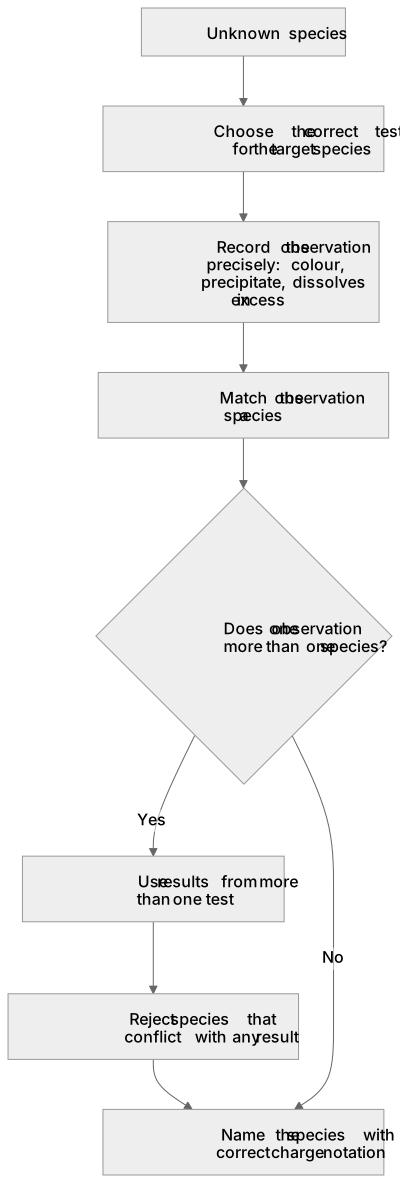
This outcome asks you to work backwards from observations to identify an unknown species. The tests in 4.8.3.1 to 4.8.3.5 cover flame tests for metal cations, sodium hydroxide precipitates for metal cations, carbonate identification with dilute acid, sulfate identification with barium chloride, and halide identification with silver nitrate. For example, a white precipitate with sodium hydroxide that dissolves in excess means Al³⁺; a cream precipitate with silver nitrate means Br⁻. You must combine evidence from several tests, because one observation alone may fit more than one species. State the species with its charge, such as Cu²⁺ or SO₄²⁻, and link each observation to the test that produced it.
What earns the marks
- Select the correct test for the target species, for example a flame test for a metal cation or silver nitrate for a halide.
- Describe the observation precisely, including colour and whether a precipitate forms or dissolves in excess.
- Match the observation to the species, such as lilac flame for K⁺ or white precipitate soluble in excess for Al³⁺.
- Use results from more than one test where a single observation is ambiguous, and reject species that conflict with any result.
- Name the species with correct charge notation, for example Fe²⁺, Fe³⁺, CO₃²⁻ or SO₄²⁻.
Common mistakes and how to put them right
Confusing the white precipitates of Al³⁺, Ca²⁺ and Mg²⁺.
Put it right by adding excess sodium hydroxide, because only aluminium hydroxide dissolves.
Treating a flame colour as proof of a mixture without checking other tests.
Put it right by using the full set of results before naming the species.
Writing ion names without charge, such as saying aluminium rather than Al³⁺.
Put it right by including the charge in the identified species.
Exam tips
- Underline the key observation in the question before choosing a species, so colour and solubility are not overlooked.
- When two species give similar results, write both and then eliminate one using a second test result.
- Give the species symbol and charge, not just the element name, to show the ion has been identified.
Try the lesson
The start of the Flame tests: Students should be able to identify species from the results of the tests in 4.8.3.1 to 4.8.3.5. lesson, made from checked teaching notes for this specification point.
Have a go first
A student dips a clean nichrome wire into a sample of an unknown compound and holds it in a roaring blue Bunsen flame. The flame turns a bright yellow colour. Which metal ion is present in the compound?
Listen
This outcome asks you to work backwards from observations to identify an unknown species. The tests in 4.8.3.1 to 4.8.3.5 cover flame tests for metal cations, sodium hydroxide precipitates for metal cations, carbonate identification with dilute acid, sulfate identification with barium chloride, and halide identification with silver nitrate. For example, a white precipitate with sodium hydroxide that dissolves in excess means Al³⁺; a cream precipitate with silver nitrate means Br⁻. You must combine evidence from several tests, because one observation alone may fit more than one species. State the species with its charge, such as Cu²⁺ or SO₄²⁻, and link each observation to the test that produced it. A strong answer earns marks for these points. Select the correct test for the target species, for example a flame test for a metal cation or silver nitrate for a halide. Describe the observation precisely, including colour and whether a precipitate forms or dissolves in excess. Match the observation to the species, such as lilac flame for K⁺ or white precipitate soluble in excess for Al³⁺. Use results from more than one test where a single observation is ambiguous, and reject species that conflict with any result. A common slip: Confusing the white precipitates of Al³⁺, Ca²⁺ and Mg²⁺. Instead, adding excess sodium hydroxide, because only aluminium hydroxide dissolves. Exam tip: Underline the key observation in the question before choosing a species, so colour and solubility are not overlooked.
See it
Key words
Say what each word means before you turn the card.
Ionic species and charges
Try answering aloud or in your head before turning the card.
Using multiple observations
Try answering aloud or in your head before turning the card.
Evidence-based identification
Try answering aloud or in your head before turning the card.
See every definition
- Ionic species and charges
- Naming the species with its charge, such as Cu²⁺ or SO₄²⁻, rather than giving just the element name.
- Using multiple observations
- Combining evidence from several tests, because one observation alone may fit more than one species.
- Evidence-based identification
- Linking each observation to the test that produced it, and rejecting species that conflict with any result.
There is more to this lesson
The full lesson goes on to check your understanding and help you earn the marks. Create a free account to carry on, with your progress saved.
A week of Premium from your first lesson · Then the free plan continues · No card, no charge
Test your understanding of Flame tests: Students should be able to identify species from the results of the tests in 4.8.3.1 to 4.8.3.5.
Active recall beats re-reading. Take an instant quiz now to test what you’ve learned and lock it into long-term memory.
A week of Premium from your first lesson · Then the free plan continues · No card, no charge