AQA · GCSE · Chemistry
Course version: 8462 · Version from Sept 2018
A formulation is a mixture that has been designed as a useful product.
Full specification wording
Formulations: A formulation is a mixture that has been designed as a useful product.
A formulation is a mixture made to a chosen recipe so that it works well as a useful product.
Checked against the AQA 8462 specification (opens in a new tab) on .
- Point 1 of 5
- 4 key terms
Study notes
From the checked teaching notes for this specification point.
The idea
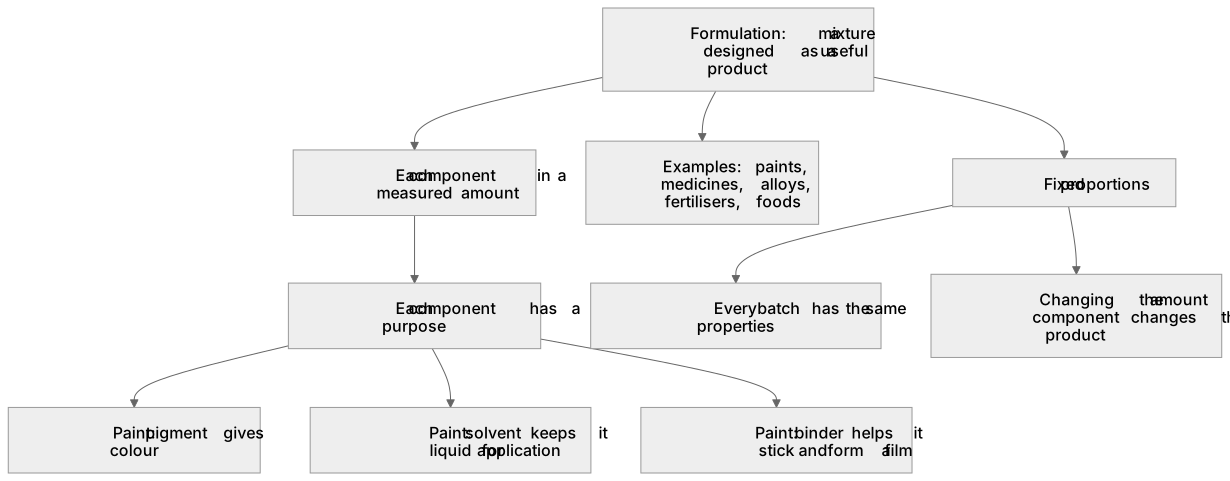
A formulation is a mixture made to a chosen recipe so that it works well as a useful product. Each component is present in a measured amount and has a purpose, such as giving flavour, colour, texture, stability or a cleaning action. Examples include paints, medicines, alloys, fertilisers and foods. In a paint, pigment gives colour, a solvent keeps it liquid for application, and a binder helps it stick and form a film. In a medicine, the active ingredient treats the condition while other components help the dose to be measured, swallowed or absorbed. Formulations are made in fixed proportions so that every batch has the same properties. Changing the amount of any component changes the product, so the recipe must be followed carefully.
What earns the marks
- A formulation is a mixture designed as a useful product.
- Each component of a formulation is present in a measured amount and has a specific purpose.
- Examples include paints, medicines, alloys, fertilisers and foods.
- The components are combined in fixed proportions so that batches have consistent properties.
- Changing the amount of a component changes the properties of the formulation.
Common mistakes and how to put them right
Calling any mixture a formulation.
Put it right: A formulation is deliberately designed as a useful product with measured components, so random mixtures do not qualify.
Ignoring the purpose of each component.
Put it right: Every component in a formulation has a function, such as colour, stability or cleaning.
Assuming proportions can be varied freely.
Put it right: Fixed proportions give consistent properties, so changing them changes the product.
Exam tips
- Name a formulation and state the purpose of at least two of its components.
- Use the phrase designed as a useful product when defining a formulation.
- Link fixed proportions to consistent properties in every batch.
Try the lesson
The start of the Formulations: A formulation is a mixture that has been designed as a useful product. lesson, made from checked teaching notes for this specification point.
Have a go first
Which of these is an example of a formulation?
Listen
A formulation is a mixture made to a chosen recipe so that it works well as a useful product. Each component is present in a measured amount and has a purpose, such as giving flavour, colour, texture, stability or a cleaning action. Examples include paints, medicines, alloys, fertilisers and foods. In a paint, pigment gives colour, a solvent keeps it liquid for application, and a binder helps it stick and form a film. In a medicine, the active ingredient treats the condition while other components help the dose to be measured, swallowed or absorbed. Formulations are made in fixed proportions so that every batch has the same properties. Changing the amount of any component changes the product, so the recipe must be followed carefully. A strong answer earns marks for these points. A formulation is a mixture designed as a useful product. Each component of a formulation is present in a measured amount and has a specific purpose. Examples include paints, medicines, alloys, fertilisers and foods. The components are combined in fixed proportions so that batches have consistent properties. Exam tip: Name a formulation and state the purpose of at least two of its components.
See it
Key words
Say what each word means before you turn the card.
Formulation
Try answering aloud or in your head before turning the card.
Function of components
Try answering aloud or in your head before turning the card.
Fixed proportions
Try answering aloud or in your head before turning the card.
Useful products
Try answering aloud or in your head before turning the card.
See every definition
- Formulation
- A mixture that has been designed as a useful product, made to a chosen recipe so that it works well.
- Function of components
- Each component is present in a measured amount and has a purpose, such as giving flavour, colour, texture, stability or a cleaning action.
- Fixed proportions
- Formulations are made in fixed proportions so that every batch has the same properties.
- Useful products
- Formulations are designed as useful products, and examples include paints, medicines, alloys, fertilisers and foods.
Label the diagram
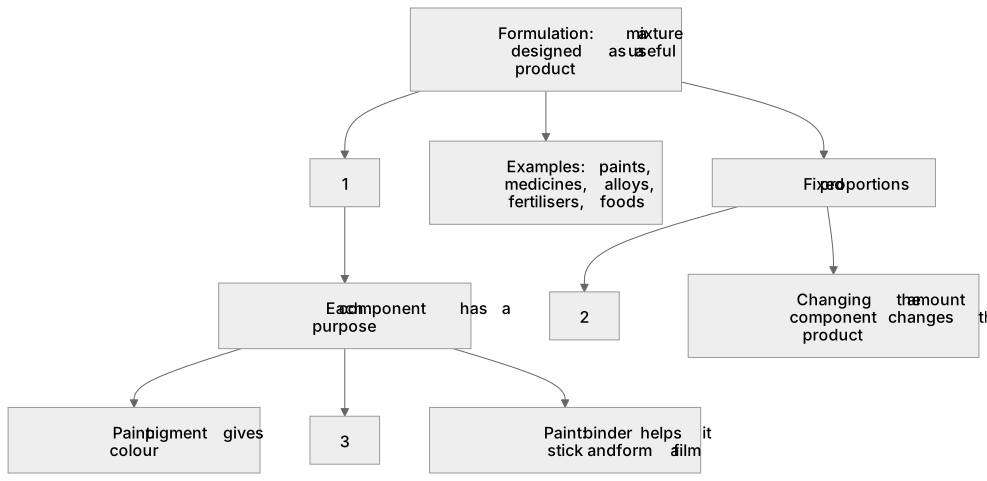
Some boxes have lost their names. Pick the right name for each number.
1Box 1
2Box 2
3Box 3
There is more to this lesson
The full lesson goes on to check your understanding and help you earn the marks. Create a free account to carry on, with your progress saved.
A week of Premium from your first lesson · Then the free plan continues · No card, no charge
Test your understanding of Formulations: A formulation is a mixture that has been designed as a useful product.
Active recall beats re-reading. Take an instant quiz now to test what you’ve learned and lock it into long-term memory.
A week of Premium from your first lesson · Then the free plan continues · No card, no charge