AQA · GCSE · Chemistry
Course version: 8462 · Version from Sept 2018
Many products are complex mixtures in which each chemical has a particular…
Full specification wording
Formulations: Many products are complex mixtures in which each chemical has a particular purpose.
A formulation is a deliberately designed mixture in which every component contributes a specific function, so the product performs better than any single substance alone.
Checked against the AQA 8462 specification (opens in a new tab) on .
- Point 2 of 5
- 4 key terms
Study notes
From the checked teaching notes for this specification point.
The idea
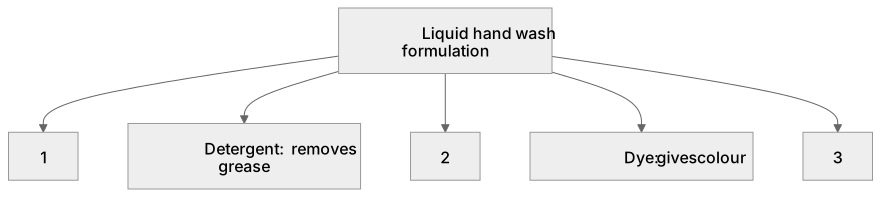
A formulation is a deliberately designed mixture in which every component contributes a specific function, so the product performs better than any single substance alone. In a liquid hand wash, water acts as the solvent and carries the detergent, the detergent removes grease, a fragrance improves smell, a dye gives colour and a preservative limits microbial growth. Each chemical is present for a reason, and changing or removing one component changes the product's behaviour. This distinguishes a formulation from a simple mixture such as salty water, where components are combined without a designed purpose. Recognising the role of each ingredient lets you explain why manufacturers choose particular substances and why the exact composition matters for the product's intended use.
What earns the marks
- A formulation is a mixture designed to have specific useful properties, not a random combination of substances.
- Each component in a formulation has a defined function, such as solvent, detergent, colourant, fragrance, preservative, fuel additive or active ingredient.
- The properties of the formulation depend on which components are present and on their proportions.
- Formulations are common in everyday products including medicines, paints, cleaning agents, fuels, alloys, fertilisers and foods.
- A simple mixture can be separated into its components, but a formulation is made to meet a performance specification.
Common mistakes and how to put them right
Treating any mixture as a formulation.
Put it right: A formulation is deliberately designed with a purpose for each component.
Assuming all ingredients are present in equal amounts.
Put it right: Quantities are carefully measured and may differ greatly between components.
Thinking a formulation is a pure substance or a compound.
Put it right: It remains a mixture of two or more substances that are not chemically combined.
Exam tips
- When asked to identify a formulation, look for a product made from several named ingredients each with a stated job.
- Link each ingredient to its function rather than listing ingredients without explanation.
- Use the phrase 'designed mixture' to show understanding that the composition is chosen for a purpose.
Try the lesson
The start of the Formulations: Many products are complex mixtures in which each chemical has a particular purpose. lesson, made from checked teaching notes for this specification point.
Have a go first
Which statement best describes a formulation?
Listen
A formulation is a deliberately designed mixture in which every component contributes a specific function, so the product performs better than any single substance alone. In a liquid hand wash, water acts as the solvent and carries the detergent, the detergent removes grease, a fragrance improves smell, a dye gives colour and a preservative limits microbial growth. Each chemical is present for a reason, and changing or removing one component changes the product's behaviour. This distinguishes a formulation from a simple mixture such as salty water, where components are combined without a designed purpose. Recognising the role of each ingredient lets you explain why manufacturers choose particular substances and why the exact composition matters for the product's intended use. A strong answer earns marks for these points. A formulation is a mixture designed to have specific useful properties, not a random combination of substances. Each component in a formulation has a defined function, such as solvent, detergent, colourant, fragrance, preservative, fuel additive or active ingredient. The properties of the formulation depend on which components are present and on their proportions. Formulations are common in everyday products including medicines, paints, cleaning agents, fuels, alloys, fertilisers and foods. A common slip: Treating any mixture as a formulation. Instead, a formulation is deliberately designed with a purpose for each component. Exam tip: When asked to identify a formulation, look for a product made from several named ingredients each with a stated job.
See it

Key words
Say what each word means before you turn the card.
Designed mixtures
Try answering aloud or in your head before turning the card.
Function of components
Try answering aloud or in your head before turning the card.
Proportions and properties
Try answering aloud or in your head before turning the card.
Everyday products
Try answering aloud or in your head before turning the card.
See every definition
- Designed mixtures
- A formulation is a mixture designed to have specific useful properties, not a random combination of substances.
- Function of components
- Each component in a formulation has a defined function, such as solvent, detergent, colourant, fragrance, preservative, fuel additive or active ingredient.
- Proportions and properties
- The properties of the formulation depend on which components are present and on their proportions.
- Everyday products
- Formulations are common in everyday products including medicines, paints, cleaning agents, fuels, alloys, fertilisers and foods.
Label the diagram
Some boxes have lost their names. Pick the right name for each number.
1Box 1
2Box 2
3Box 3
There is more to this lesson
The full lesson goes on to check your understanding and help you earn the marks. Create a free account to carry on, with your progress saved.
A week of Premium from your first lesson · Then the free plan continues · No card, no charge
Test your understanding of Formulations: Many products are complex mixtures in which each chemical has a particular purpose.
Active recall beats re-reading. Take an instant quiz now to test what you’ve learned and lock it into long-term memory.
A week of Premium from your first lesson · Then the free plan continues · No card, no charge