AQA · GCSE · Chemistry
Course version: 8462 · Version from Sept 2018
Formulations are made by mixing the components in carefully measured…
Full specification wording
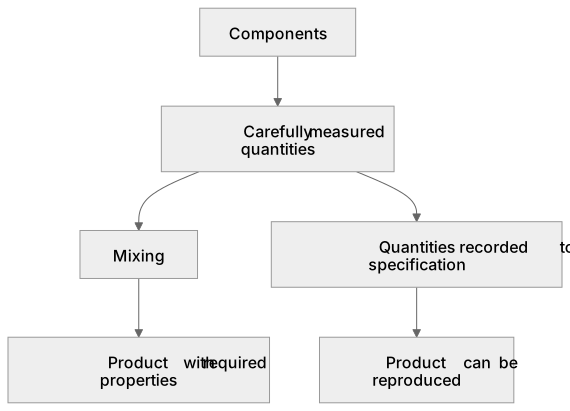
Formulations: Formulations are made by mixing the components in carefully measured quantities to ensure that the product has the required properties.
Making a formulation is a controlled process: the manufacturer measures each component accurately and mixes them in a fixed ratio so that every batch behaves in the same way.
Checked against the AQA 8462 specification (opens in a new tab) on .
- Point 3 of 5
Study notes
From the checked teaching notes for this specification point.
The idea
Making a formulation is a controlled process: the manufacturer measures each component accurately and mixes them in a fixed ratio so that every batch behaves in the same way. If a medicine contains too little active ingredient it may not work, while too much may be harmful; if a paint contains too much solvent it may not cover properly. Careful measurement therefore links composition to performance. In practice, components may be measured by mass or by volume, and the chosen quantities are recorded so the product can be reproduced. This is why formulations are made to a specification rather than by adding ingredients by eye. The required properties, such as colour, consistency, strength or shelf life, determine the recipe that is used.
What earns the marks
- Components are mixed in carefully measured quantities rather than approximate amounts.
- The measured quantities are chosen so the product has the required properties.
- Consistent measurement allows batches of a product to be reproduced with the same composition and performance.
- The proportions of components affect properties such as colour, strength, viscosity, effectiveness or shelf life.
- Formulations are made to a specification that states the identity and amount of each component.
Common mistakes and how to put them right
Believing that any amount of each ingredient will give the same product.
Put it right: Properties depend on the measured quantities used.
Confusing careful measurement with chemical reaction.
Put it right: The components are mixed and not necessarily chemically combined.
Assuming the largest component is always the active ingredient.
Put it right: The main component may be a solvent, carrier or bulking agent while a smaller amount provides the key effect.
Exam tips
- Use the idea of a recipe or specification to explain why quantities must be measured accurately.
- When comparing two formulations, refer to differences in the amounts of components and the resulting properties.
- Avoid saying 'a lot' or 'a little'; refer to measured quantities or proportions instead.
Try the lesson
The start of the Formulations: Formulations are made by mixing the components in carefully measured quantities to ensure that the product has the required properties. lesson, made from checked teaching notes for this specification point.
Have a go first
Why are the components of a formulation mixed in carefully measured quantities?
Listen
Making a formulation is a controlled process: the manufacturer measures each component accurately and mixes them in a fixed ratio so that every batch behaves in the same way. If a medicine contains too little active ingredient it may not work, while too much may be harmful; if a paint contains too much solvent it may not cover properly. Careful measurement therefore links composition to performance. In practice, components may be measured by mass or by volume, and the chosen quantities are recorded so the product can be reproduced. This is why formulations are made to a specification rather than by adding ingredients by eye. The required properties, such as colour, consistency, strength or shelf life, determine the recipe that is used. A strong answer earns marks for these points. Components are mixed in carefully measured quantities rather than approximate amounts. The measured quantities are chosen so the product has the required properties. Consistent measurement allows batches of a product to be reproduced with the same composition and performance. The proportions of components affect properties such as colour, strength, viscosity, effectiveness or shelf life. A common slip: Believing that any amount of each ingredient will give the same product. Instead, properties depend on the measured quantities used. Exam tip: Use the idea of a recipe or specification to explain why quantities must be measured accurately.
See it
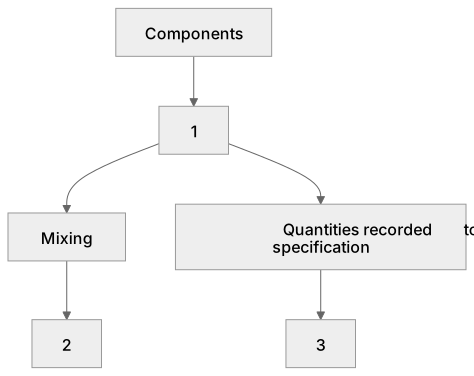
Label the diagram
Some boxes have lost their names. Pick the right name for each number.
1Box 1
2Box 2
3Box 3
There is more to this lesson
The full lesson goes on to check your understanding and help you earn the marks. Create a free account to carry on, with your progress saved.
A week of Premium from your first lesson · Then the free plan continues · No card, no charge
Test your understanding of Formulations: Formulations are made by mixing the components in carefully measured quantities to ensure that the product has the required properties.
Active recall beats re-reading. Take an instant quiz now to test what you’ve learned and lock it into long-term memory.
A week of Premium from your first lesson · Then the free plan continues · No card, no charge