AQA · GCSE · Chemistry
Course version: 8462 · Version from Sept 2018
The fractions can be processed to produce fuels and feedstock for the…
Full specification wording
Fractional distillation and petrochemicals: The fractions can be processed to produce fuels and feedstock for the petrochemical industry.
The fractions obtained from crude oil are not wasted; they are processed in several ways to make useful products.
Checked against the AQA 8462 specification (opens in a new tab) on .
- Point 2 of 6
- 4 key terms
Study notes
From the checked teaching notes for this specification point.
The idea
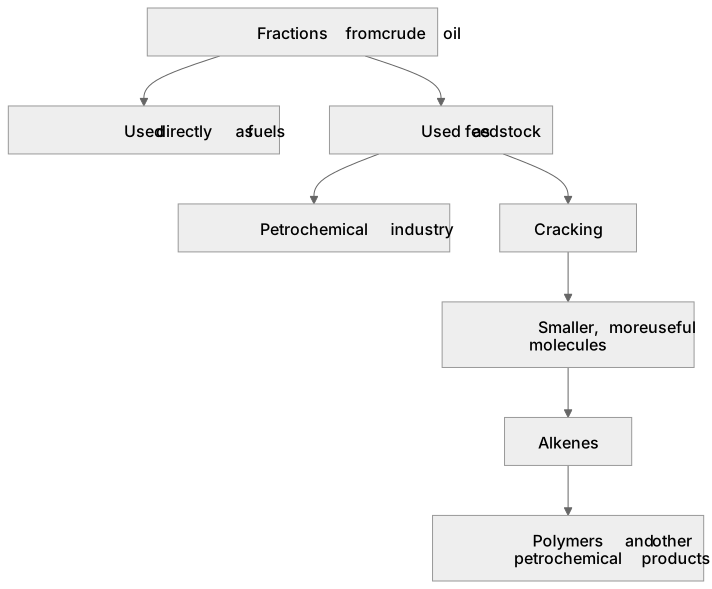
The fractions obtained from crude oil are not wasted; they are processed in several ways to make useful products. Some fractions are used directly as fuels, for example petrol for cars and diesel oil for lorries. Other fractions are used as feedstock, meaning they are the starting materials for the petrochemical industry. Feedstock fractions can be cracked to produce smaller, more useful molecules, including alkenes, which are then used to make polymers and other chemicals. Processing therefore links the separation of crude oil to the manufacture of fuels and to a wide range of petrochemical products, showing that crude oil is a valuable raw material rather than just a fuel source.
What earns the marks
- Fractions from crude oil can be used directly as fuels, such as petrol, diesel oil and kerosene.
- Fractions can also be used as feedstock, which means starting materials for the petrochemical industry.
- Cracking converts larger hydrocarbon molecules into smaller, more useful molecules, including alkenes.
- Alkenes produced by cracking are used to make polymers and other petrochemical products.
- Processing fractions increases their usefulness because supply of fractions does not always match demand.
Common mistakes and how to put them right
Saying fractions are burned only as fuels.
Put it right: Also stating that fractions can be used as feedstock for the petrochemical industry.
Confusing feedstock with fuel.
Put it right by explaining that feedstock is a starting material for making other chemicals, not necessarily something burned for energy.
Thinking cracking adds carbon atoms to molecules.
Put it right by stating that cracking breaks larger molecules into smaller ones.
Exam tips
- Use the word feedstock correctly and explain it as a starting material for the petrochemical industry.
- When asked about processing, mention cracking as a key example that turns larger fractions into smaller, more useful molecules.
- Link each processed product to its use, such as alkenes for polymers or hydrogen for other industrial processes.
Try the lesson
The start of the Fractional distillation and petrochemicals: The fractions can be processed to produce fuels and feedstock for the petrochemical industry. lesson, made from checked teaching notes for this specification point.
Have a go first
Fractions obtained from crude oil can be processed to produce fuels. Which of these is a fuel produced from crude oil fractions?
Listen
The fractions obtained from crude oil are not wasted; they are processed in several ways to make useful products. Some fractions are used directly as fuels, for example petrol for cars and diesel oil for lorries. Other fractions are used as feedstock, meaning they are the starting materials for the petrochemical industry. Feedstock fractions can be cracked to produce smaller, more useful molecules, including alkenes, which are then used to make polymers and other chemicals. Processing therefore links the separation of crude oil to the manufacture of fuels and to a wide range of petrochemical products, showing that crude oil is a valuable raw material rather than just a fuel source. A strong answer earns marks for these points. Fractions from crude oil can be used directly as fuels, such as petrol, diesel oil and kerosene. Fractions can also be used as feedstock, which means starting materials for the petrochemical industry. Cracking converts larger hydrocarbon molecules into smaller, more useful molecules, including alkenes. Alkenes produced by cracking are used to make polymers and other petrochemical products. A common slip: Saying fractions are burned only as fuels. Instead, also stating that fractions can be used as feedstock for the petrochemical industry. Exam tip: Use the word feedstock correctly and explain it as a starting material for the petrochemical industry.
See it
Key words
Say what each word means before you turn the card.
Feedstock
Try answering aloud or in your head before turning the card.
Cracking
Try answering aloud or in your head before turning the card.
Alkenes
Try answering aloud or in your head before turning the card.
Petrochemical industry
Try answering aloud or in your head before turning the card.
See every definition
- Feedstock
- A starting material for the petrochemical industry, rather than something necessarily burned for energy.
- Cracking
- A process that converts larger hydrocarbon molecules into smaller, more useful molecules, including alkenes.
- Alkenes
- Smaller, more useful molecules produced by cracking, which are then used to make polymers and other chemicals.
- Petrochemical industry
- The industry for which fractions are used as feedstock, the starting materials for making other chemicals.
Label the diagram
Some boxes have lost their names. Pick the right name for each number.
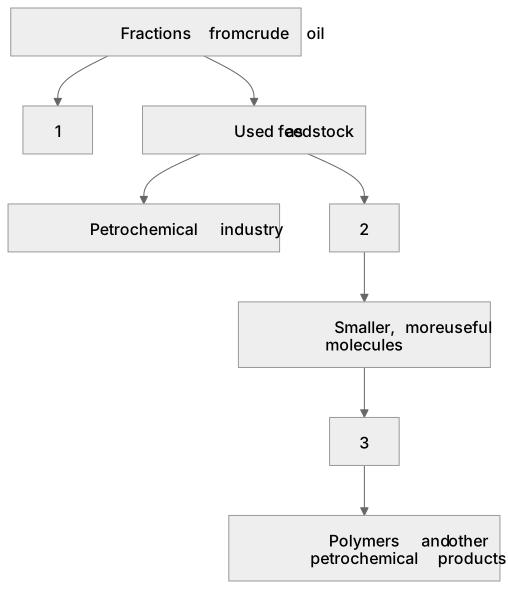
1Box 1
2Box 2
3Box 3
There is more to this lesson
The full lesson goes on to check your understanding and help you earn the marks. Create a free account to carry on, with your progress saved.
A week of Premium from your first lesson · Then the free plan continues · No card, no charge
Test your understanding of Fractional distillation and petrochemicals: The fractions can be processed to produce fuels and feedstock for the petrochemical industry.
Active recall beats re-reading. Take an instant quiz now to test what you’ve learned and lock it into long-term memory.
A week of Premium from your first lesson · Then the free plan continues · No card, no charge