AQA · GCSE · Chemistry
Course version: 8462 · Version from Sept 2018
Many of the fuels on which we depend for our modern lifestyle, such as…
Full specification wording
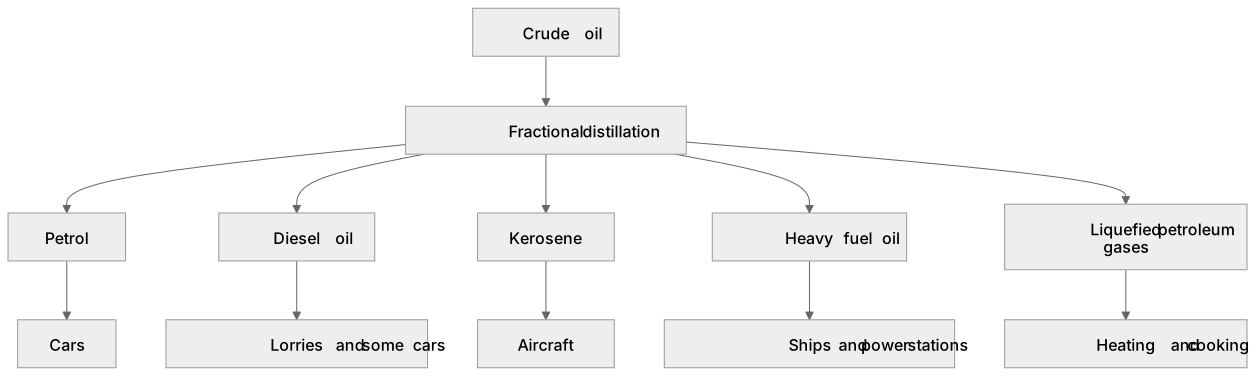
Fractional distillation and petrochemicals: Many of the fuels on which we depend for our modern lifestyle, such as petrol, diesel oil, kerosene, heavy fuel oil and liquefied petroleum gases, are produced from crude oil.
Modern transport, heating and industry rely heavily on fuels obtained from crude oil.
Checked against the AQA 8462 specification (opens in a new tab) on .
- Point 3 of 6
- 4 key terms
Study notes
From the checked teaching notes for this specification point.
The idea
Modern transport, heating and industry rely heavily on fuels obtained from crude oil. Fractional distillation separates crude oil into fractions, and several of these fractions are used directly as fuels. Petrol is used in cars, diesel oil in lorries and some cars, kerosene in aircraft, heavy fuel oil in ships and power stations, and liquefied petroleum gases for heating and cooking. Each fuel is a mixture of hydrocarbons with a similar number of carbon atoms, which gives it suitable properties such as a particular boiling point range and how easily it burns. This dependence means crude oil is a finite resource, so alternative energy sources and conservation are important considerations.
What earns the marks
- Petrol, diesel oil, kerosene, heavy fuel oil and liquefied petroleum gases are all produced from crude oil.
- Each fuel is a mixture of hydrocarbons with a similar number of carbon atoms and a similar boiling point range.
- Different fuels suit different uses, for example petrol for cars, kerosene for aircraft and heavy fuel oil for ships.
- Crude oil is a finite resource, so reliance on these fuels has economic and environmental implications.
Common mistakes and how to put them right
Naming individual pure compounds as the fuels.
Put it right by stating that each fuel is a mixture of hydrocarbons with a similar boiling point range.
Mixing up the uses of fractions, such as saying kerosene is used in cars.
Put it right by matching kerosene to aircraft fuel and petrol to cars.
Forgetting that liquefied petroleum gases are also obtained from crude oil.
Put it right by including them in the list of crude-oil-derived fuels.
Exam tips
- Learn the main fractions and one typical use for each, so you can match fuel to purpose accurately.
- When listing fuels, use the names given in the specification, such as petrol, diesel oil, kerosene, heavy fuel oil and liquefied petroleum gases.
- Link the use of a fuel to its properties, such as how easily it ignites or how cleanly it burns.
Try the lesson
The start of the Fractional distillation and petrochemicals: Many of the fuels on which we depend for our modern lifestyle, such as petrol, diesel oil, kerosene, heavy fuel oil and liquefied petroleum gases, are produced from crude oil. lesson, made from checked teaching notes for this specification point.
Have a go first
Which raw material is the source of petrol, diesel oil and kerosene?
Listen
Modern transport, heating and industry rely heavily on fuels obtained from crude oil. Fractional distillation separates crude oil into fractions, and several of these fractions are used directly as fuels. Petrol is used in cars, diesel oil in lorries and some cars, kerosene in aircraft, heavy fuel oil in ships and power stations, and liquefied petroleum gases for heating and cooking. Each fuel is a mixture of hydrocarbons with a similar number of carbon atoms, which gives it suitable properties such as a particular boiling point range and how easily it burns. This dependence means crude oil is a finite resource, so alternative energy sources and conservation are important considerations. A strong answer earns marks for these points. Petrol, diesel oil, kerosene, heavy fuel oil and liquefied petroleum gases are all produced from crude oil. Each fuel is a mixture of hydrocarbons with a similar number of carbon atoms and a similar boiling point range. Different fuels suit different uses, for example petrol for cars, kerosene for aircraft and heavy fuel oil for ships. Crude oil is a finite resource, so reliance on these fuels has economic and environmental implications. A common slip: Naming individual pure compounds as the fuels. Instead, stating that each fuel is a mixture of hydrocarbons with a similar boiling point range. Exam tip: Learn the main fractions and one typical use for each, so you can match fuel to purpose accurately.
See it
Key words
Say what each word means before you turn the card.
Fuels from crude oil
Try answering aloud or in your head before turning the card.
Fractional distillation products
Try answering aloud or in your head before turning the card.
Finite resources
Try answering aloud or in your head before turning the card.
Energy and modern lifestyle
Try answering aloud or in your head before turning the card.
See every definition
- Fuels from crude oil
- Petrol, diesel oil, kerosene, heavy fuel oil and liquefied petroleum gases are all produced from crude oil.
- Fractional distillation products
- These fuels are fractions obtained by fractional distillation of crude oil.
- Finite resources
- Crude oil is a finite resource, so alternative energy sources and conservation are important considerations.
- Energy and modern lifestyle
- Many of the fuels on which we depend for our modern lifestyle are produced from crude oil.
Label the diagram
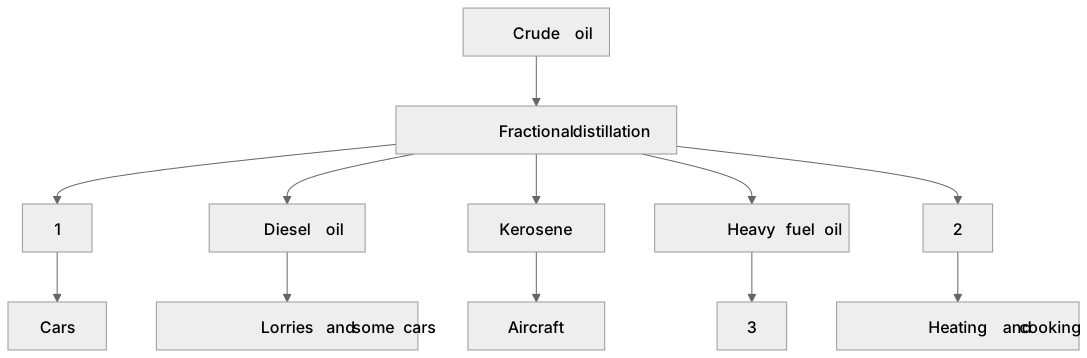
Some boxes have lost their names. Pick the right name for each number.
1Box 1
2Box 2
3Box 3
There is more to this lesson
The full lesson goes on to check your understanding and help you earn the marks. Create a free account to carry on, with your progress saved.
A week of Premium from your first lesson · Then the free plan continues · No card, no charge
Test your understanding of Fractional distillation and petrochemicals: Many of the fuels on which we depend for our modern lifestyle, such as petrol, diesel oil, kerosene, heavy fuel oil and liquefied petroleum gases, are produced from crude oil.
Active recall beats re-reading. Take an instant quiz now to test what you’ve learned and lock it into long-term memory.
A week of Premium from your first lesson · Then the free plan continues · No card, no charge