AQA · GCSE · Chemistry
Course version: 8462 · Version from Sept 2018
Fullerenes are molecules of carbon atoms with hollow shapes.
Full specification wording
Graphene and fullerenes: Fullerenes are molecules of carbon atoms with hollow shapes.
Fullerenes are molecular forms of carbon in which the atoms join to make closed, hollow cages or tubes.
Checked against the AQA 8462 specification (opens in a new tab) on .
- Point 3 of 7
- 3 key terms
Study notes
From the checked teaching notes for this specification point.
The idea
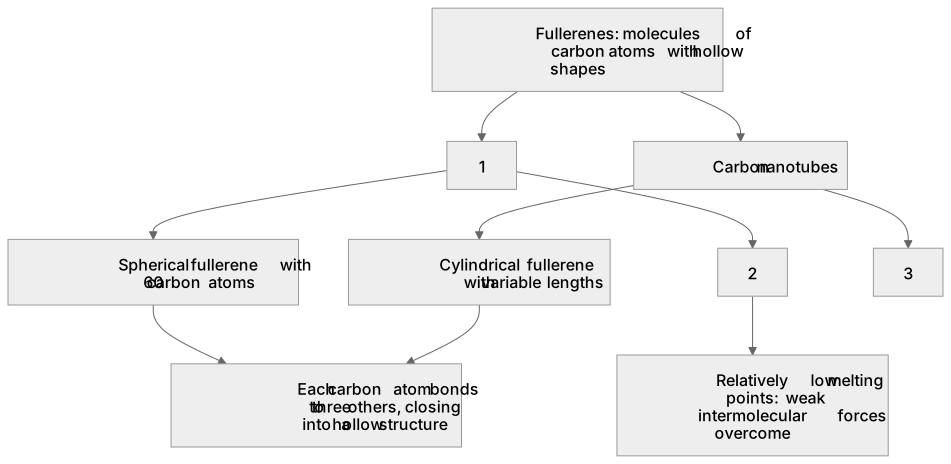
Fullerenes are molecular forms of carbon in which the atoms join to make closed, hollow cages or tubes. The most familiar is buckminsterfullerene, C₆₀, which has 60 carbon atoms arranged in pentagons and hexagons like a football. Other fullerenes form tubes, called carbon nanotubes. Each carbon atom bonds to three others, so the shape closes into a hollow structure. Spherical fullerenes like C₆₀ are simple molecules with fixed formulae and relatively low melting points, as only weak intermolecular forces need to be overcome. In contrast, carbon nanotubes are extended cylindrical structures with variable lengths and high melting points. Their hollow cages can enclose other atoms or molecules, which is useful in drug delivery, and nanotubes are strong and can conduct electricity, making them useful in electronics and materials.
What earns the marks
- Fullerenes are molecules of carbon with hollow shapes, such as closed cages or tubes.
- Buckminsterfullerene, C₆₀, is a spherical fullerene with 60 carbon atoms and a fixed formula.
- Carbon nanotubes are cylindrical fullerenes and are included in the fullerene family, but have variable lengths.
- Each carbon atom bonds to three others, producing curved closed structures.
- Spherical fullerenes are simple molecules with weaker intermolecular forces, whereas nanotubes are extended structures.
Common mistakes and how to put them right
Confusing fullerenes with graphite or diamond.
Put it right by stating that fullerenes have hollow closed shapes.
Saying all fullerenes are giant covalent structures.
Put it right by describing spherical fullerenes as molecules with a fixed number of carbon atoms.
Describing nanotubes as flat sheets.
Put it right by stating that nanotubes are hollow cylinders formed from curved carbon layers.
Exam tips
- Name buckminsterfullerene and give its formula C₆₀ as a concrete example of a hollow spherical fullerene.
- Use the word hollow when describing the shape, since this is the key feature in the statement.
- Distinguish spherical fullerenes (fixed formula) from carbon nanotubes (extended cylindrical structures).
Try the lesson
The start of the Graphene and fullerenes: Fullerenes are molecules of carbon atoms with hollow shapes. lesson, made from checked teaching notes for this specification point.
Have a go first
Which description best matches a fullerene?
Listen
Fullerenes are molecular forms of carbon in which the atoms join to make closed, hollow cages or tubes. The most familiar is buckminsterfullerene, C₆₀, which has 60 carbon atoms arranged in pentagons and hexagons like a football. Other fullerenes form tubes, called carbon nanotubes. Each carbon atom bonds to three others, so the shape closes into a hollow structure. Spherical fullerenes like C₆₀ are simple molecules with fixed formulae and relatively low melting points, as only weak intermolecular forces need to be overcome. In contrast, carbon nanotubes are extended cylindrical structures with variable lengths and high melting points. Their hollow cages can enclose other atoms or molecules, which is useful in drug delivery, and nanotubes are strong and can conduct electricity, making them useful in electronics and materials. A strong answer earns marks for these points. Fullerenes are molecules of carbon with hollow shapes, such as closed cages or tubes. Buckminsterfullerene, C₆₀, is a spherical fullerene with 60 carbon atoms and a fixed formula. Carbon nanotubes are cylindrical fullerenes and are included in the fullerene family, but have variable lengths. Each carbon atom bonds to three others, producing curved closed structures. A common slip: Confusing fullerenes with graphite or diamond. Instead, stating that fullerenes have hollow closed shapes. Exam tip: Name buckminsterfullerene and give its formula C₆₀ as a concrete example of a hollow spherical fullerene.
See it

Key words
Say what each word means before you turn the card.
Fullerenes
Try answering aloud or in your head before turning the card.
Buckminsterfullerene
Try answering aloud or in your head before turning the card.
Carbon nanotubes
Try answering aloud or in your head before turning the card.
See every definition
- Fullerenes
- Molecules of carbon atoms with hollow shapes, such as closed cages or tubes.
- Buckminsterfullerene
- A spherical fullerene, C₆₀, with 60 carbon atoms and a fixed formula.
- Carbon nanotubes
- Cylindrical fullerenes with variable lengths, forming extended structures rather than simple molecules.
Label the diagram
Some boxes have lost their names. Pick the right name for each number.
1Box 1
2Box 2
3Box 3
There is more to this lesson
The full lesson goes on to check your understanding and help you earn the marks. Create a free account to carry on, with your progress saved.
A week of Premium from your first lesson · Then the free plan continues · No card, no charge
Test your understanding of Graphene and fullerenes: Fullerenes are molecules of carbon atoms with hollow shapes.
Active recall beats re-reading. Take an instant quiz now to test what you’ve learned and lock it into long-term memory.
A week of Premium from your first lesson · Then the free plan continues · No card, no charge