AQA · GCSE · Chemistry
Course version: 8462 · Version from Sept 2018
The structure of fullerenes is based on hexagonal rings of carbon atoms…
Full specification wording
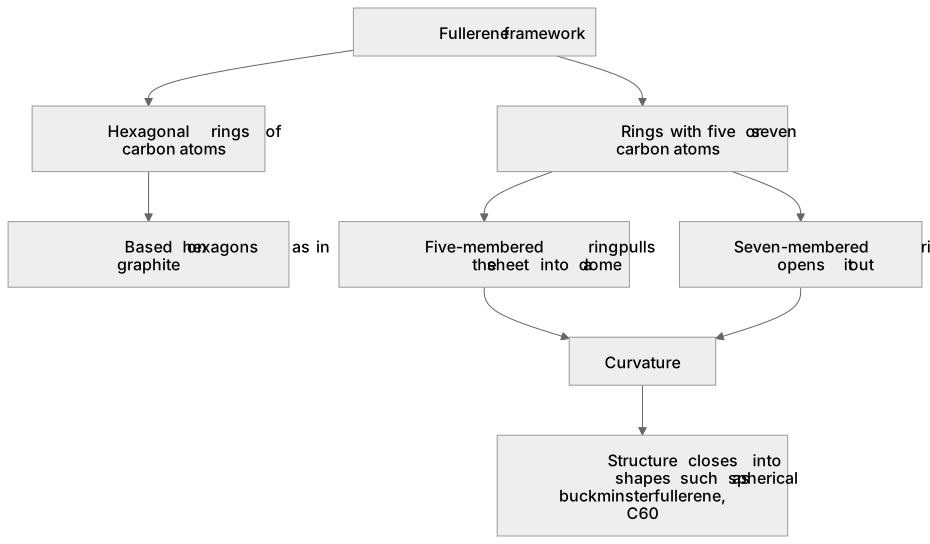
Graphene and fullerenes: The structure of fullerenes is based on hexagonal rings of carbon atoms but they may also contain rings with five or seven carbon atoms.
Fullerenes are molecular forms of carbon in which every carbon atom bonds to three others, producing curved cage-like or tubular molecules.
Checked against the AQA 8462 specification (opens in a new tab) on .
- Point 4 of 7
- 4 key terms
Study notes
From the checked teaching notes for this specification point.
The idea
Fullerenes are molecular forms of carbon in which every carbon atom bonds to three others, producing curved cage-like or tubular molecules. The framework is built mainly from hexagonal rings of carbon atoms, exactly like the six-membered rings in graphite, but curvature is introduced by rings containing five or seven carbon atoms. A five-membered ring pulls the sheet into a dome, while a seven-membered ring opens it out; combining these with hexagons closes the structure into shapes such as the spherical buckminsterfullerene, C₆₀. Although each carbon uses three covalent bonds within the cage, leaving one delocalised electron per atom, spherical fullerenes like C₆₀ do not conduct electricity as bulk solids because electrons cannot easily jump between discrete molecules. Recognising the ring sizes in a diagram is the key skill.
What earns the marks
- Fullerenes are molecules of carbon in which each carbon atom is covalently bonded to three other carbon atoms.
- The framework is based on hexagonal rings of carbon atoms, as in graphite, but the network is curved and closed.
- Rings containing five or seven carbon atoms are also present; five-membered rings create curvature and help close the cage.
- Buckminsterfullerene, C₆₀, is a spherical fullerene whose surface is made from hexagons and pentagons.
- While each carbon has a delocalised electron, spherical fullerenes are simple molecules and do not conduct electricity as bulk solids.
Common mistakes and how to put them right
Describing fullerenes as a giant covalent lattice like diamond or graphite.
Put it right by stating that spherical fullerenes are individual molecules.
Stating that fullerenes contain only hexagonal rings.
Put it right by noting that five- and seven-membered rings are also present and cause the curvature.
Assuming all fullerenes conduct electricity like graphite.
Put it right by noting that spherical fullerenes like C₆₀ are insulators as bulk solids.
Exam tips
- When a diagram is given, count the number of sides on the rings shown and name the ring sizes explicitly, for example 'hexagonal rings with some five-membered rings'.
- Link the ring sizes to the shape: state that five-membered rings introduce curvature, which is why the molecule is closed rather than flat.
- Remember that each carbon atom forms three bonds, but do not assume this makes all fullerenes good electrical conductors.
Try the lesson
The start of the Graphene and fullerenes: The structure of fullerenes is based on hexagonal rings of carbon atoms but they may also contain rings with five or seven carbon atoms. lesson, made from checked teaching notes for this specification point.
Have a go first
The structure of fullerenes is based on rings of carbon atoms. Which combination of ring sizes forms the basis of fullerene molecules?
Listen
Fullerenes are molecular forms of carbon in which every carbon atom bonds to three others, producing curved cage-like or tubular molecules. The framework is built mainly from hexagonal rings of carbon atoms, exactly like the six-membered rings in graphite, but curvature is introduced by rings containing five or seven carbon atoms. A five-membered ring pulls the sheet into a dome, while a seven-membered ring opens it out; combining these with hexagons closes the structure into shapes such as the spherical buckminsterfullerene, C₆₀. Although each carbon uses three covalent bonds within the cage, leaving one delocalised electron per atom, spherical fullerenes like C₆₀ do not conduct electricity as bulk solids because electrons cannot easily jump between discrete molecules. Recognising the ring sizes in a diagram is the key skill. A strong answer earns marks for these points. Fullerenes are molecules of carbon in which each carbon atom is covalently bonded to three other carbon atoms. The framework is based on hexagonal rings of carbon atoms, as in graphite, but the network is curved and closed. Rings containing five or seven carbon atoms are also present; five-membered rings create curvature and help close the cage. Buckminsterfullerene, C₆₀, is a spherical fullerene whose surface is made from hexagons and pentagons. A common slip: Describing fullerenes as a giant covalent lattice like diamond or graphite. Instead, stating that spherical fullerenes are individual molecules. Exam tip: When a diagram is given, count the number of sides on the rings shown and name the ring sizes explicitly, for example 'hexagonal rings with some five-membered rings'.
See it
Key words
Say what each word means before you turn the card.
Fullerenes
Try answering aloud or in your head before turning the card.
Hexagonal rings
Try answering aloud or in your head before turning the card.
Five-membered rings
Try answering aloud or in your head before turning the card.
Buckminsterfullerene
Try answering aloud or in your head before turning the card.
See every definition
- Fullerenes
- Molecular forms of carbon in which every carbon atom bonds to three others, producing curved cage-like or tubular molecules.
- Hexagonal rings
- Six-membered rings of carbon atoms, exactly like those in graphite, that form the main framework of fullerenes.
- Five-membered rings
- Rings containing five carbon atoms that pull the sheet into a dome and help close the cage.
- Buckminsterfullerene
- A spherical fullerene, C₆₀, whose surface is made from hexagons and pentagons.
Label the diagram
Some boxes have lost their names. Pick the right name for each number.
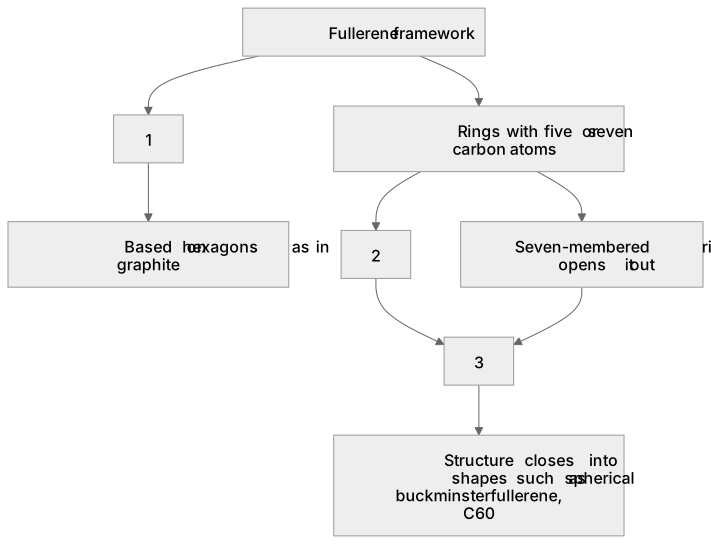
1Box 1
2Box 2
3Box 3
There is more to this lesson
The full lesson goes on to check your understanding and help you earn the marks. Create a free account to carry on, with your progress saved.
A week of Premium from your first lesson · Then the free plan continues · No card, no charge
Test your understanding of Graphene and fullerenes: The structure of fullerenes is based on hexagonal rings of carbon atoms but they may also contain rings with five or seven carbon atoms.
Active recall beats re-reading. Take an instant quiz now to test what you’ve learned and lock it into long-term memory.
A week of Premium from your first lesson · Then the free plan continues · No card, no charge