AQA · GCSE · Chemistry
Course version: 8462 · Version from Sept 2018
The boiling points of the noble gases increase with increasing relative…
Full specification wording
Group 0: The boiling points of the noble gases increase with increasing relative atomic mass (going down the group).
As you go down Group 0, the relative atomic mass increases because atoms have more protons and neutrons.
Checked against the AQA 8462 specification (opens in a new tab) on .
- Point 4 of 5
- 4 key terms
Study notes
From the checked teaching notes for this specification point.
The idea
As you go down Group 0, the relative atomic mass increases because atoms have more protons and neutrons. Larger atoms have more electrons and a greater number of electron shells, so the electron cloud is more polarisable. This leads to stronger London dispersion forces between atoms. Although noble gases are monatomic and do not form covalent bonds, these weak intermolecular forces must be overcome to boil the liquid. Stronger forces mean more energy is needed, so boiling point increases from helium to radon.
For example: Helium boils at about 4 K, while radon boils at about 211 K. Exam answers should link increasing relative atomic mass to stronger intermolecular forces and therefore higher boiling points.
What earns the marks
- Going down Group 0, relative atomic mass increases.
- Atoms become larger and have more electrons as you go down the group.
- London dispersion forces between noble gas atoms become stronger with more electrons.
- More energy is required to overcome stronger intermolecular forces, so boiling point increases.
- Helium has the lowest boiling point and radon has the highest among the noble gases.
Common mistakes and how to put them right
Saying boiling point increases because atoms form stronger covalent bonds.
Put it right: Noble gases are monatomic and do not bond to each other.
Confusing boiling point with melting point.
Put it right: Both increase down the group, but the statement refers to boiling point.
Stating that boiling point increases because atoms are heavier.
Put it right: Mass alone is not the reason, it is the increase in electrons and dispersion forces.
Exam tips
- Use the term 'intermolecular forces' or 'London dispersion forces' rather than 'bonds'.
- Link the trend to the number of electrons, not just to relative atomic mass.
- If given data, quote values to support the trend, for example helium 4 K and radon 211 K.
Try the lesson
The start of the Group 0: The boiling points of the noble gases increase with increasing relative atomic mass (going down the group). lesson, made from checked teaching notes for this specification point.
Have a go first
What happens to the boiling points of the noble gases as you go down Group 0?
Listen
As you go down Group 0, the relative atomic mass increases because atoms have more protons and neutrons. Larger atoms have more electrons and a greater number of electron shells, so the electron cloud is more polarisable. This leads to stronger London dispersion forces between atoms. Although noble gases are monatomic and do not form covalent bonds, these weak intermolecular forces must be overcome to boil the liquid. Stronger forces mean more energy is needed, so boiling point increases from helium to radon. For example, helium boils at about 4 K, while radon boils at about 211 K. Exam answers should link increasing relative atomic mass to stronger intermolecular forces and therefore higher boiling points. A strong answer earns marks for these points. Going down Group 0, relative atomic mass increases. Atoms become larger and have more electrons as you go down the group. London dispersion forces between noble gas atoms become stronger with more electrons. More energy is required to overcome stronger intermolecular forces, so boiling point increases. Exam tip: Use the term 'intermolecular forces' or 'London dispersion forces' rather than 'bonds'.
See it
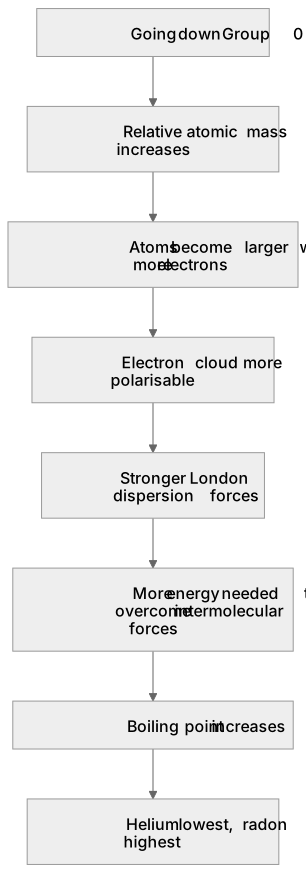
Put it in order
Put these steps in the order they happen.
- 1. Stronger London dispersion forces
- 2. Helium lowest, radon highest
- 3. More energy needed to overcome intermolecular forces
- 4. Going down Group 0
- 5. Relative atomic mass increases
- 6. Boiling point increases
- 7. Atoms become larger with more electrons
- 8. Electron cloud more polarisable
Key words
Say what each word means before you turn the card.
Trends in Group 0
Try answering aloud or in your head before turning the card.
Intermolecular forces
Try answering aloud or in your head before turning the card.
Relative atomic mass
Try answering aloud or in your head before turning the card.
States of matter and boiling point
Try answering aloud or in your head before turning the card.
See every definition
- Trends in Group 0
- Going down the group, relative atomic mass increases and boiling point increases from helium to radon.
- Intermolecular forces
- Weak London dispersion forces between noble gas atoms must be overcome to boil the liquid, and stronger forces mean more energy is needed.
- Relative atomic mass
- This increases going down Group 0 because atoms have more protons and neutrons.
- States of matter and boiling point
- Boiling point increases down the group because more energy is required to overcome stronger intermolecular forces.
Label the diagram
Some boxes have lost their names. Pick the right name for each number.
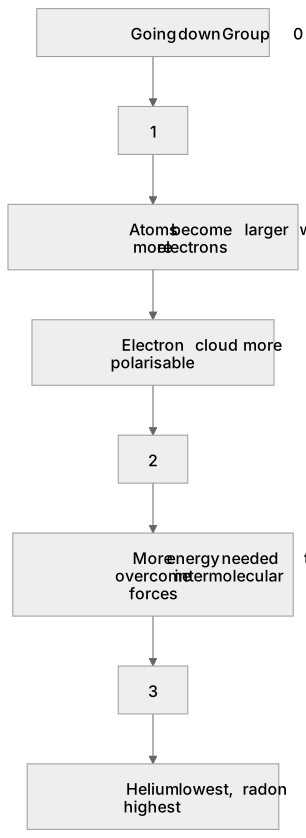
1Box 1
2Box 2
3Box 3
There is more to this lesson
The full lesson goes on to check your understanding and help you earn the marks. Create a free account to carry on, with your progress saved.
A week of Premium from your first lesson · Then the free plan continues · No card, no charge
Test your understanding of Group 0: The boiling points of the noble gases increase with increasing relative atomic mass (going down the group).
Active recall beats re-reading. Take an instant quiz now to test what you’ve learned and lock it into long-term memory.
A week of Premium from your first lesson · Then the free plan continues · No card, no charge