AQA · GCSE · Chemistry
Course version: 8462 · Version from Sept 2018
Elements and compounds can be detected and identified using instrumental…
Full specification wording
Instrumental methods: Elements and compounds can be detected and identified using instrumental methods. Instrumental methods are accurate, sensitive and rapid.
Instrumental methods use machines to detect and identify elements and compounds.
Checked against the AQA 8462 specification (opens in a new tab) on .
- Point 1 of 2
- 4 key terms
Study notes
From the checked teaching notes for this specification point.
The idea
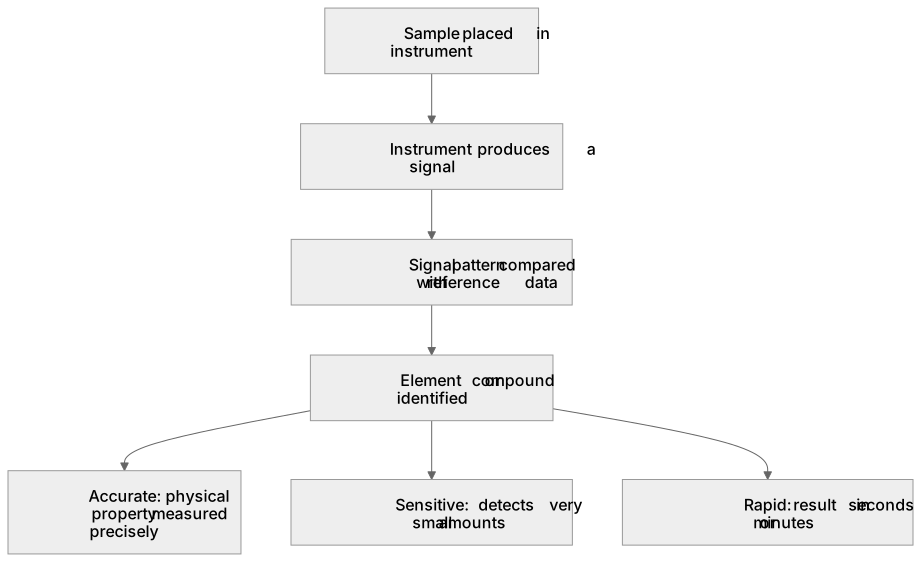
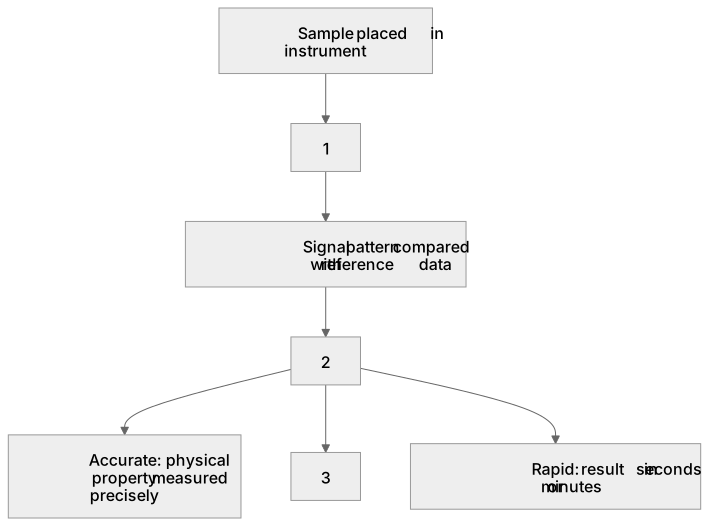
Instrumental methods use machines to detect and identify elements and compounds. A sample is placed in an instrument, which produces a signal such as a line spectrum, a peak on a chromatogram or a mass spectrum. The pattern of lines or peaks is compared with reference data to identify the substance. These methods are accurate because the instrument measures a physical property precisely; sensitive because they can detect very small amounts, sometimes parts per million or less; and rapid because a result can be produced in seconds or minutes.
For example: A mass spectrometer can identify a compound from its molecular ion peak and fragmentation pattern, and atomic emission spectroscopy can detect metal ions from their characteristic wavelengths.
What earns the marks
- State that instrumental methods use machines to detect and identify elements or compounds from a measured signal.
- Explain that instrumental methods are accurate because they measure a physical property precisely and compare it with reference data.
- Explain that instrumental methods are sensitive because they can detect very small amounts of a substance.
- Explain that instrumental methods are rapid because they produce results quickly compared with many chemical tests.
- Give a named example, such as a mass spectrometer or atomic emission spectroscopy, and state what it detects.
Common mistakes and how to put them right
Confusing sensitive with accurate.
Put it right: Sensitive means able to detect small amounts, while accurate means giving a result close to the true value.
Thinking instrumental methods replace all chemical tests.
Put it right: They are often used alongside chemical tests, and some instruments need calibration and reference data.
Describing an instrument without saying what it detects.
Put it right: Link the method to the element or compound it identifies, such as a mass spectrometer identifying a compound from its molecular ion.
Exam tips
- Learn the three advantages as a set: accurate, sensitive and rapid, and be ready to explain each one.
- Name a specific instrument and state the signal it produces, such as a line spectrum or a peak on a chromatogram.
- Compare instrumental methods with chemical tests by referring to speed, sensitivity and the need for reference data.
Try the lesson
The start of the Instrumental methods: Elements and compounds can be detected and identified using instrumental methods. Instrumental methods are accurate, sensitive and rapid. lesson, made from checked teaching notes for this specification point.
Have a go first
Which statement describes an advantage of using instrumental methods to detect and identify elements and compounds?
Listen
Instrumental methods use machines to detect and identify elements and compounds. A sample is placed in an instrument, which produces a signal such as a line spectrum, a peak on a chromatogram or a mass spectrum. The pattern of lines or peaks is compared with reference data to identify the substance. These methods are accurate because the instrument measures a physical property precisely; sensitive because they can detect very small amounts, sometimes parts per million or less; and rapid because a result can be produced in seconds or minutes. For example, a mass spectrometer can identify a compound from its molecular ion peak and fragmentation pattern, and atomic emission spectroscopy can detect metal ions from their characteristic wavelengths. A strong answer earns marks for these points. State that instrumental methods use machines to detect and identify elements or compounds from a measured signal. Explain that instrumental methods are accurate because they measure a physical property precisely and compare it with reference data. Explain that instrumental methods are sensitive because they can detect very small amounts of a substance. Explain that instrumental methods are rapid because they produce results quickly compared with many chemical tests. A common slip: Confusing sensitive with accurate. Instead, sensitive means able to detect small amounts, while accurate means giving a result close to the true value. Exam tip: Learn the three advantages as a set: accurate, sensitive and rapid, and be ready to explain each one.
See it
Key words
Say what each word means before you turn the card.
Instrumental methods
Try answering aloud or in your head before turning the card.
Accurate
Try answering aloud or in your head before turning the card.
Sensitive
Try answering aloud or in your head before turning the card.
Rapid
Try answering aloud or in your head before turning the card.
See every definition
- Instrumental methods
- Methods that use machines to detect and identify elements and compounds from a measured signal.
- Accurate
- Describes a method that measures a physical property precisely and compares it with reference data.
- Sensitive
- Describes a method that can detect very small amounts of a substance, sometimes parts per million or less.
- Rapid
- Describes a method that produces a result in seconds or minutes, quickly compared with many chemical tests.
Label the diagram
Some boxes have lost their names. Pick the right name for each number.
1Box 1
2Box 2
3Box 3
There is more to this lesson
The full lesson goes on to check your understanding and help you earn the marks. Create a free account to carry on, with your progress saved.
A week of Premium from your first lesson · Then the free plan continues · No card, no charge
Test your understanding of Instrumental methods: Elements and compounds can be detected and identified using instrumental methods. Instrumental methods are accurate, sensitive and rapid.
Active recall beats re-reading. Take an instant quiz now to test what you’ve learned and lock it into long-term memory.
A week of Premium from your first lesson · Then the free plan continues · No card, no charge