AQA · GCSE · Chemistry
Course version: 8462 · Version from Sept 2018
Students should be able to state advantages of instrumental methods…
Full specification wording
Instrumental methods: Students should be able to state advantages of instrumental methods compared with the chemical tests in this specification.
Instrumental methods use machines to measure a property of a sample, such as the light emitted by metal ions in a flame.
Checked against the AQA 8462 specification (opens in a new tab) on .
- Point 2 of 2
- 4 key terms
Study notes
From the checked teaching notes for this specification point.
The idea
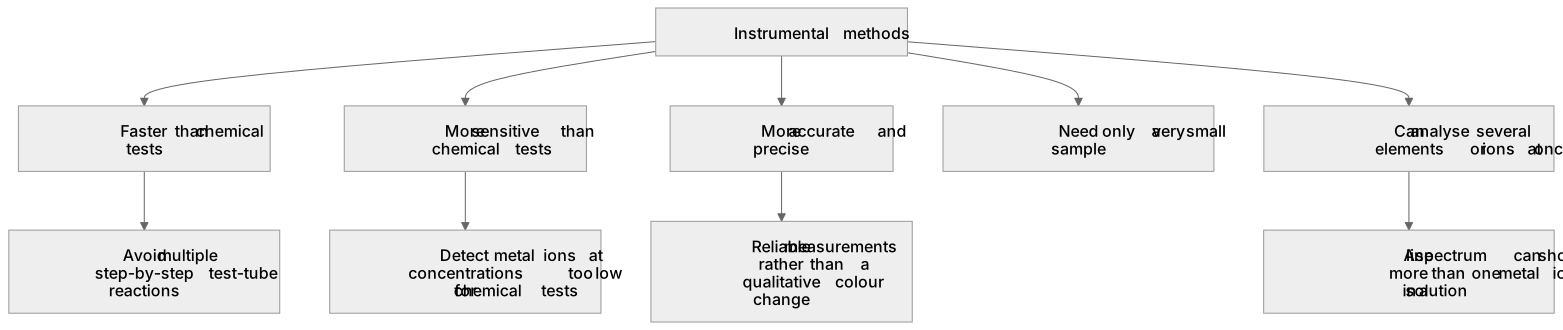
Instrumental methods use machines to measure a property of a sample, such as the light emitted by metal ions in a flame. Compared with the chemical tests in this specification, they are faster because no lengthy test-tube reactions are needed, and they are more sensitive, detecting very low concentrations that chemical tests would miss. They are also more accurate and precise, and they can be used with very small samples.
For example: Flame emission spectroscopy can identify and measure several metal ions from one small sample, whereas a series of chemical tests would take longer and use more sample.
What earns the marks
- Instrumental methods are faster than the chemical tests in this specification because they avoid multiple step-by-step test-tube reactions.
- Instrumental methods are more sensitive, so they can detect metal ions at concentrations too low for the chemical tests to show a result.
- Instrumental methods are more accurate and precise, giving reliable measurements rather than a qualitative colour change.
- Instrumental methods often need only a very small sample, which is useful when the sample is limited or valuable.
- Instrumental methods can analyse several elements or ions at once, for example a line spectrum can show more than one metal ion in a solution.
- A valid comparison must refer to the chemical tests in this specification, such as flame tests or precipitation reactions with sodium hydroxide solution, rather than chemical tests in general.
Common mistakes and how to put them right
Saying instrumental methods are always cheaper.
Put it right: Instruments can be expensive, so cost is not a reliable advantage to state.
Saying instrumental methods are simpler because no skill is needed.
Put it right: The advantage is speed, sensitivity and accuracy, not lack of skill.
Describing a chemical test in detail instead of comparing.
Put it right: State the advantage and link it directly to the chemical test it replaces.
Exam tips
- Use comparative wording such as faster than, more sensitive than and more accurate than, and name the chemical test being compared.
- Link each advantage to a consequence, for example more sensitive means lower concentrations can be detected.
- Keep the answer focused on advantages of instrumental methods; do not spend time describing how a flame test is carried out.
Try the lesson
The start of the Instrumental methods: Students should be able to state advantages of instrumental methods compared with the chemical tests in this specification. lesson, made from checked teaching notes for this specification point.
Have a go first
Which statement describes an advantage of instrumental methods compared with the chemical tests in this specification?
Listen
Instrumental methods use machines to measure a property of a sample, such as the light emitted by metal ions in a flame. Compared with the chemical tests in this specification, they are faster because no lengthy test-tube reactions are needed, and they are more sensitive, detecting very low concentrations that chemical tests would miss. They are also more accurate and precise, and they can be used with very small samples. For example, flame emission spectroscopy can identify and measure several metal ions from one small sample, whereas a series of chemical tests would take longer and use more sample. A strong answer earns marks for these points. Instrumental methods are faster than the chemical tests in this specification because they avoid multiple step-by-step test-tube reactions. Instrumental methods are more sensitive, so they can detect metal ions at concentrations too low for the chemical tests to show a result. Instrumental methods are more accurate and precise, giving reliable measurements rather than a qualitative colour change. Instrumental methods often need only a very small sample, which is useful when the sample is limited or valuable. A common slip: Saying instrumental methods are always cheaper: the error is assuming cost is an advantage. Instead, instruments can be expensive, so cost is not a reliable advantage to state. Exam tip: Use comparative wording such as faster than, more sensitive than and more accurate than, and name the chemical test being compared.
See it
Key words
Say what each word means before you turn the card.
Instrumental analysis
Try answering aloud or in your head before turning the card.
Sensitivity and accuracy
Try answering aloud or in your head before turning the card.
Speed of analysis
Try answering aloud or in your head before turning the card.
Comparison of analytical methods
Try answering aloud or in your head before turning the card.
See every definition
- Instrumental analysis
- Methods that use machines to measure a property of a sample, such as the light emitted by metal ions in a flame.
- Sensitivity and accuracy
- Being more sensitive means detecting very low concentrations that chemical tests would miss, and being more accurate and precise gives reliable measurements rather than a qualitative colour change.
- Speed of analysis
- These methods are faster than the chemical tests in this specification because no lengthy test-tube reactions are needed.
- Comparison of analytical methods
- Stating advantages such as speed, sensitivity, accuracy and precision, and use with very small samples, with reference to the chemical tests in this specification.
Label the diagram
Some boxes have lost their names. Pick the right name for each number.
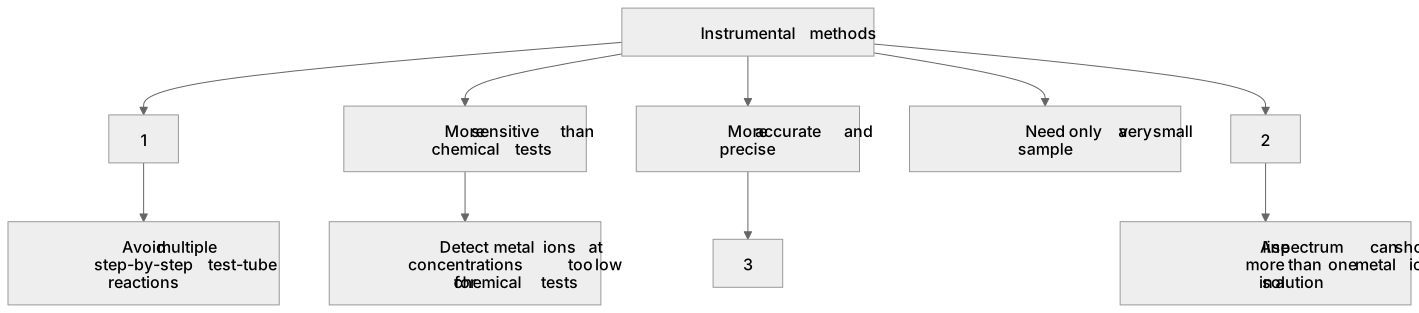
1Box 1
2Box 2
3Box 3
There is more to this lesson
The full lesson goes on to check your understanding and help you earn the marks. Create a free account to carry on, with your progress saved.
A week of Premium from your first lesson · Then the free plan continues · No card, no charge
Test your understanding of Instrumental methods: Students should be able to state advantages of instrumental methods compared with the chemical tests in this specification.
Active recall beats re-reading. Take an instant quiz now to test what you’ve learned and lock it into long-term memory.
A week of Premium from your first lesson · Then the free plan continues · No card, no charge