AQA · GCSE · Chemistry
Course version: 8462 · Version from Sept 2018
Life cycle assessments (LCAs) are carried out to assess the environmental…
Full specification wording
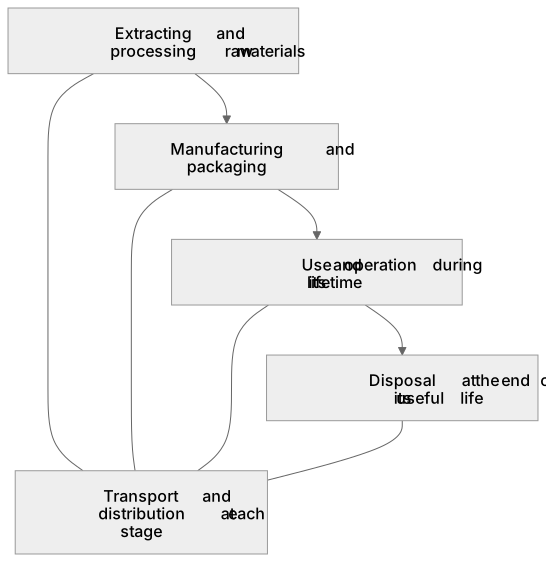
Life cycle assessment: Life cycle assessments (LCAs) are carried out to assess the environmental impact of products in each of these stages: extracting and processing raw materials manufacturing and packaging use and operation during its lifetime disposal at the end of its useful life, including transport and distribution at each stage.
A life cycle assessment, or LCA, examines a product from the cradle to the grave.
Checked against the AQA 8462 specification (opens in a new tab) on .
- Point 1 of 5
- 2 key terms
Study notes
From the checked teaching notes for this specification point.
The idea
A life cycle assessment, or LCA, examines a product from the cradle to the grave. The four stages are extracting and processing raw materials, manufacturing and packaging, use and operation during its lifetime, and disposal at the end of its useful life. Transport and distribution must be considered at every stage, because moving materials and products uses energy and produces emissions. For example, an LCA of a plastic bottle would consider the oil used to make the plastic, the energy used in moulding and packaging, any energy used during its use, and whether it is recycled, incinerated or sent to landfill. LCAs help compare products, but they are only as reliable as the data and assumptions used, and different assessors may reach different conclusions.
What earns the marks
- An LCA assesses the environmental impact of a product across its whole life cycle.
- Stage one is extracting and processing the raw materials needed to make the product.
- Stage two is manufacturing and packaging the product.
- Stage three is use and operation of the product during its lifetime.
- Stage four is disposal at the end of its useful life, such as recycling, incineration or landfill.
- Transport and distribution must be included at each stage because they contribute energy use and emissions.
- LCAs are comparative tools, but their conclusions depend on the data and assumptions used.
Common mistakes and how to put them right
Listing only the disposal stage.
Put it right: An LCA must cover all four stages, from raw material extraction to disposal.
Forgetting transport and distribution.
Put it right: These apply at each stage and must be included in the assessment.
Treating an LCA result as an absolute fact.
Put it right: LCAs depend on the data and assumptions chosen, so different assessments can give different conclusions.
Exam tips
- Name all four stages in order before discussing any one of them in detail.
- Mention transport and distribution explicitly, since it applies across every stage.
- When comparing two products, comment on the reliability of the LCA data as well as the environmental impacts.
Try the lesson
The start of the Life cycle assessment: Life cycle assessments (LCAs) are carried out to assess the environmental impact of products in each of these stages: extracting and processing raw materials manufacturing and packaging use and operation during its lifetime disposal at the end of its useful life, including transport and distribution at each stage. lesson, made from checked teaching notes for this specification point.
Have a go first
Which stage of a life cycle assessment (LCA) covers getting the raw materials needed to make a product?
Listen
A life cycle assessment, or LCA, examines a product from the cradle to the grave. The four stages are extracting and processing raw materials, manufacturing and packaging, use and operation during its lifetime, and disposal at the end of its useful life. Transport and distribution must be considered at every stage, because moving materials and products uses energy and produces emissions. For example, an LCA of a plastic bottle would consider the oil used to make the plastic, the energy used in moulding and packaging, any energy used during its use, and whether it is recycled, incinerated or sent to landfill. LCAs help compare products, but they are only as reliable as the data and assumptions used, and different assessors may reach different conclusions. A strong answer earns marks for these points. An LCA assesses the environmental impact of a product across its whole life cycle. Stage one is extracting and processing the raw materials needed to make the product. Stage two is manufacturing and packaging the product. Stage three is use and operation of the product during its lifetime. A common slip: Listing only the disposal stage. Instead, an LCA must cover all four stages, from raw material extraction to disposal. Exam tip: Name all four stages in order before discussing any one of them in detail.
See it
Key words
Say what each word means before you turn the card.
Cradle-to-grave environmental assessment
Try answering aloud or in your head before turning the card.
Raw material extraction and processing
Try answering aloud or in your head before turning the card.
See every definition
- Cradle-to-grave environmental assessment
- An assessment carried out to assess the environmental impact of products in each stage, from extracting and processing raw materials to disposal at the end of its useful life.
- Raw material extraction and processing
- The first stage of an LCA, in which the raw materials needed to make the product are extracted and processed.
Label the diagram
Some boxes have lost their names. Pick the right name for each number.
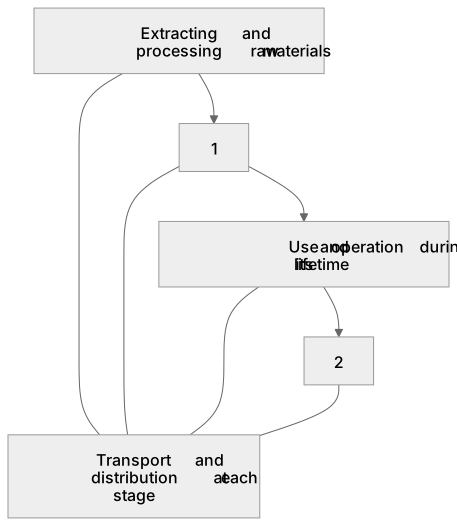
1Box 1
2Box 2
There is more to this lesson
The full lesson goes on to check your understanding and help you earn the marks. Create a free account to carry on, with your progress saved.
A week of Premium from your first lesson · Then the free plan continues · No card, no charge
Test your understanding of Life cycle assessment: Life cycle assessments (LCAs) are carried out to assess the environmental impact of products in each of these stages: extracting and processing raw materials manufacturing and packaging use and operation during its lifetime disposal at the end of its useful life, including transport and distribution at each stage.
Active recall beats re-reading. Take an instant quiz now to test what you’ve learned and lock it into long-term memory.
A week of Premium from your first lesson · Then the free plan continues · No card, no charge