AQA · GCSE · Chemistry
Course version: 8462 · Version from Sept 2018
Use of water, resources, energy sources and production of some wastes can…
Full specification wording
Life cycle assessment: Use of water, resources, energy sources and production of some wastes can be fairly easily quantified.
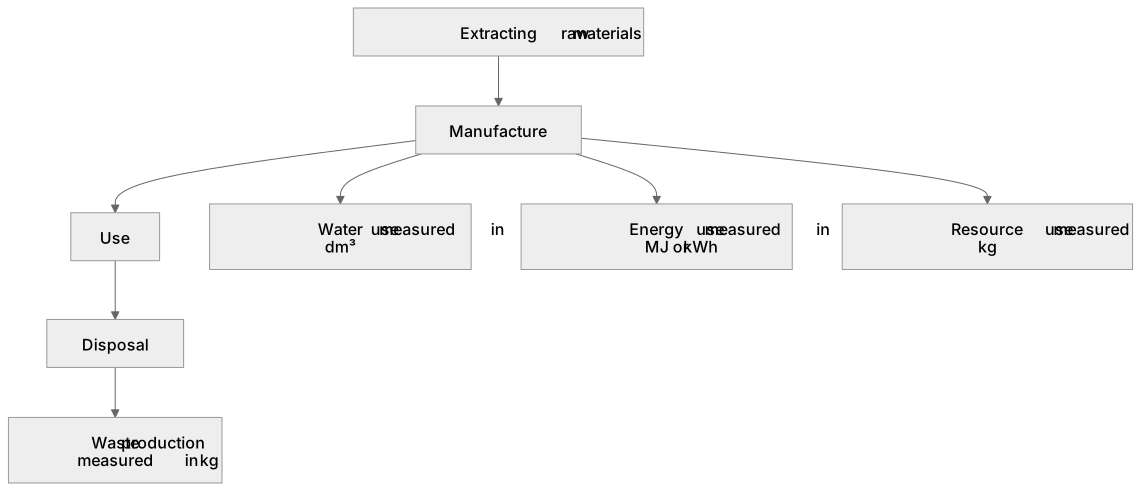
A life cycle assessment (LCA) tracks a product through raw material extraction, manufacture, use and disposal.
Checked against the AQA 8462 specification (opens in a new tab) on .
- Point 2 of 5
- 2 key terms
Study notes
From the checked teaching notes for this specification point.
The idea
A life cycle assessment (LCA) tracks a product through raw material extraction, manufacture, use and disposal. Some inputs and outputs are measurable: a factory's water meter records litres used, electricity bills give kilowatt-hours, and a balance gives the mass of material consumed. Waste masses sent to landfill or recycling can be weighed. For example, making 1000 paper bags might use 2500 dm³ of water and 400 MJ of energy, while 1000 plastic bags might use 500 dm³ of water and 700 MJ of energy. These quantities are objective because instruments give numbers in defined units. However, quantification is only 'fairly easy' for measurable flows; it does not tell us which impact matters more.
What earns the marks
- Identify the four stages of an LCA: extracting raw materials, manufacture, use and disposal.
- State that water use, resource use, energy use and waste production can be measured in defined units such as dm³, kg, MJ and kWh.
- Explain that measured quantities are objective because they come from instruments, meters or mass balances rather than opinion.
- Use a comparative example, such as water and energy totals for paper and plastic bags, to show how data are collected.
- Recognise that quantification is limited to measurable flows and does not by itself rank environmental harm.
Common mistakes and how to put them right
Treating an LCA as only the disposal stage.
Put it right by including extraction, manufacture, use and disposal.
Confusing energy with power.
Put it right by using joules or kilowatt-hours for energy and watts for power.
Assuming all impacts can be measured equally easily.
Put it right by noting that some pollutant effects need value judgements.
Exam tips
- Name the unit whenever you quote a quantity, for example 400 MJ or 2500 dm³.
- Link each measurable item to its LCA stage so the answer is structured.
- Use a short comparison of two products to show the data are quantitative.
Try the lesson
The start of the Life cycle assessment: Use of water, resources, energy sources and production of some wastes can be fairly easily quantified. lesson, made from checked teaching notes for this specification point.
Have a go first
In a life cycle assessment of a plastic bottle, which item can be fairly easily quantified?
Listen
A life cycle assessment (LCA) tracks a product through raw material extraction, manufacture, use and disposal. Some inputs and outputs are measurable: a factory's water meter records litres used, electricity bills give kilowatt-hours, and a balance gives the mass of material consumed. Waste masses sent to landfill or recycling can be weighed. For example, making 1000 paper bags might use 2500 dm³ of water and 400 MJ of energy, while 1000 plastic bags might use 500 dm³ of water and 700 MJ of energy. These quantities are objective because instruments give numbers in defined units. However, quantification is only 'fairly easy' for measurable flows; it does not tell us which impact matters more. A strong answer earns marks for these points. Identify the four stages of an LCA: extracting raw materials, manufacture, use and disposal. State that water use, resource use, energy use and waste production can be measured in defined units such as dm³, kg, MJ and kWh. Explain that measured quantities are objective because they come from instruments, meters or mass balances rather than opinion. Use a comparative example, such as water and energy totals for paper and plastic bags, to show how data are collected. A common slip: Treating an LCA as only the disposal stage. Instead, including extraction, manufacture, use and disposal. Exam tip: Name the unit whenever you quote a quantity, for example 400 MJ or 2500 dm³.
See it
Key words
Say what each word means before you turn the card.
Life cycle assessment
Try answering aloud or in your head before turning the card.
Quantitative measurement
Try answering aloud or in your head before turning the card.
See every definition
- Life cycle assessment
- Tracks a product through raw material extraction, manufacture, use and disposal.
- Quantitative measurement
- Quantities that are objective because instruments give numbers in defined units.
Label the diagram
Some boxes have lost their names. Pick the right name for each number.
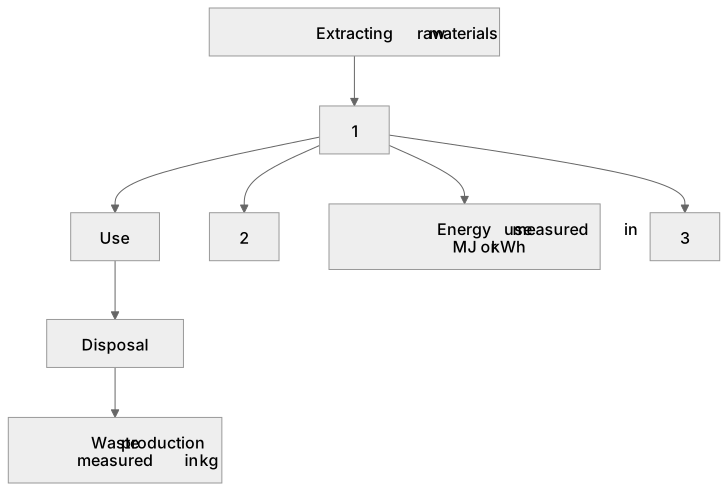
1Box 1
2Box 2
3Box 3
There is more to this lesson
The full lesson goes on to check your understanding and help you earn the marks. Create a free account to carry on, with your progress saved.
A week of Premium from your first lesson · Then the free plan continues · No card, no charge
Test your understanding of Life cycle assessment: Use of water, resources, energy sources and production of some wastes can be fairly easily quantified.
Active recall beats re-reading. Take an instant quiz now to test what you’ve learned and lock it into long-term memory.
A week of Premium from your first lesson · Then the free plan continues · No card, no charge