AQA · GCSE · Chemistry
Course version: 8462 · Version from Sept 2018
Some reactions may appear to involve a change in mass but this can usually…
Full specification wording
Mass changes when a reactant or product is a gas: Some reactions may appear to involve a change in mass but this can usually be explained because a reactant or product is a gas and its mass has not been taken into account. For example: when a metal reacts with oxygen the mass of the oxide produced is greater than the mass of the metal or in thermal decompositions of metal carbonates carbon dioxide is produced and escapes into the atmosphere leaving the metal oxide as the only solid product.
Mass appears to change in some reactions because a gaseous reactant or product is not included in the measurement.
Checked against the AQA 8462 specification (opens in a new tab) on .
- Point 1 of 2
Study notes
From the checked teaching notes for this specification point.
The idea
Mass appears to change in some reactions because a gaseous reactant or product is not included in the measurement. When a metal such as magnesium reacts with oxygen, the oxygen from the air joins the metal, so the white magnesium oxide product has a greater mass than the original metal. In the thermal decomposition of a metal carbonate, for example calcium carbonate → calcium oxide + carbon dioxide, the carbon dioxide escapes as a gas, leaving only the solid metal oxide; the remaining solid therefore has less mass than the original carbonate. In both cases, total mass is conserved if the gas is accounted for. Reactions in closed systems show no overall mass change.
What earns the marks
- Apparent mass changes are usually due to a gaseous reactant or product not being measured.
- Metal + oxygen → metal oxide: oxygen from the air adds to the metal, so the oxide has greater mass than the metal.
- Thermal decomposition of a metal carbonate: carbon dioxide gas escapes, so the remaining solid oxide has less mass than the carbonate.
- Total mass is conserved when all substances, including gases, are taken into account.
- In a closed system, the total mass before and after a reaction is unchanged.
- Example equation: CaCO₃ → CaO + CO₂ shows the gaseous product leaving the solid.
Common mistakes and how to put them right
Thinking that mass is destroyed or created in these reactions.
Put it right: Gases are involved and must be included in the mass balance.
Assuming the mass loss on heating a carbonate is due to the metal oxide escaping.
Put it right: Carbon dioxide gas escapes while the metal oxide remains as the solid.
Ignoring the role of oxygen from the air when a metal gains mass.
Put it right: Oxygen is a reactant and its mass is added to the metal.
Exam tips
- Identify whether a gas is a reactant or a product and state whether it is entering or leaving the reaction vessel.
- Use a closed system example to explain why mass does not change when gases are contained.
- Write the balanced symbol equation to show which substance is gaseous, for example CO₂ in a decomposition.
- Link the observation to conservation of mass rather than saying mass is lost or gained overall.
Try the lesson
The start of the Mass changes when a reactant or product is a gas: Some reactions may appear to involve a change in mass but this can usually be explained because a reactant or product is a gas and its mass has not been taken into account. For example: when a metal reacts with oxygen the mass of the oxide produced is greater than the mass of the metal or in thermal decompositions of metal carbonates carbon dioxide is produced and escapes into the atmosphere leaving the metal oxide as the only solid product. lesson, made from checked teaching notes for this specification point.
Have a go first
When magnesium burns in air, the white powder produced has a greater mass than the magnesium at the start. Why does the mass increase?
Listen
Mass appears to change in some reactions because a gaseous reactant or product is not included in the measurement. When a metal such as magnesium reacts with oxygen, the oxygen from the air joins the metal, so the white magnesium oxide product has a greater mass than the original metal. In the thermal decomposition of a metal carbonate, for example calcium carbonate → calcium oxide + carbon dioxide, the carbon dioxide escapes as a gas, leaving only the solid metal oxide; the remaining solid therefore has less mass than the original carbonate. In both cases, total mass is conserved if the gas is accounted for. Reactions in closed systems show no overall mass change. A strong answer earns marks for these points. Apparent mass changes are usually due to a gaseous reactant or product not being measured. Metal + oxygen → metal oxide: oxygen from the air adds to the metal, so the oxide has greater mass than the metal. Thermal decomposition of a metal carbonate: carbon dioxide gas escapes, so the remaining solid oxide has less mass than the carbonate. Total mass is conserved when all substances, including gases, are taken into account. A common slip: Thinking that mass is destroyed or created in these reactions. Instead, gases are involved and must be included in the mass balance. Exam tip: Identify whether a gas is a reactant or a product and state whether it is entering or leaving the reaction vessel.
See it
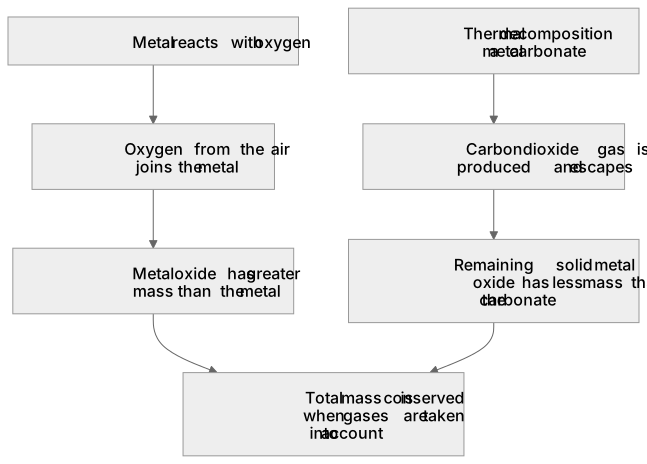
Label the diagram
Some boxes have lost their names. Pick the right name for each number.
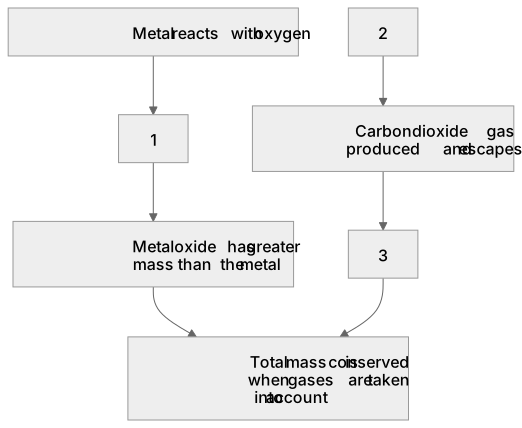
1Box 1
2Box 2
3Box 3
There is more to this lesson
The full lesson goes on to check your understanding and help you earn the marks. Create a free account to carry on, with your progress saved.
A week of Premium from your first lesson · Then the free plan continues · No card, no charge
Test your understanding of Mass changes when a reactant or product is a gas: Some reactions may appear to involve a change in mass but this can usually be explained because a reactant or product is a gas and its mass has not been taken into account. For example: when a metal reacts with oxygen the mass of the oxide produced is greater than the mass of the metal or in thermal decompositions of metal carbonates carbon dioxide is produced and escapes into the atmosphere leaving the metal oxide as the only solid product.
Active recall beats re-reading. Take an instant quiz now to test what you’ve learned and lock it into long-term memory.
A week of Premium from your first lesson · Then the free plan continues · No card, no charge