AQA · GCSE · Chemistry
Course version: 8462 · Version from Sept 2018
Students should be able to explain any observed changes in mass in…
Full specification wording
Mass changes when a reactant or product is a gas: Students should be able to explain any observed changes in mass in non-enclosed systems during a chemical reaction given the balanced symbol equation for the reaction and explain these changes in terms of the particle model.
In a non-enclosed system, matter can leave or enter as a gas, so the mass reading may change even though atoms are conserved.
Checked against the AQA 8462 specification (opens in a new tab) on .
- Point 2 of 2
- 4 key terms
Study notes
From the checked teaching notes for this specification point.
The idea
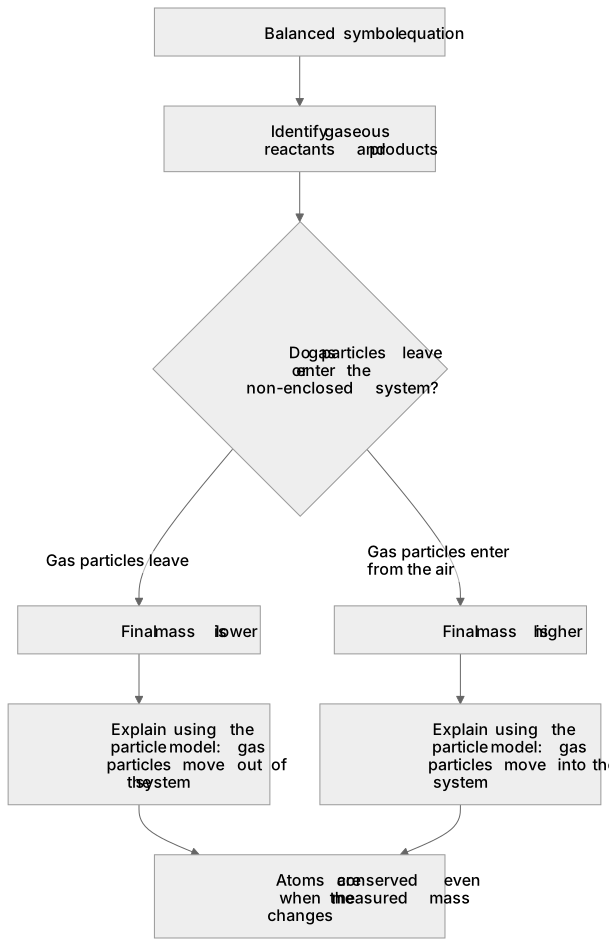
In a non-enclosed system, matter can leave or enter as a gas, so the mass reading may change even though atoms are conserved. Use the balanced symbol equation to identify gaseous reactants or products. If a gas escapes, the final mass is lower; if a gas from the air is absorbed, the final mass is higher. For example, magnesium burning in air, 2Mg + O₂ → 2MgO, gains mass because oxygen particles from the air join the solid. In contrast, marble chips reacting with acid, CaCO₃ + 2HCl → CaCl₂ + H₂O + CO₂, lose mass because carbon dioxide particles escape. Explain using the particle model: atoms are rearranged, not destroyed, but gas particles can move into or out of the container.
What earns the marks
- Identify from the balanced symbol equation which reactants or products are gases.
- State whether gas particles leave the reaction mixture or enter it from the surroundings.
- Compare the total mass of gaseous material lost or gained with the mass of the contents remaining.
- Explain the mass change by referring to gas particles moving into or out of the non-enclosed system.
- Use the balanced equation to show that atoms are conserved even when the measured mass changes.
Common mistakes and how to put them right
Thinking that mass is destroyed or created in the reaction.
Put it right by stating that atoms are conserved and gas particles move into or out of the non-enclosed system.
Ignoring the state symbols in the equation.
Put it right by using (g) to identify which substances are gases.
Assuming all reactions in open containers lose mass.
Put it right by checking whether a gaseous reactant is taken in from the air, which can increase the measured mass.
Exam tips
- Underline the gaseous species in the equation before writing your explanation.
- Use the phrase non-enclosed system to show that gas can escape or enter.
- Link each mass change to named particles, such as oxygen molecules entering or carbon dioxide molecules leaving.
Try the lesson
The start of the Mass changes when a reactant or product is a gas: Students should be able to explain any observed changes in mass in non-enclosed systems during a chemical reaction given the balanced symbol equation for the reaction and explain these changes in terms of the particle model. lesson, made from checked teaching notes for this specification point.
Have a go first
Magnesium ribbon is burned in a crucible that is open to the air. The balanced symbol equation is 2Mg(s) + O₂(g) → 2MgO(s). The white powder left in the crucible has a greater mass than the magnesium at the start. Which statement explains this increase in mass?
Listen
In a non-enclosed system, matter can leave or enter as a gas, so the mass reading may change even though atoms are conserved. Use the balanced symbol equation to identify gaseous reactants or products. If a gas escapes, the final mass is lower; if a gas from the air is absorbed, the final mass is higher. For example, magnesium burning in air, 2Mg + O₂ → 2MgO, gains mass because oxygen particles from the air join the solid. In contrast, marble chips reacting with acid, CaCO₃ + 2HCl → CaCl₂ + H₂O + CO₂, lose mass because carbon dioxide particles escape. Explain using the particle model: atoms are rearranged, not destroyed, but gas particles can move into or out of the container. A strong answer earns marks for these points. Identify from the balanced symbol equation which reactants or products are gases. State whether gas particles leave the reaction mixture or enter it from the surroundings. Compare the total mass of gaseous material lost or gained with the mass of the contents remaining. Explain the mass change by referring to gas particles moving into or out of the non-enclosed system. A common slip: Thinking that mass is destroyed or created in the reaction. Instead, stating that atoms are conserved and gas particles move into or out of the non-enclosed system. Exam tip: Underline the gaseous species in the equation before writing your explanation.
See it
Key words
Say what each word means before you turn the card.
Conservation of mass
Try answering aloud or in your head before turning the card.
States of matter and the particle model
Try answering aloud or in your head before turning the card.
Balanced symbol equations
Try answering aloud or in your head before turning the card.
Non-enclosed systems
Try answering aloud or in your head before turning the card.
See every definition
- Conservation of mass
- Atoms are rearranged, not destroyed, so atoms are conserved even when the measured mass changes.
- States of matter and the particle model
- Atoms are rearranged, not destroyed, but gas particles can move into or out of the container.
- Balanced symbol equations
- These are used to identify which reactants or products are gases, using (g) to show which substances are gases.
- Non-enclosed systems
- In these, matter can leave or enter as a gas, so the mass reading may change even though atoms are conserved.
Label the diagram
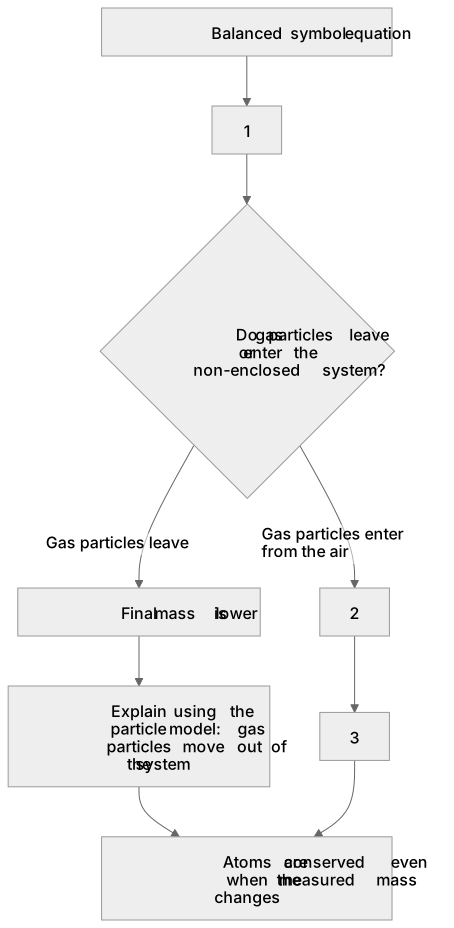
Some boxes have lost their names. Pick the right name for each number.
1Box 1
2Box 2
3Box 3
There is more to this lesson
The full lesson goes on to check your understanding and help you earn the marks. Create a free account to carry on, with your progress saved.
A week of Premium from your first lesson · Then the free plan continues · No card, no charge
Test your understanding of Mass changes when a reactant or product is a gas: Students should be able to explain any observed changes in mass in non-enclosed systems during a chemical reaction given the balanced symbol equation for the reaction and explain these changes in terms of the particle model.
Active recall beats re-reading. Take an instant quiz now to test what you’ve learned and lock it into long-term memory.
A week of Premium from your first lesson · Then the free plan continues · No card, no charge