AQA · GCSE · Chemistry
Course version: 8462 · Version from Sept 2018
Sodium hydroxide solution can be used to identify some metal ions (cations).
Full specification wording
Metal hydroxides: Sodium hydroxide solution can be used to identify some metal ions (cations).
Adding sodium hydroxide solution to a solution containing metal cations produces insoluble metal hydroxides, which appear as coloured precipitates.
Checked against the AQA 8462 specification (opens in a new tab) on .
- Point 1 of 5
Study notes
From the checked teaching notes for this specification point.
The idea
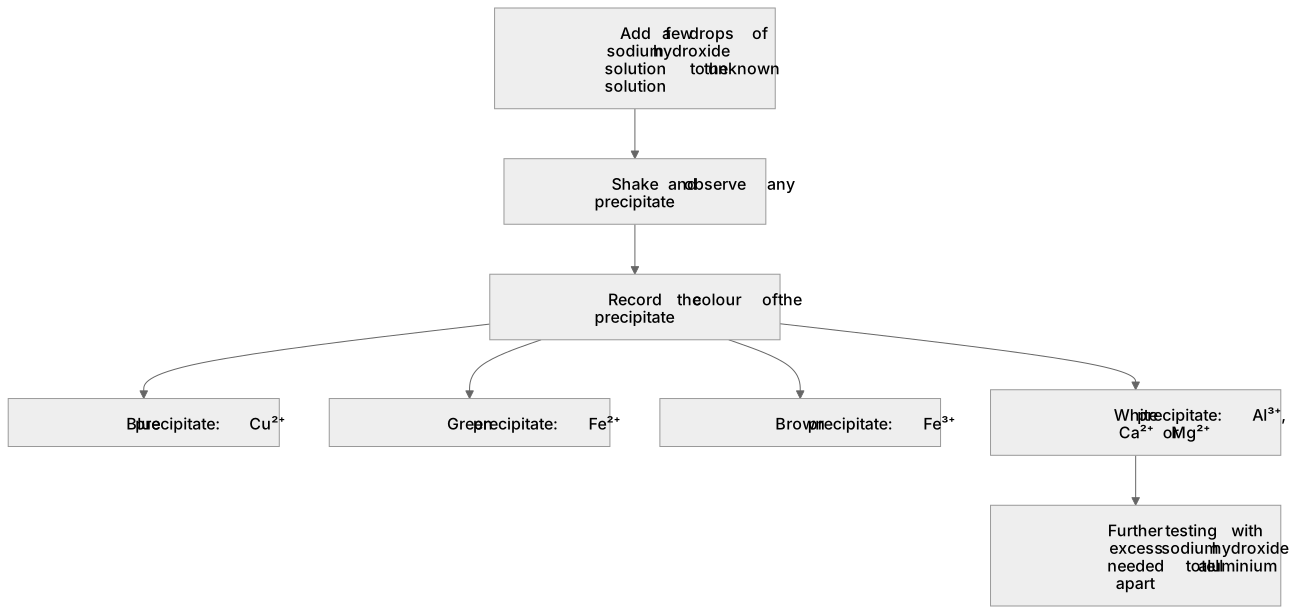
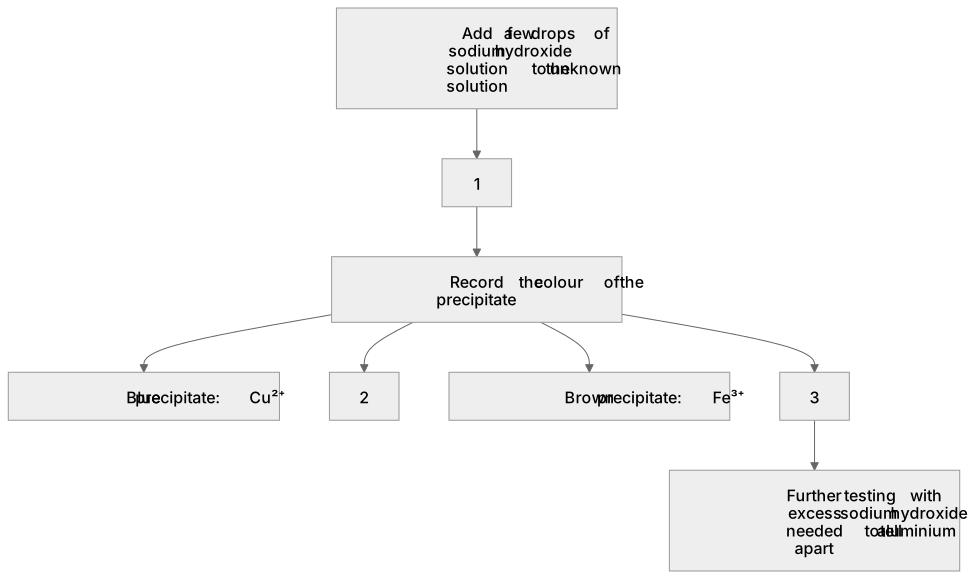
Adding sodium hydroxide solution to a solution containing metal cations produces insoluble metal hydroxides, which appear as coloured precipitates. The colour identifies the cation: for example, Cu²⁺ gives a blue precipitate, Fe²⁺ gives a green precipitate and Fe³⁺ gives a brown precipitate. For Al³⁺, Ca²⁺ and Mg²⁺ the precipitate is white, so further testing with excess sodium hydroxide is needed to tell aluminium apart. The method is to add a few drops of sodium hydroxide solution to the unknown solution, shake, and record the colour of any precipitate. This test identifies the cation, not the anion. The hydroxide ions combine with the metal cation to form the precipitate, while the sodium ions act as spectator ions and remain in solution.
What earns the marks
- Add sodium hydroxide solution to the unknown solution and observe any precipitate.
- Record the colour of the precipitate, such as blue for Cu²⁺, green for Fe²⁺ or brown for Fe³⁺.
- Identify the cation from the precipitate colour, using the specified ions.
- Recognise that a white precipitate indicates Al³⁺, Ca²⁺ or Mg²⁺ and needs excess sodium hydroxide for further distinction.
- State that the precipitate is a metal hydroxide formed from the metal cation and hydroxide ions, with sodium ions remaining in solution.
Common mistakes and how to put them right
Adding excess sodium hydroxide immediately and missing the initial precipitate colour.
Put it right by adding a few drops first and observing before adding more.
Confusing the green Fe²⁺ precipitate with the brown Fe³⁺ precipitate.
Put it right by learning the two colours as a pair.
Stating that sodium ions form the precipitate.
Put it right by stating that hydroxide ions react with the metal cation to form the insoluble hydroxide.
Exam tips
- Write the observation as colour plus precipitate, for example a blue precipitate, rather than colour alone.
- If the precipitate is white, say that further testing with excess sodium hydroxide is needed before naming the cation.
- Link each colour to the ion symbol with its charge, such as Cu²⁺ or Fe³⁺, to make the identification unambiguous.
Try the lesson
The start of the Metal hydroxides: Sodium hydroxide solution can be used to identify some metal ions (cations). lesson, made from checked teaching notes for this specification point.
Have a go first
Which reagent is added to a solution of a metal salt to produce a coloured precipitate that helps identify the metal ion present?
Listen
Adding sodium hydroxide solution to a solution containing metal cations produces insoluble metal hydroxides, which appear as coloured precipitates. The colour identifies the cation: for example, Cu²⁺ gives a blue precipitate, Fe²⁺ gives a green precipitate and Fe³⁺ gives a brown precipitate. For Al³⁺, Ca²⁺ and Mg²⁺ the precipitate is white, so further testing with excess sodium hydroxide is needed to tell aluminium apart. The method is to add a few drops of sodium hydroxide solution to the unknown solution, shake, and record the colour of any precipitate. This test identifies the cation, not the anion. The hydroxide ions combine with the metal cation to form the precipitate, while the sodium ions act as spectator ions and remain in solution. A strong answer earns marks for these points. Add sodium hydroxide solution to the unknown solution and observe any precipitate. Record the colour of the precipitate, such as blue for Cu²⁺, green for Fe²⁺ or brown for Fe³⁺. Identify the cation from the precipitate colour, using the specified ions. Recognise that a white precipitate indicates Al³⁺, Ca²⁺ or Mg²⁺ and needs excess sodium hydroxide for further distinction. A common slip: Adding excess sodium hydroxide immediately and missing the initial precipitate colour. Instead, adding a few drops first and observing before adding more. Exam tip: Write the observation as colour plus precipitate, for example a blue precipitate, rather than colour alone.
See it
Label the diagram
Some boxes have lost their names. Pick the right name for each number.
1Box 1
2Box 2
3Box 3
There is more to this lesson
The full lesson goes on to check your understanding and help you earn the marks. Create a free account to carry on, with your progress saved.
A week of Premium from your first lesson · Then the free plan continues · No card, no charge
Test your understanding of Metal hydroxides: Sodium hydroxide solution can be used to identify some metal ions (cations).
Active recall beats re-reading. Take an instant quiz now to test what you’ve learned and lock it into long-term memory.
A week of Premium from your first lesson · Then the free plan continues · No card, no charge