AQA · GCSE · Chemistry
Course version: 8462 · Version from Sept 2018
Solutions of aluminium, calcium and magnesium ions form white precipitates…
Full specification wording
Metal hydroxides: Solutions of aluminium, calcium and magnesium ions form white precipitates when sodium hydroxide solution is added but only the aluminium hydroxide precipitate dissolves in excess sodium hydroxide solution.
Al³⁺, Ca²⁺ and Mg²⁺ all give a white precipitate with sodium hydroxide solution, so the initial observation cannot distinguish them.
Checked against the AQA 8462 specification (opens in a new tab) on .
- Point 2 of 5
Study notes
From the checked teaching notes for this specification point.
The idea
Al³⁺, Ca²⁺ and Mg²⁺ all give a white precipitate with sodium hydroxide solution, so the initial observation cannot distinguish them. Adding excess sodium hydroxide solution resolves this: aluminium hydroxide dissolves to give a colourless solution, while calcium hydroxide and magnesium hydroxide remain as white precipitates. The method is to add sodium hydroxide solution dropwise, note the white precipitate, then continue adding excess and observe whether the precipitate disappears. If it dissolves, the cation is Al³⁺; if it remains, the cation is Ca²⁺ or Mg²⁺. This is a sequential test, and both observations should be reported.
What earns the marks
- State that Al³⁺, Ca²⁺ and Mg²⁺ each give a white precipitate with sodium hydroxide solution.
- Add excess sodium hydroxide solution after the initial precipitate forms.
- State that aluminium hydroxide dissolves in excess sodium hydroxide solution, giving a colourless solution.
- State that calcium hydroxide and magnesium hydroxide do not dissolve in excess sodium hydroxide solution.
- Use the excess-sodium-hydroxide result to distinguish Al³⁺ from Ca²⁺ and Mg²⁺.
Common mistakes and how to put them right
Stopping after the white precipitate and naming the ion.
Put it right by adding excess sodium hydroxide before deciding.
Saying the aluminium precipitate disappears because it is washed away.
Put it right by stating that it dissolves in excess sodium hydroxide solution.
Claiming calcium or magnesium hydroxide also dissolves in excess.
Put it right by stating that both remain as white precipitates.
Exam tips
- Record both observations: the white precipitate first, then whether it dissolves in excess.
- Use the phrase in excess sodium hydroxide solution to show the second stage has been carried out.
- If the precipitate remains, name the possible ions as Ca²⁺ or Mg²⁺ and state that a further test is needed to separate them.
Try the lesson
The start of the Metal hydroxides: Solutions of aluminium, calcium and magnesium ions form white precipitates when sodium hydroxide solution is added but only the aluminium hydroxide precipitate dissolves in excess sodium hydroxide solution. lesson, made from checked teaching notes for this specification point.
Have a go first
Sodium hydroxide solution is added to separate solutions of aluminium, calcium and magnesium ions. What colour precipitate forms in each case?
Listen
Al³⁺, Ca²⁺ and Mg²⁺ all give a white precipitate with sodium hydroxide solution, so the initial observation cannot distinguish them. Adding excess sodium hydroxide solution resolves this: aluminium hydroxide dissolves to give a colourless solution, while calcium hydroxide and magnesium hydroxide remain as white precipitates. The method is to add sodium hydroxide solution dropwise, note the white precipitate, then continue adding excess and observe whether the precipitate disappears. If it dissolves, the cation is Al³⁺; if it remains, the cation is Ca²⁺ or Mg²⁺. This is a sequential test, and both observations should be reported. A strong answer earns marks for these points. State that Al³⁺, Ca²⁺ and Mg²⁺ each give a white precipitate with sodium hydroxide solution. Add excess sodium hydroxide solution after the initial precipitate forms. State that aluminium hydroxide dissolves in excess sodium hydroxide solution, giving a colourless solution. State that calcium hydroxide and magnesium hydroxide do not dissolve in excess sodium hydroxide solution. A common slip: Stopping after the white precipitate and naming the ion. Instead, adding excess sodium hydroxide before deciding. Exam tip: Record both observations: the white precipitate first, then whether it dissolves in excess.
See it
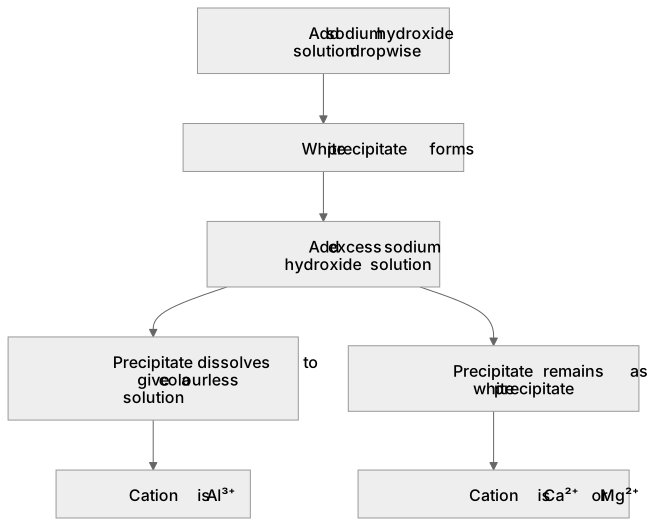
Label the diagram
Some boxes have lost their names. Pick the right name for each number.
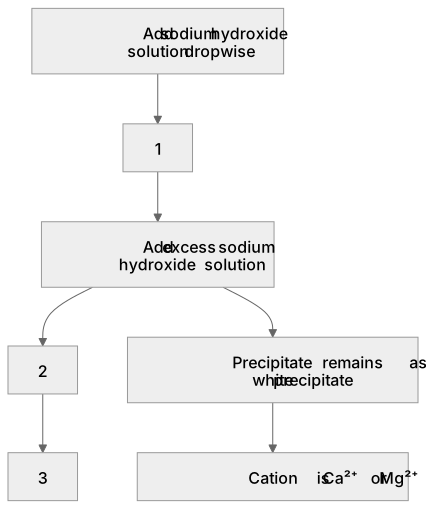
1Box 1
2Box 2
3Box 3
There is more to this lesson
The full lesson goes on to check your understanding and help you earn the marks. Create a free account to carry on, with your progress saved.
A week of Premium from your first lesson · Then the free plan continues · No card, no charge
Test your understanding of Metal hydroxides: Solutions of aluminium, calcium and magnesium ions form white precipitates when sodium hydroxide solution is added but only the aluminium hydroxide precipitate dissolves in excess sodium hydroxide solution.
Active recall beats re-reading. Take an instant quiz now to test what you’ve learned and lock it into long-term memory.
A week of Premium from your first lesson · Then the free plan continues · No card, no charge