AQA · GCSE · Chemistry
Course version: 8462 · Version from Sept 2018
Students should be able to write balanced equations for the reactions to…
Full specification wording
Metal hydroxides: Students should be able to write balanced equations for the reactions to produce the insoluble hydroxides.
A balanced equation shows the reactants and products in the correct ratios and with the same number of each type of atom on both sides.
Checked against the AQA 8462 specification (opens in a new tab) on .
- Point 5 of 5
Study notes
From the checked teaching notes for this specification point.
The idea
A balanced equation shows the reactants and products in the correct ratios and with the same number of each type of atom on both sides. For the precipitation reactions, the metal ion and hydroxide ion combine to form the insoluble metal hydroxide. For example, copper(II) sulfate solution reacts with sodium hydroxide solution to form copper(II) hydroxide precipitate and sodium sulfate solution: CuSO₄(aq) + 2NaOH(aq) → Cu(OH)₂(s) + Na₂SO₄(aq). The state symbols show that the hydroxide is a solid precipitate while the other compounds remain aqueous. Similar equations can be written for iron(II) and iron(III) hydroxides, taking care to balance the number of hydroxide ions against the charge on the metal ion.
What earns the marks
- Write the correct formulae for the reactants, including the metal compound and sodium hydroxide.
- Write the correct formula for the insoluble metal hydroxide product, using the metal ion charge to determine the number of hydroxide ions.
- Balance the equation so that the number of each type of atom is the same on both sides.
- Include state symbols where required, showing the metal hydroxide as a solid and the soluble reactants and by-product as aqueous.
- Check that the charges balance, for example Fe³⁺ requires three OH⁻ ions to form Fe(OH)₃.
Common mistakes and how to put them right
Using the wrong number of hydroxide ions for the metal charge.
Put it right: For example, iron(III) needs three hydroxide ions, so the formula is Fe(OH)₃, not FeOH or Fe(OH)₂.
Forgetting to balance the sodium and sulfate ions as well as the metal and hydroxide ions.
Put it right: The full equation must balance all atoms.
Omitting state symbols or using the wrong state for the precipitate.
Put it right: The insoluble hydroxide should be shown as a solid.
Exam tips
- Work out the formula of the hydroxide first from the metal ion charge, then balance the rest of the equation around it.
- Check each element in turn after balancing, including polyatomic ions such as sulfate, which can be counted as groups.
- Include state symbols if the question asks for them, and make sure the precipitate is marked as solid.
Try the lesson
The start of the Metal hydroxides: Students should be able to write balanced equations for the reactions to produce the insoluble hydroxides. lesson, made from checked teaching notes for this specification point.
Have a go first
Copper(II) sulfate solution reacts with sodium hydroxide solution to form a precipitate of copper(II) hydroxide and sodium sulfate solution. Which balanced equation represents this reaction?
Listen
A balanced equation shows the reactants and products in the correct ratios and with the same number of each type of atom on both sides. For the precipitation reactions, the metal ion and hydroxide ion combine to form the insoluble metal hydroxide. For example, copper(II) sulfate solution reacts with sodium hydroxide solution to form copper(II) hydroxide precipitate and sodium sulfate solution: CuSO₄(aq) + 2NaOH(aq) → Cu(OH)₂(s) + Na₂SO₄(aq). The state symbols show that the hydroxide is a solid precipitate while the other compounds remain aqueous. Similar equations can be written for iron(II) and iron(III) hydroxides, taking care to balance the number of hydroxide ions against the charge on the metal ion. A strong answer earns marks for these points. Write the correct formulae for the reactants, including the metal compound and sodium hydroxide. Write the correct formula for the insoluble metal hydroxide product, using the metal ion charge to determine the number of hydroxide ions. Balance the equation so that the number of each type of atom is the same on both sides. Include state symbols where required, showing the metal hydroxide as a solid and the soluble reactants and by-product as aqueous. Exam tip: Work out the formula of the hydroxide first from the metal ion charge, then balance the rest of the equation around it.
See it
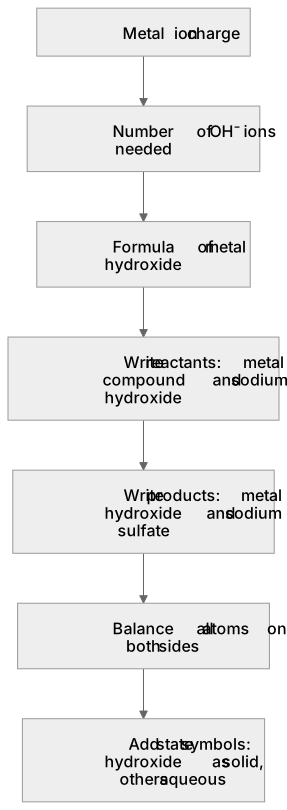
Put it in order
Put these steps in the order they happen.
- 1. Add state symbols: hydroxide as solid, others aqueous
- 2. Balance all atoms on both sides
- 3. Formula of metal hydroxide
- 4. Write products: metal hydroxide and sodium sulfate
- 5. Metal ion charge
- 6. Number of OH⁻ ions needed
- 7. Write reactants: metal compound and sodium hydroxide
Label the diagram
Some boxes have lost their names. Pick the right name for each number.
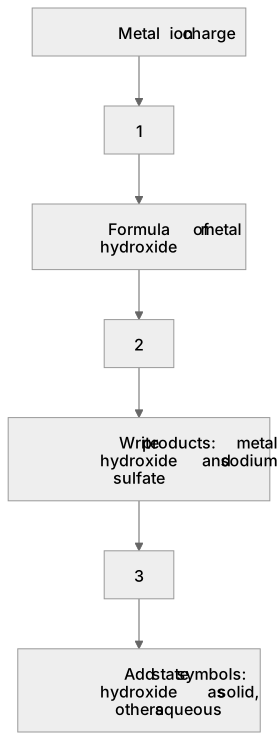
1Box 1
2Box 2
3Box 3
There is more to this lesson
The full lesson goes on to check your understanding and help you earn the marks. Create a free account to carry on, with your progress saved.
A week of Premium from your first lesson · Then the free plan continues · No card, no charge
Test your understanding of Metal hydroxides: Students should be able to write balanced equations for the reactions to produce the insoluble hydroxides.
Active recall beats re-reading. Take an instant quiz now to test what you’ve learned and lock it into long-term memory.
A week of Premium from your first lesson · Then the free plan continues · No card, no charge