AQA · GCSE · Chemistry
Course version: 8462 · Version from Sept 2018
Copper(II) forms a blue precipitate, iron(II) a green precipitate and…
Full specification wording
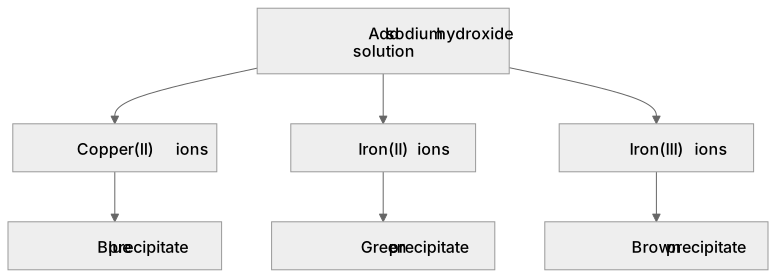
Metal hydroxides: Copper(II) forms a blue precipitate, iron(II) a green precipitate and iron(III) a brown precipitate.
This statement gives the specific colour observed for each transition metal hydroxide precipitate.
Checked against the AQA 8462 specification (opens in a new tab) on .
- Point 4 of 5
- 4 key terms
Study notes
From the checked teaching notes for this specification point.
The idea
This statement gives the specific colour observed for each transition metal hydroxide precipitate. When sodium hydroxide solution is added to a solution containing copper(II) ions, a blue precipitate of copper(II) hydroxide forms. With iron(II) ions, the precipitate of iron(II) hydroxide is green. With iron(III) ions, the precipitate of iron(III) hydroxide is brown. These colours are distinctive and allow the ions to be identified in a simple test. For example, a green precipitate shows that the original solution contained iron(II) ions, not iron(III) ions, because the two oxidation states give different colours. The colour is an observation of the solid formed, not of the solution before reaction.
What earns the marks
- Copper(II) ions produce a blue precipitate with sodium hydroxide solution.
- Iron(II) ions produce a green precipitate with sodium hydroxide solution.
- Iron(III) ions produce a brown precipitate with sodium hydroxide solution.
- The colour identifies the metal ion and distinguishes between iron(II) and iron(III).
- The precipitate is the insoluble metal hydroxide, such as Cu(OH)₂, Fe(OH)₂ or Fe(OH)₃.
Common mistakes and how to put them right
Swapping the colours of iron(II) and iron(III).
Put it right: The correct pairing is iron(II) green and iron(III) brown.
Calling the copper precipitate green or the iron precipitate blue.
Put it right: Copper(II) hydroxide is blue and should not be confused with iron colours.
Forgetting that the colour is seen in the precipitate, not in the original solution.
Put it right: The observation should describe the solid formed after adding sodium hydroxide.
Exam tips
- Learn the three colour–ion pairs as a table: copper(II) blue, iron(II) green, iron(III) brown.
- In an identification question, give both the reagent and the colour, for example sodium hydroxide solution gives a green precipitate.
- Use the oxidation state in the ion name so the examiner can see which iron ion is meant.
Try the lesson
The start of the Metal hydroxides: Copper(II) forms a blue precipitate, iron(II) a green precipitate and iron(III) a brown precipitate. lesson, made from checked teaching notes for this specification point.
Have a go first
What colour precipitate does copper(II) form when sodium hydroxide solution is added?
Listen
This statement gives the specific colour observed for each transition metal hydroxide precipitate. When sodium hydroxide solution is added to a solution containing copper(II) ions, a blue precipitate of copper(II) hydroxide forms. With iron(II) ions, the precipitate of iron(II) hydroxide is green. With iron(III) ions, the precipitate of iron(III) hydroxide is brown. These colours are distinctive and allow the ions to be identified in a simple test. For example, a green precipitate shows that the original solution contained iron(II) ions, not iron(III) ions, because the two oxidation states give different colours. The colour is an observation of the solid formed, not of the solution before reaction. A strong answer earns marks for these points. Copper(II) ions produce a blue precipitate with sodium hydroxide solution. Iron(II) ions produce a green precipitate with sodium hydroxide solution. Iron(III) ions produce a brown precipitate with sodium hydroxide solution. The colour identifies the metal ion and distinguishes between iron(II) and iron(III). Exam tip: Learn the three colour–ion pairs as a table: copper(II) blue, iron(II) green, iron(III) brown.
See it
Key words
Say what each word means before you turn the card.
Characteristic colours of metal hydroxides
Try answering aloud or in your head before turning the card.
Identifying transition metal ions
Try answering aloud or in your head before turning the card.
Oxidation states of iron
Try answering aloud or in your head before turning the card.
Precipitation tests
Try answering aloud or in your head before turning the card.
See every definition
- Characteristic colours of metal hydroxides
- Copper(II) forms a blue precipitate, iron(II) a green precipitate and iron(III) a brown precipitate.
- Identifying transition metal ions
- These colours are distinctive and allow the ions to be identified in a simple test.
- Oxidation states of iron
- Iron(II) and iron(III) give different colours, so a green precipitate shows the original solution contained iron(II) ions, not iron(III) ions.
- Precipitation tests
- The colour is an observation of the solid formed when sodium hydroxide solution is added, not of the solution before reaction.
Label the diagram
Some boxes have lost their names. Pick the right name for each number.
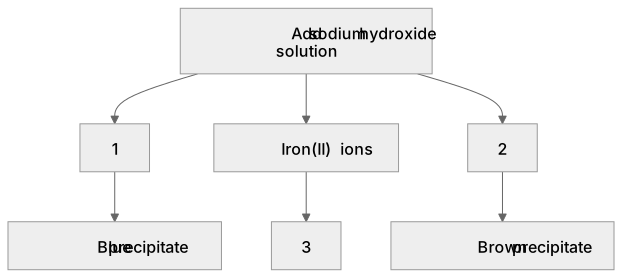
1Box 1
2Box 2
3Box 3
There is more to this lesson
The full lesson goes on to check your understanding and help you earn the marks. Create a free account to carry on, with your progress saved.
A week of Premium from your first lesson · Then the free plan continues · No card, no charge
Test your understanding of Metal hydroxides: Copper(II) forms a blue precipitate, iron(II) a green precipitate and iron(III) a brown precipitate.
Active recall beats re-reading. Take an instant quiz now to test what you’ve learned and lock it into long-term memory.
A week of Premium from your first lesson · Then the free plan continues · No card, no charge