AQA · GCSE · Chemistry
Course version: 8462 · Version from Sept 2018
Metals and non-metals: Elements that react to form positive ions are metals.
Metals are elements that lose electrons when they react, forming positive ions.
Checked against the AQA 8462 specification (opens in a new tab) on .
- Point 1 of 6
Study notes
From the checked teaching notes for this specification point.
The idea
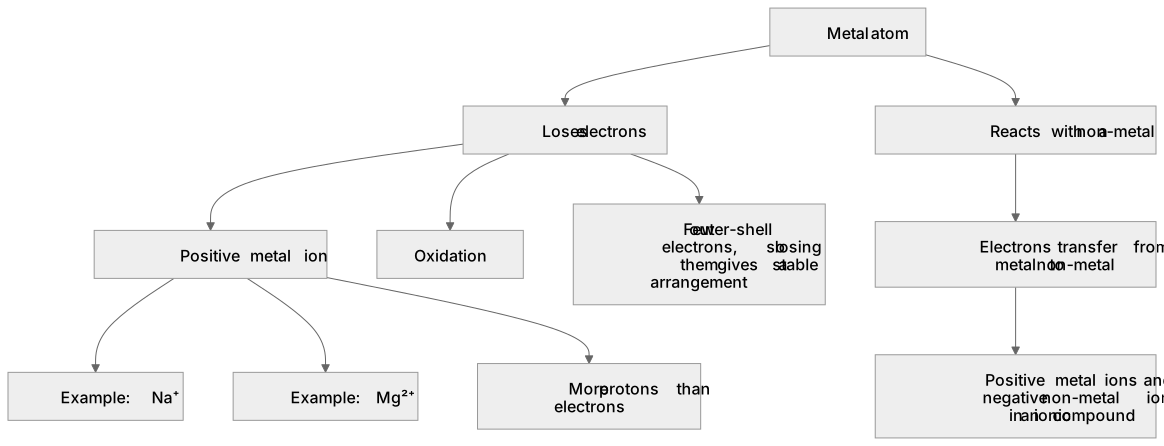
Metals are elements that lose electrons when they react, forming positive ions. For example, sodium loses one electron to form Na⁺, and magnesium loses two electrons to form Mg²⁺. This loss of electrons is oxidation, and it happens because metals have relatively few electrons in their outer shell, so losing them gives a stable electron arrangement. The resulting positive ion has more protons than electrons. This behaviour links to other metal properties such as conduction and malleability, but the defining test in this section is the formation of positive ions during reaction. When a metal reacts with a non-metal, electrons transfer from metal to non-metal, producing positive metal ions and negative non-metal ions in an ionic compound.
What earns the marks
- State that metals form positive ions when they react.
- Give an example such as Na⁺ or Mg²⁺ with the correct charge.
- Explain that metal atoms lose electrons to form positive ions.
- Link electron loss to the outer-shell electron arrangement of metals.
- Describe electron transfer to a non-metal in a reaction such as sodium with chlorine.
Common mistakes and how to put them right
Writing ion charges without superscript signs.
Put it right by using forms such as Na⁺ and Mg²⁺.
Saying metals gain electrons to form ions.
Put it right by stating metals lose electrons and become positive.
Confusing the number of electrons lost with the group number for every element.
Put it right by checking the outer-shell electron count.
Exam tips
- Always include the charge when naming a metal ion, for example Mg²⁺.
- Use the phrase lose electrons to form positive ions to answer the statement directly.
- Support the point with one balanced example of a metal reacting with a non-metal.
Try the lesson
The start of the Metals and non-metals: Elements that react to form positive ions are metals. lesson, made from checked teaching notes for this specification point.
Have a go first
Which type of ion is formed by a metal when it reacts?
Listen
Metals are elements that lose electrons when they react, forming positive ions. For example, sodium loses one electron to form Na⁺, and magnesium loses two electrons to form Mg²⁺. This loss of electrons is oxidation, and it happens because metals have relatively few electrons in their outer shell, so losing them gives a stable electron arrangement. The resulting positive ion has more protons than electrons. This behaviour links to other metal properties such as conduction and malleability, but the defining test in this section is the formation of positive ions during reaction. When a metal reacts with a non-metal, electrons transfer from metal to non-metal, producing positive metal ions and negative non-metal ions in an ionic compound. A strong answer earns marks for these points. State that metals form positive ions when they react. Give an example such as Na⁺ or Mg²⁺ with the correct charge. Explain that metal atoms lose electrons to form positive ions. Link electron loss to the outer-shell electron arrangement of metals. A common slip: Writing ion charges without superscript signs. Instead, using forms such as Na⁺ and Mg²⁺. Exam tip: Always include the charge when naming a metal ion, for example Mg²⁺.
See it
Label the diagram
Some boxes have lost their names. Pick the right name for each number.
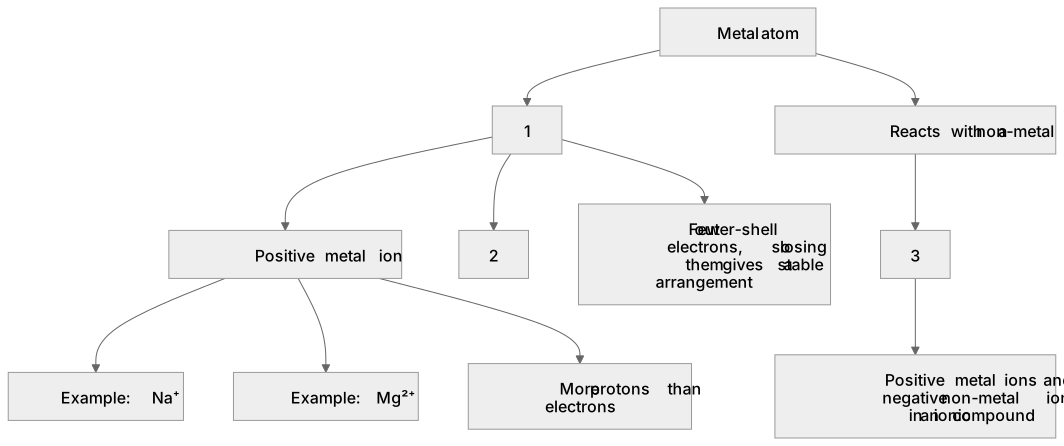
1Box 1
2Box 2
3Box 3
There is more to this lesson
The full lesson goes on to check your understanding and help you earn the marks. Create a free account to carry on, with your progress saved.
A week of Premium from your first lesson · Then the free plan continues · No card, no charge
Test your understanding of Metals and non-metals: Elements that react to form positive ions are metals.
Active recall beats re-reading. Take an instant quiz now to test what you’ve learned and lock it into long-term memory.
A week of Premium from your first lesson · Then the free plan continues · No card, no charge