Metals and non-metals — AQA GCSE Chemistry
Verified courseTeaching note checked against the official specification.
Metals and non-metals explained
Metals and non-metals covers 6 specification points, including Elements that react to form positive ions are… and Elements that do not form positive ions are….
Read the full explanation
Open a point below for its explanation and revision guidance.
Elements that react to form positive ions are metals.
Metals are elements that lose electrons when they react, forming positive ions. For example, sodium loses one electron to form Na⁺, and magnesium loses two electrons to form Mg²⁺. This loss of electrons is oxidation, and it happens because metals have relatively few electrons in their outer shell, so losing them gives a stable electron arrangement. The resulting positive ion has more protons than electrons. This behaviour links to other metal properties such as conduction and malleability, but the defining test in this section is the formation of positive ions during reaction. When a metal reacts with a non-metal, electrons transfer from metal to non-metal, producing positive metal ions and negative non-metal ions in an ionic compound.
Elements that do not form positive ions are non-metals.
Non-metals are elements that do not form positive ions. Instead, when they react they gain electrons to form negative ions, or they share electrons in covalent bonds. For example, chlorine gains one electron to form Cl⁻, and oxygen gains two electrons to form O²⁻. This happens because non-metals have relatively full outer shells, so gaining electrons is energetically favourable and gives a stable arrangement. The resulting negative ion has more electrons than protons. In reactions with metals, non-metals accept the electrons that metals lose, forming ionic compounds. Some non-metals, such as carbon and hydrogen, mainly form covalent bonds rather than ions, but they still do not form positive ions in these reactions.
The majority of elements are metals.
The periodic table contains over one hundred elements, and most of them are metals. Metals occupy the large block on the left, centre and lower part of the table, including Groups 1, 2 and the transition metals, while non-metals form a much smaller region towards the top right. This matters because the physical and chemical behaviour you meet in later topics, such as conduction, malleability, reaction with acids and formation of positive ions, applies to the majority of elements. For example, iron, copper, sodium and calcium are all metals, whereas oxygen, chlorine and sulfur are non-metals. Recognising that metals dominate the table helps you predict properties and interpret trends rather than learning each element separately.
Metals are found to the left and towards the bottom of the periodic table.
Metals occupy the left-hand side and the lower portion of the periodic table. Group 1 metals such as lithium, sodium and potassium sit on the far left, Group 2 metals such as magnesium and calcium sit next to them, and the large central block contains the transition metals such as iron, copper and zinc. Moving down a group, metallic character becomes more pronounced, so elements lower in a group behave more typically as metals. This positional pattern lets you predict properties: an element on the left or low down is likely to conduct electricity, be malleable and form positive ions. For example, sodium in Group 1 and iron in the transition block are both clearly metallic, whereas elements towards the top right are not.
Non-metals are found towards the right and top of the periodic table.
Non-metals occupy the upper right region of the periodic table. Group 0 noble gases such as helium, neon and argon sit on the far right, Group 7 halogens such as fluorine, chlorine and bromine sit just to their left, and Group 6 includes oxygen and sulfur. Elements towards the top right generally lack metallic properties: they are poor conductors of electricity, often brittle as solids, and tend to form negative ions or share electrons in covalent bonds. Hydrogen is a non-metal even though it appears at the top left, which is a useful exception to remember. Position therefore allows prediction: an element high and to the right is likely to be a non-metal with low conductivity and a tendency to gain or share electrons.
Students should be able to: explain the differences between metals and non-metals on the basis of their characteristic physical and chemical properties. This links to Group 0 (page 24), Group 1 (page 24), Group 7 (page 25) and Bonding, structure and the properties of matter (page 26) explain how the atomic structure of metals and non-metals relates to their position in the periodic table explain how the reactions of elements are related to the arrangement of electrons in their atoms and hence to their atomic number.
This outcome asks you to connect three ideas. First, metals and non-metals differ in physical properties such as conductivity, malleability and melting point, and in chemical behaviour such as forming positive or negative ions. Second, an element's position in the periodic table reflects its atomic structure, because elements are arranged in order of atomic number, so proton number determines the number of electrons and therefore the group and period. Third, chemical reactions depend on the arrangement of electrons, especially the outer shell: Group 1 metals lose one electron readily, Group 7 non-metals gain one electron, and Group 0 elements have full outer shells and are unreactive. For example, sodium (2,8,1) reacts vigorously because it can lose its single outer electron, while chlorine (2,8,7) gains one electron to form a 1⁻ ion.
Watch and listen
Listen: Metals and non-metals audio lesson
Read the full guide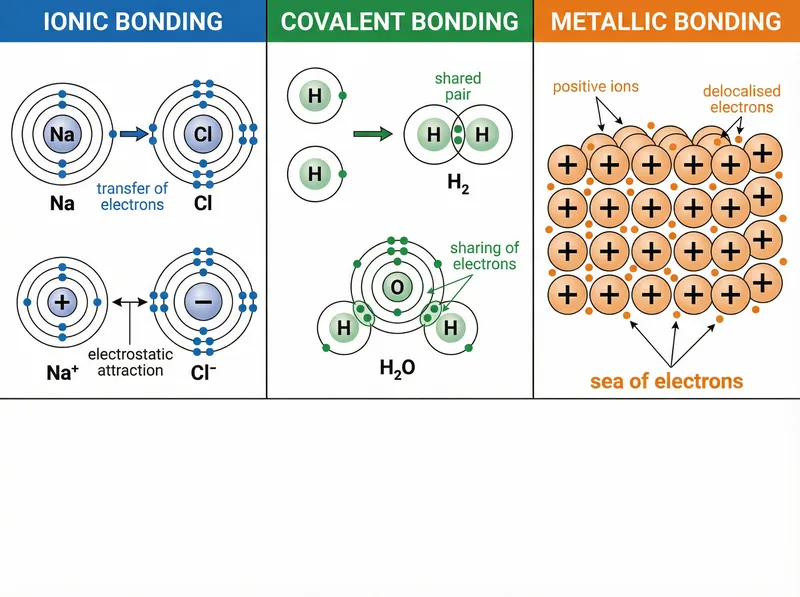
Interactive Diagrams
1 interactive diagram to visualise key concepts
Conceptual Flow Outline
Decision tree for identifying bonding and structure types from a chemical formula.
Your focus
- Identify metals as elements that form positive ions.
- Write correct symbols and charges for common metal ions.
- Explain electron loss in terms of outer-shell electrons.
Show all 18 objectives
- Identify non-metals as elements that do not form positive ions.
- Write correct symbols and charges for common non-metal ions.
- Explain electron gain or sharing in terms of outer-shell electrons.
- State that most elements are metals.
- Classify named elements as metals or non-metals using the periodic table.
- Relate the metal majority to typical metallic properties such as conduction and malleability.
- Identify the region of the periodic table occupied by metals.
- Describe how metallic character changes down a group.
- Predict metallic properties from an element's position on the left or lower part of the table.
- Identify the region of the periodic table occupied by non-metals.
- Describe typical physical properties of non-metals.
- Predict non-metal behaviour from an element's position towards the top right.
- Explain differences between metals and non-metals using physical and chemical properties.
- Explain how atomic structure determines an element's position in the periodic table.
- Explain how outer-shell electron arrangement and atomic number relate to the reactions of elements.
Metals and non-metals exam tips
Marking Points
- State that metals form positive ions when they react.
- Give an example such as Na⁺ or Mg²⁺ with the correct charge.
- Explain that metal atoms lose electrons to form positive ions.
- Link electron loss to the outer-shell electron arrangement of metals.
- Describe electron transfer to a non-metal in a reaction such as sodium with chlorine.
- State that non-metals do not form positive ions.
- Give an example such as Cl⁻ or O²⁻ with the correct charge.
- Explain that non-metal atoms gain electrons to form negative ions.
- Link electron gain to the outer-shell electron arrangement of non-metals.
- Describe electron transfer from a metal to a non-metal in a reaction such as sodium with chlorine.
- States that most elements in the periodic table are metals, with non-metals forming a minority.
- Identifies common metals such as sodium, magnesium, iron, copper and zinc from their position or name.
- Links the metal majority to characteristic properties such as electrical conductivity, malleability and shiny appearance.
- Uses the periodic table to distinguish a metal from a non-metal by location rather than by memorising every element.
- Applies the idea that metals generally form positive ions when they react.
- Locates metals on the left-hand side of the periodic table, including Groups 1 and 2.
- Recognises the central transition metal block as metallic.
- Notes that metallic character increases towards the bottom of a group.
- Uses position to predict metallic properties such as conduction and positive ion formation.
- Contrasts the metal region with the non-metal region at the top right.
- Locates non-metals towards the top right of the periodic table, including Groups 0, 7 and much of Group 6.
- Links non-metal position to properties such as poor electrical conductivity and brittleness.
- Recognises that non-metals typically form negative ions or share electrons in covalent bonds.
- Identifies hydrogen as a non-metal despite its top-left position.
- Uses position to predict whether an unfamiliar element is likely to be a non-metal.
- Compares metals and non-metals using physical properties such as electrical conductivity, malleability and melting point.
- Compares chemical behaviour, including the formation of positive ions by metals and negative ions by non-metals.
- Explains that elements are arranged in order of atomic number, which determines electron arrangement and position.
- Links group number to the number of outer-shell electrons and therefore to reactivity.
- Uses examples such as sodium in Group 1, chlorine in Group 7 and neon in Group 0 to illustrate electron-related reactivity.
- Connects metallic and non-metallic character to position on the left or top right of the periodic table.
Examiner Tips
- 💡Always include the charge when naming a metal ion, for example Mg²⁺.
- 💡Use the phrase lose electrons to form positive ions to answer the statement directly.
- 💡Support the point with one balanced example of a metal reacting with a non-metal.
- 💡Use the phrase do not form positive ions to match the statement directly.
- 💡Give one ionic example and one covalent example to show the range of non-metal behaviour.
- 💡Check the charge sign and number when writing ions such as O²⁻.
- 💡When asked to classify an element, quote its position in the periodic table as evidence rather than relying on appearance alone.
- 💡Use the phrase 'the majority of elements are metals' precisely, because 'many' or 'some' weakens a classification answer.
- 💡If a question gives an unfamiliar element, decide metal or non-metal from its position before predicting its properties.
- 💡Sketch a simple dividing line from the top of Group 13 down to the bottom of Group 16 to separate metals from non-metals.
- 💡When predicting properties, state both the horizontal and vertical position, for example 'left of the table and low in the group'.
- 💡Use named examples such as sodium, magnesium and iron to support a position-based answer.
- 💡Remember the phrase 'top right for non-metals' and use it to justify classification answers.
- 💡Quote a named non-metal from the correct region, such as chlorine in Group 7 or neon in Group 0.
- 💡If an element is described as a poor conductor and brittle, link that description back to its top-right position.
- 💡Structure comparison answers around physical properties first, then chemical behaviour, using named examples.
- 💡When explaining trends, always refer to outer-shell electrons and atomic number rather than to size or mass alone.
- 💡Use electron configurations such as 2,8,1 for sodium and 2,8,7 for chlorine to make reactivity reasoning explicit.
- 💡Link each explanation back to the relevant group, such as Group 1, Group 7 or Group 0, to show the connection the specification requires.
Common Mistakes
- Writing ion charges without superscript signs; correct this by using forms such as Na⁺ and Mg²⁺.
- Saying metals gain electrons to form ions; correct this by stating metals lose electrons and become positive.
- Confusing the number of electrons lost with the group number for every element; correct this by checking the outer-shell electron count.
- Writing ion charges without superscript signs; correct this by using forms such as Cl⁻ and O²⁻.
- Saying all non-metals form negative ions; correct this by noting that some share electrons in covalent bonds.
- Confusing non-metal ions with metal ions; correct this by checking whether the element is on the right of the periodic table.
- Assuming that about half of all elements are metals; the correct idea is that the large majority are metals.
- Treating hydrogen as a metal because it sits at the top left; hydrogen is a non-metal despite its position.
- Believing that all metals are magnetic or all metals are hard; only some metals are magnetic and hardness varies widely.
- Placing all metals only in Groups 1 and 2 and forgetting the large transition metal block in the centre.
- Thinking that position alone guarantees metallic behaviour at every point; hydrogen is an exception at the top left.
- Assuming metals are only found at the very bottom of the table rather than across the left and centre.
- Placing all non-metals strictly in Group 0 and ignoring Groups 6 and 7.
- Classifying hydrogen as a metal because of its position at the top left; hydrogen is a non-metal.
- Assuming every element on the right is a gas; bromine is a liquid and carbon and sulfur are solids.
- Describing metals as 'good conductors' without contrasting them with non-metals, which are generally poor conductors.
- Confusing atomic number with mass number when explaining periodic table order; position depends on atomic number.
- Saying Group 0 elements react vigorously because they have full outer shells; full outer shells make them unreactive.
- Treating reactivity as random rather than linking it to the number and arrangement of outer-shell electrons.