AQA · GCSE · Chemistry
Course version: 8462 · Version from Sept 2018
Metals are found to the left and towards the bottom of the periodic table.
Full specification wording
Metals and non-metals: Metals are found to the left and towards the bottom of the periodic table.
Metals occupy the left-hand side and the lower portion of the periodic table.
Checked against the AQA 8462 specification (opens in a new tab) on .
- Point 4 of 6
- 4 key terms
Study notes
From the checked teaching notes for this specification point.
The idea
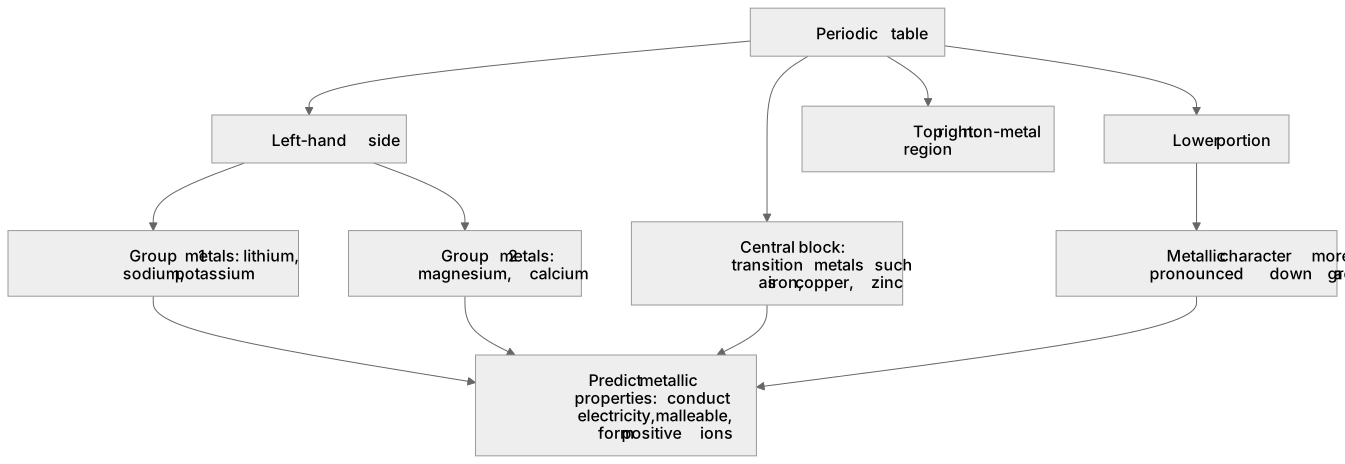
Metals occupy the left-hand side and the lower portion of the periodic table. Group 1 metals such as lithium, sodium and potassium sit on the far left, Group 2 metals such as magnesium and calcium sit next to them, and the large central block contains the transition metals such as iron, copper and zinc. Moving down a group, metallic character becomes more pronounced, so elements lower in a group behave more typically as metals. This positional pattern lets you predict properties: an element on the left or low down is likely to conduct electricity, be malleable and form positive ions.
For example: Sodium in Group 1 and iron in the transition block are both clearly metallic, whereas elements towards the top right are not.
What earns the marks
- Locates metals on the left-hand side of the periodic table, including Groups 1 and 2.
- Recognises the central transition metal block as metallic.
- Notes that metallic character increases towards the bottom of a group.
- Uses position to predict metallic properties such as conduction and positive ion formation.
- Contrasts the metal region with the non-metal region at the top right.
Common mistakes and how to put them right
Placing all metals only in Groups 1 and 2 and forgetting the large transition metal block in the centre.
Thinking that position alone guarantees metallic behaviour at every point.
Put it right: Hydrogen is an exception at the top left.
Assuming metals are only found at the very bottom of the table rather than across the left and centre.
Exam tips
- Sketch a simple dividing line from the top of Group 13 down to the bottom of Group 16 to separate metals from non-metals.
- When predicting properties, state both the horizontal and vertical position, for example 'left of the table and low in the group'.
- Use named examples such as sodium, magnesium and iron to support a position-based answer.
Try the lesson
The start of the Metals and non-metals: Metals are found to the left and towards the bottom of the periodic table. lesson, made from checked teaching notes for this specification point.
Have a go first
Where in the periodic table are metals mainly found?
Listen
Metals occupy the left-hand side and the lower portion of the periodic table. Group 1 metals such as lithium, sodium and potassium sit on the far left, Group 2 metals such as magnesium and calcium sit next to them, and the large central block contains the transition metals such as iron, copper and zinc. Moving down a group, metallic character becomes more pronounced, so elements lower in a group behave more typically as metals. This positional pattern lets you predict properties: an element on the left or low down is likely to conduct electricity, be malleable and form positive ions. For example, sodium in Group 1 and iron in the transition block are both clearly metallic, whereas elements towards the top right are not. A strong answer earns marks for these points. Locates metals on the left-hand side of the periodic table, including Groups 1 and 2. Recognises the central transition metal block as metallic. Notes that metallic character increases towards the bottom of a group. Uses position to predict metallic properties such as conduction and positive ion formation. Exam tip: Sketch a simple dividing line from the top of Group 13 down to the bottom of Group 16 to separate metals from non-metals.
See it
Key words
Say what each word means before you turn the card.
Periodic table layout
Try answering aloud or in your head before turning the card.
Group 1 and Group 2 metals
Try answering aloud or in your head before turning the card.
Transition metals
Try answering aloud or in your head before turning the card.
Trends in metallic character
Try answering aloud or in your head before turning the card.
See every definition
- Periodic table layout
- Metals are found to the left and towards the bottom of the periodic table, while elements towards the top right are not metallic.
- Group 1 and Group 2 metals
- Group 1 metals such as lithium, sodium and potassium sit on the far left, and Group 2 metals such as magnesium and calcium sit next to them.
- Transition metals
- The large central block of the periodic table contains the transition metals such as iron, copper and zinc.
- Trends in metallic character
- Moving down a group, metallic character becomes more pronounced, so elements lower in a group behave more typically as metals.
Label the diagram
Some boxes have lost their names. Pick the right name for each number.
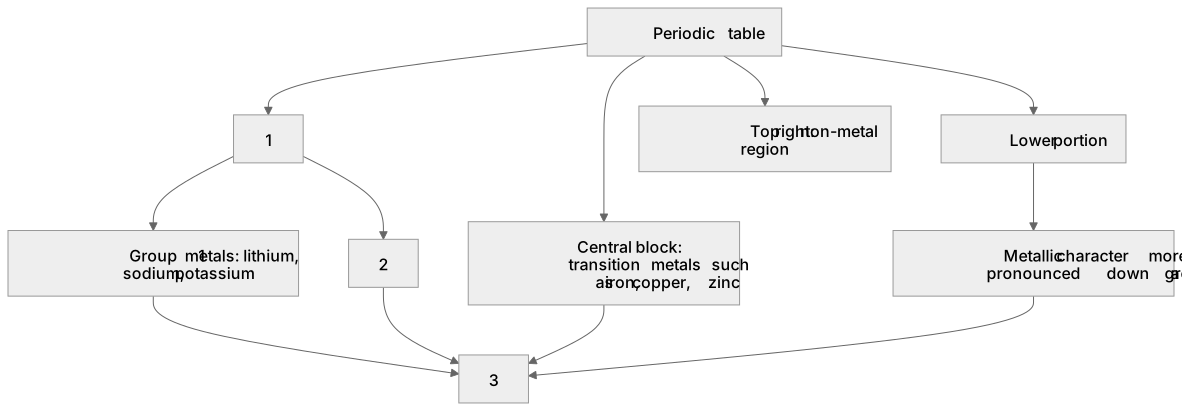
1Box 1
2Box 2
3Box 3
There is more to this lesson
The full lesson goes on to check your understanding and help you earn the marks. Create a free account to carry on, with your progress saved.
A week of Premium from your first lesson · Then the free plan continues · No card, no charge
Test your understanding of Metals and non-metals: Metals are found to the left and towards the bottom of the periodic table.
Active recall beats re-reading. Take an instant quiz now to test what you’ve learned and lock it into long-term memory.
A week of Premium from your first lesson · Then the free plan continues · No card, no charge