AQA · GCSE · Chemistry
Course version: 8462 · Version from Sept 2018
Mixtures can be separated by physical processes such as filtration,…
Full specification wording
Mixtures: Mixtures can be separated by physical processes such as filtration, crystallisation, simple distillation, fractional distillation and chromatography.
A mixture contains two or more substances not chemically joined, so it can be separated by physical processes that use differences in properties.
Checked against the AQA 8462 specification (opens in a new tab) on .
- Point 3 of 5
- 4 key terms
Study notes
From the checked teaching notes for this specification point.
The idea
A mixture contains two or more substances not chemically joined, so it can be separated by physical processes that use differences in properties. Filtration separates an insoluble solid from a liquid using filter paper and a funnel. Crystallisation recovers a dissolved solid by evaporating some solvent then leaving crystals to form. Simple distillation separates a solvent from a solution by evaporating and condensing it. Fractional distillation separates miscible liquids with different boiling points, for example ethanol and water, using a fractionating column. Chromatography separates dissolved substances by how far they travel up a stationary phase in a solvent.
What earns the marks
- Filtration separates an insoluble solid from a liquid because the solid particles are too large to pass through the filter paper pores.
- Crystallisation recovers a dissolved solid by gently evaporating some solvent to reach a saturated solution, then cooling or leaving it so crystals form.
- Simple distillation separates a solvent from a solution by heating to evaporate the solvent, then condensing the vapour back to a liquid.
- Fractional distillation separates miscible liquids with different boiling points, using a fractionating column so the liquid with the lower boiling point distils first.
- Chromatography separates dissolved substances because they have different solubilities in the solvent and different attractions to the stationary phase, so they travel different distances.
Common mistakes and how to put them right
Thinking filtration can separate a dissolved solid from a solution.
Put it right: Filtration only removes an insoluble solid, so crystallisation or evaporation is needed for a dissolved solid.
Using simple distillation to separate two miscible liquids with close boiling points.
Put it right: Fractional distillation is used because it gives better separation.
Believing chromatography separates substances by boiling point.
Put it right: It separates by differing solubility and attraction to the stationary phase.
Exam tips
- Name the process first, then state the property difference it relies on, such as solubility or boiling point.
- For a mixture question, identify the states and whether the solid is dissolved before choosing a technique.
- Describe the key apparatus or step, such as filter paper and funnel, a fractionating column, or a locating agent, to show understanding.
Try the lesson
The start of the Mixtures: Mixtures can be separated by physical processes such as filtration, crystallisation, simple distillation, fractional distillation and chromatography. lesson, made from checked teaching notes for this specification point.
Have a go first
Which physical process is used to separate a solid that is insoluble in a liquid from that liquid?
Listen
A mixture contains two or more substances not chemically joined, so it can be separated by physical processes that use differences in properties. Filtration separates an insoluble solid from a liquid using filter paper and a funnel. Crystallisation recovers a dissolved solid by evaporating some solvent then leaving crystals to form. Simple distillation separates a solvent from a solution by evaporating and condensing it. Fractional distillation separates miscible liquids with different boiling points, for example ethanol and water, using a fractionating column. Chromatography separates dissolved substances by how far they travel up a stationary phase in a solvent. A strong answer earns marks for these points. Filtration separates an insoluble solid from a liquid because the solid particles are too large to pass through the filter paper pores. Crystallisation recovers a dissolved solid by gently evaporating some solvent to reach a saturated solution, then cooling or leaving it so crystals form. Simple distillation separates a solvent from a solution by heating to evaporate the solvent, then condensing the vapour back to a liquid. Fractional distillation separates miscible liquids with different boiling points, using a fractionating column so the liquid with the lower boiling point distils first. A common slip: Thinking filtration can separate a dissolved solid from a solution. Instead, filtration only removes an insoluble solid, so crystallisation or evaporation is needed for a dissolved solid. Exam tip: Name the process first, then state the property difference it relies on, such as solubility or boiling point.
See it

Key words
Say what each word means before you turn the card.
Filtration
Try answering aloud or in your head before turning the card.
Crystallisation
Try answering aloud or in your head before turning the card.
Simple distillation
Try answering aloud or in your head before turning the card.
Chromatography
Try answering aloud or in your head before turning the card.
See every definition
- Filtration
- Separates an insoluble solid from a liquid using filter paper and a funnel, because the solid particles are too large to pass through the filter paper pores.
- Crystallisation
- Recovers a dissolved solid by evaporating some solvent then leaving crystals to form.
- Simple distillation
- Separates a solvent from a solution by evaporating and condensing it.
- Chromatography
- Separates dissolved substances by how far they travel up a stationary phase in a solvent.
Label the diagram
Some boxes have lost their names. Pick the right name for each number.
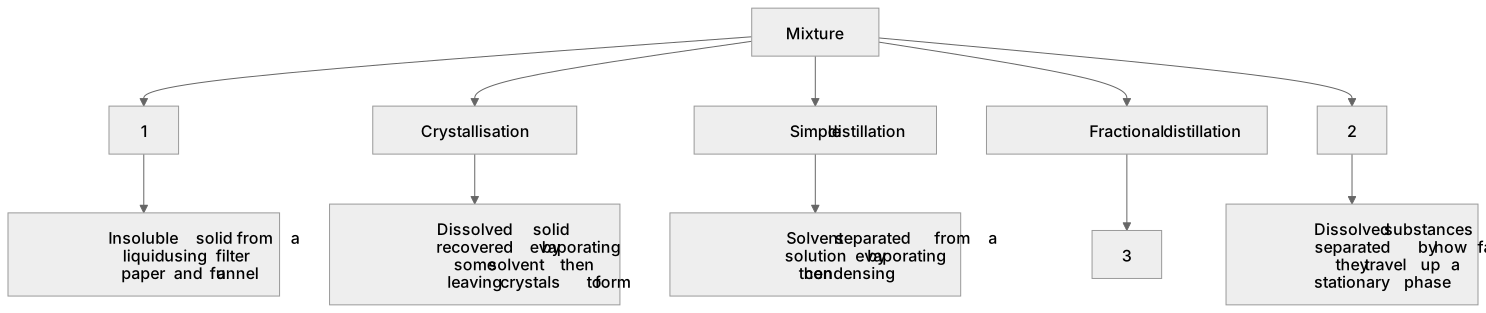
1Box 1
2Box 2
3Box 3
There is more to this lesson
The full lesson goes on to check your understanding and help you earn the marks. Create a free account to carry on, with your progress saved.
A week of Premium from your first lesson · Then the free plan continues · No card, no charge
Test your understanding of Mixtures: Mixtures can be separated by physical processes such as filtration, crystallisation, simple distillation, fractional distillation and chromatography.
Active recall beats re-reading. Take an instant quiz now to test what you’ve learned and lock it into long-term memory.
A week of Premium from your first lesson · Then the free plan continues · No card, no charge