AQA · GCSE · Chemistry
Course version: 8462 · Version from Sept 2018
These physical processes do not involve chemical reactions and no new…
Full specification wording
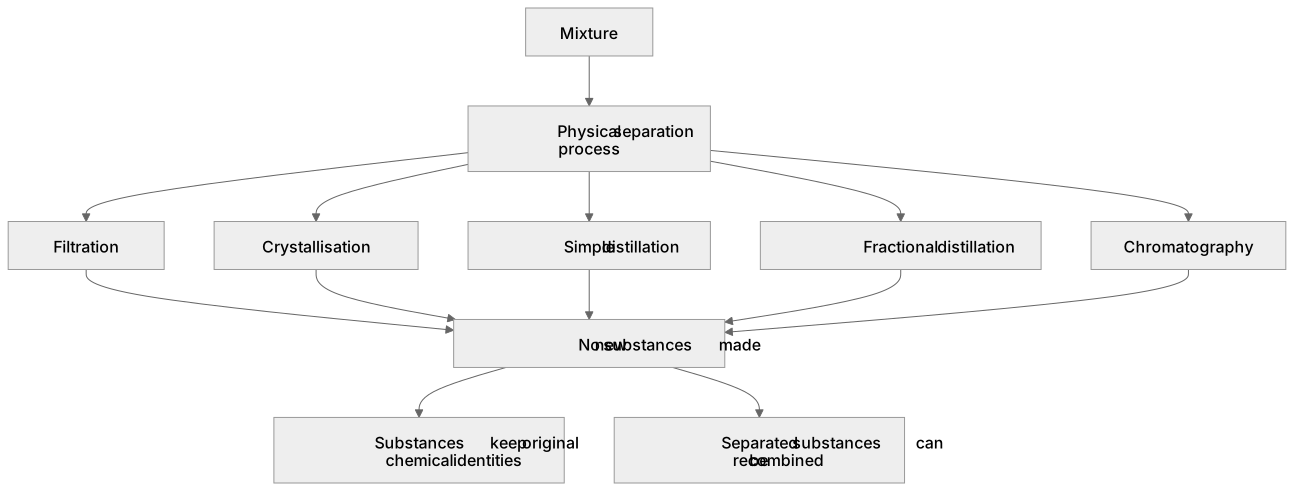
Mixtures: These physical processes do not involve chemical reactions and no new substances are made.
Separation techniques such as filtration, crystallisation, simple distillation, fractional distillation and chromatography are physical processes.
Checked against the AQA 8462 specification (opens in a new tab) on .
- Point 4 of 5
- 4 key terms
Study notes
From the checked teaching notes for this specification point.
The idea
Separation techniques such as filtration, crystallisation, simple distillation, fractional distillation and chromatography are physical processes. They separate substances that are already present in a mixture without changing their chemical identities, so no new substances are made. For example, filtering a mixture of sand and salt solution gives sand and salt solution, and evaporating the water from salt solution leaves the same sodium chloride. In contrast, a chemical reaction such as burning magnesium produces magnesium oxide, a new substance with different properties. Recognising this difference helps you choose a separation method and explain why it works.
What earns the marks
- Physical separation processes do not involve chemical reactions, so the substances keep their original chemical identities.
- No new substances are made during filtration, crystallisation, simple distillation, fractional distillation or chromatography.
- The separated substances can be recombined to give the original mixture because no chemical change has occurred.
- A chemical reaction, such as burning magnesium to form magnesium oxide, does make a new substance and is not a separation process.
- Changes of state during distillation or crystallisation are physical changes, not chemical reactions.
Common mistakes and how to put them right
Saying distillation makes a new substance because the liquid changes to a gas.
Put it right: Changes of state are physical, so the substance is unchanged.
Confusing separation with a chemical reaction.
Put it right: Separation only divides a mixture, whereas a reaction forms new products.
Thinking crystallisation changes the dissolved solid into a different compound.
Put it right: The solid recrystallises as the same substance.
Exam tips
- Use the phrase no new substances are made when explaining why a separation is physical.
- Contrast a separation with a named chemical reaction to show the difference clearly.
- Check whether the question asks about a mixture or a compound before describing the process.
Try the lesson
The start of the Mixtures: These physical processes do not involve chemical reactions and no new substances are made. lesson, made from checked teaching notes for this specification point.
Have a go first
When a mixture is separated by filtration, what happens to the substances in the mixture?
Listen
Separation techniques such as filtration, crystallisation, simple distillation, fractional distillation and chromatography are physical processes. They separate substances that are already present in a mixture without changing their chemical identities, so no new substances are made. For example, filtering a mixture of sand and salt solution gives sand and salt solution, and evaporating the water from salt solution leaves the same sodium chloride. In contrast, a chemical reaction such as burning magnesium produces magnesium oxide, a new substance with different properties. Recognising this difference helps you choose a separation method and explain why it works. A strong answer earns marks for these points. Physical separation processes do not involve chemical reactions, so the substances keep their original chemical identities. No new substances are made during filtration, crystallisation, simple distillation, fractional distillation or chromatography. The separated substances can be recombined to give the original mixture because no chemical change has occurred. A chemical reaction, such as burning magnesium to form magnesium oxide, does make a new substance and is not a separation process. A common slip: Saying distillation makes a new substance because the liquid changes to a gas. Instead, changes of state are physical, so the substance is unchanged. Exam tip: Use the phrase no new substances are made when explaining why a separation is physical.
See it
Key words
Say what each word means before you turn the card.
Physical versus chemical change
Try answering aloud or in your head before turning the card.
Conservation of chemical identity
Try answering aloud or in your head before turning the card.
Mixtures and compounds
Try answering aloud or in your head before turning the card.
Evidence for no new substance
Try answering aloud or in your head before turning the card.
See every definition
- Physical versus chemical change
- Physical separation processes do not involve chemical reactions, whereas a chemical reaction does make a new substance.
- Conservation of chemical identity
- The substances keep their original chemical identities because no chemical reactions occur during the separation.
- Mixtures and compounds
- Separation only divides a mixture, whereas a reaction forms new products.
- Evidence for no new substance
- No new substances are made during filtration, crystallisation, simple distillation, fractional distillation or chromatography.
Label the diagram
Some boxes have lost their names. Pick the right name for each number.
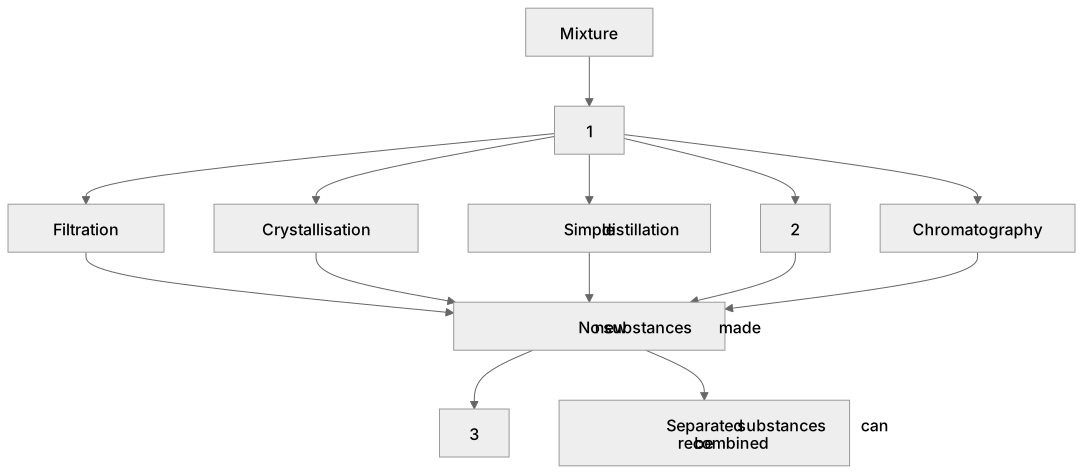
1Box 1
2Box 2
3Box 3
There is more to this lesson
The full lesson goes on to check your understanding and help you earn the marks. Create a free account to carry on, with your progress saved.
A week of Premium from your first lesson · Then the free plan continues · No card, no charge
Test your understanding of Mixtures: These physical processes do not involve chemical reactions and no new substances are made.
Active recall beats re-reading. Take an instant quiz now to test what you’ve learned and lock it into long-term memory.
A week of Premium from your first lesson · Then the free plan continues · No card, no charge