AQA · GCSE · Chemistry
Course version: 8462 · Version from Sept 2018
Potable water: These processes require large amounts of energy.
The processes that make water potable can demand significant energy, especially when water is scarce or salty.
Checked against the AQA 8462 specification (opens in a new tab) on .
- Point 10 of 12
- 3 key terms
Study notes
From the checked teaching notes for this specification point.
The idea
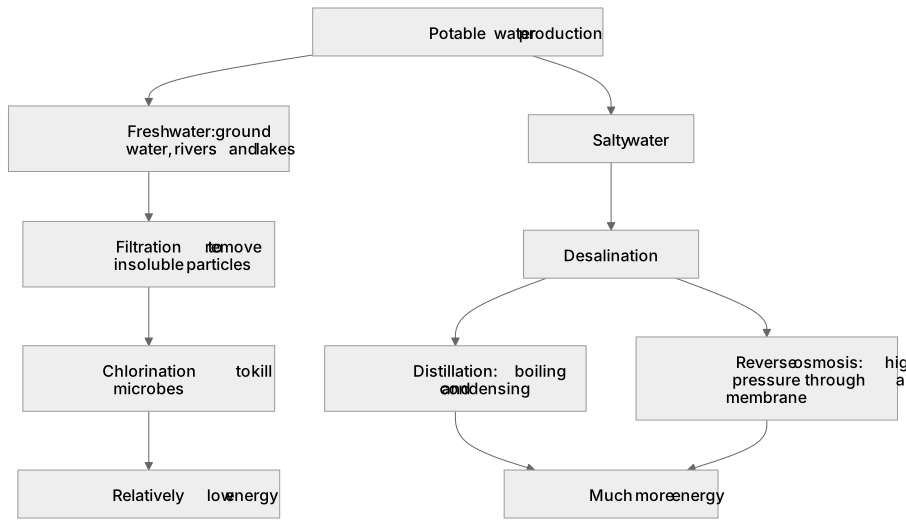
The processes that make water potable can demand significant energy, especially when water is scarce or salty. In the UK, most potable water comes from ground water or rivers and lakes, and treatment usually involves filtration to remove insoluble particles and chlorination to kill microbes; these steps are relatively low in energy compared with desalination. Desalination of salty water, by distillation or reverse osmosis, requires much more energy because water must be heated to boiling and condensed, or forced at high pressure through a membrane. For example, heating 1 kg of water from 20 °C to 100 °C requires about 3.4 × 10⁵ J, and the energy demand rises further when large volumes are treated. This explains why desalination is used mainly where fresh water is limited, such as in some dry coastal regions, and why reducing energy use is a key design aim.
What earns the marks
- States that potable water production can require large amounts of energy, especially when the source is salty water.
- Identifies distillation as an energy-intensive desalination method because it involves boiling water and condensing the vapour.
- Identifies reverse osmosis as a desalination method that requires energy to pressurise water through a membrane.
- Compares the energy demand of treating fresh water (filtration and chlorination) with desalinating salty water.
- Explains that energy use affects the cost and environmental impact of supplying potable water.
- Links the choice of water treatment method to local availability of fresh water and energy resources.
Common mistakes and how to put them right
Thinking that all potable water treatment requires the same amount of energy.
Put it right: Treatment of fresh water is generally less energy-intensive than desalination of salty water.
Confusing distillation with filtration.
Put it right: Distillation involves boiling and condensation and requires heating, whereas filtration separates insoluble solids without boiling.
Assuming that energy is only needed for pumping water.
Put it right: Energy is also needed for heating, pressurising and operating treatment processes such as distillation and reverse osmosis.
Exam tips
- When asked why desalination is expensive, link your answer to the energy needed for boiling or high-pressure pumping, not just to the equipment.
- Use comparative language such as 'more energy than' when contrasting salty water treatment with fresh water treatment.
- If a question gives data about energy costs, quote the relevant values and state what they show about the process.
Try the lesson
The start of the Potable water: These processes require large amounts of energy. lesson, made from checked teaching notes for this specification point.
Have a go first
Which process used to make salty water potable requires large amounts of energy?
Listen
The processes that make water potable can demand significant energy, especially when water is scarce or salty. In the UK, most potable water comes from ground water or rivers and lakes, and treatment usually involves filtration to remove insoluble particles and chlorination to kill microbes; these steps are relatively low in energy compared with desalination. Desalination of salty water, by distillation or reverse osmosis, requires much more energy because water must be heated to boiling and condensed, or forced at high pressure through a membrane. For example, heating 1 kg of water from 20 °C to 100 °C requires about 3.4 × 10⁵ J, and the energy demand rises further when large volumes are treated. This explains why desalination is used mainly where fresh water is limited, such as in some dry coastal regions, and why reducing energy use is a key design aim. A strong answer earns marks for these points. States that potable water production can require large amounts of energy, especially when the source is salty water. Identifies distillation as an energy-intensive desalination method because it involves boiling water and condensing the vapour. Identifies reverse osmosis as a desalination method that requires energy to pressurise water through a membrane. Compares the energy demand of treating fresh water (filtration and chlorination) with desalinating salty water. A common slip: Thinking that all potable water treatment requires the same amount of energy. Instead, treatment of fresh water is generally less energy-intensive than desalination of salty water. Exam tip: When asked why desalination is expensive, link your answer to the energy needed for boiling or high-pressure pumping, not just to the equipment.
See it
Key words
Say what each word means before you turn the card.
Desalination by distillation
Try answering aloud or in your head before turning the card.
Desalination by reverse osmosis
Try answering aloud or in your head before turning the card.
Energy demand in water treatment
Try answering aloud or in your head before turning the card.
See every definition
- Desalination by distillation
- A desalination method that requires much more energy because water must be heated to boiling and condensed.
- Desalination by reverse osmosis
- A desalination method that requires energy to force water at high pressure through a membrane.
- Energy demand in water treatment
- The processes that make water potable can demand significant energy, especially when water is scarce or salty.
Label the diagram
Some boxes have lost their names. Pick the right name for each number.
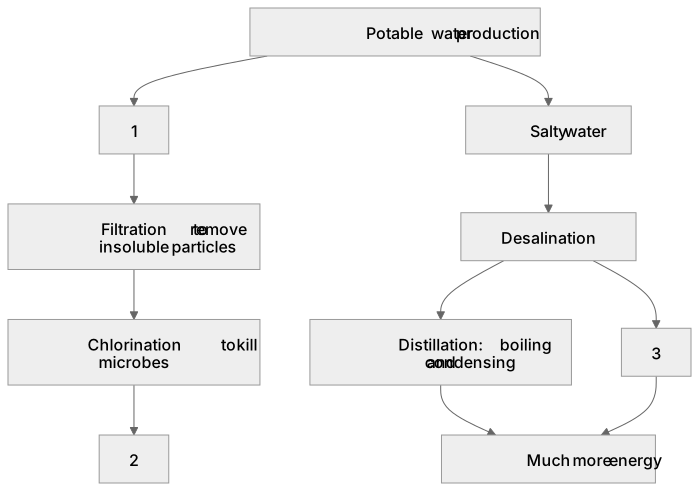
1Box 1
2Box 2
3Box 3
There is more to this lesson
The full lesson goes on to check your understanding and help you earn the marks. Create a free account to carry on, with your progress saved.
A week of Premium from your first lesson · Then the free plan continues · No card, no charge
Test your understanding of Potable water: These processes require large amounts of energy.
Active recall beats re-reading. Take an instant quiz now to test what you’ve learned and lock it into long-term memory.
A week of Premium from your first lesson · Then the free plan continues · No card, no charge