AQA · GCSE · Chemistry
Course version: 8462 · Version from Sept 2018
Students should be able to: distinguish between potable water and pure…
Full specification wording
Potable water: Students should be able to: distinguish between potable water and pure water describe the differences in treatment of ground water and salty water give reasons for the steps used to produce potable water.
Potable water is water that is safe to drink; it contains dissolved substances but has sufficiently low levels of microbes and contaminants.
Checked against the AQA 8462 specification (opens in a new tab) on .
- Point 11 of 12
- 4 key terms
Study notes
From the checked teaching notes for this specification point.
The idea
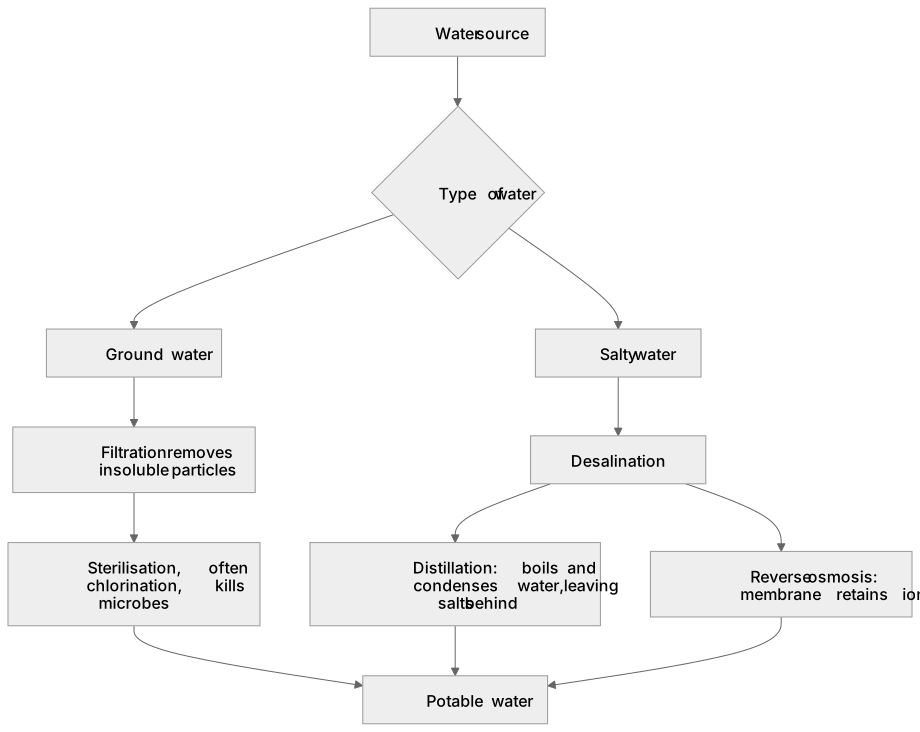
Potable water is water that is safe to drink; it contains dissolved substances but has sufficiently low levels of microbes and contaminants. Pure water, in a chemistry context, contains only H₂O molecules and no dissolved substances. Ground water is usually treated by filtration to remove insoluble particles and sterilisation, often by chlorination, to kill microbes. Salty water needs desalination, for example by distillation or reverse osmosis, because dissolved salts must be removed. Each step has a purpose: filtration removes solids, chlorination kills microorganisms, distillation boils and condenses water leaving salts behind, and reverse osmosis forces water through a membrane that retains ions. Understanding these differences allows students to select and justify treatment methods for a given water source.
What earns the marks
- Defines potable water as water that is safe to drink and pure water as water containing only H₂O molecules.
- States that potable water may contain dissolved substances but must have low levels of microbes and harmful contaminants.
- Describes ground water treatment as filtration followed by sterilisation, such as chlorination.
- Describes salty water treatment as desalination by distillation or reverse osmosis.
- Explains that filtration removes insoluble particles and chlorination kills microorganisms.
- Explains that distillation removes dissolved salts by boiling and condensing water, while reverse osmosis uses pressure and a membrane.
- Gives reasons for each step in terms of the type of impurity being removed.
Common mistakes and how to put them right
Confusing potable water with pure water.
Put it right: Potable water is safe to drink but may contain dissolved substances, whereas pure water contains only H₂O molecules.
Thinking that filtration removes dissolved salts.
Put it right: Filtration removes insoluble particles, while dissolved salts require desalination.
Believing that chlorination removes dirt.
Put it right: Chlorination kills microorganisms, and filtration removes insoluble particles.
Exam tips
- When comparing ground water and salty water, name the specific treatment steps and the impurity each step removes.
- Use the term 'sterilisation' or 'chlorination' for killing microbes, and 'desalination' for removing salts.
- If asked to give reasons, link each step to the problem it solves, such as 'filtration removes solid particles that would make water cloudy or unsafe'.
Try the lesson
The start of the Potable water: Students should be able to: distinguish between potable water and pure water describe the differences in treatment of ground water and salty water give reasons for the steps used to produce potable water. lesson, made from checked teaching notes for this specification point.
Have a go first
Which statement describes potable water?
Listen
Potable water is water that is safe to drink; it contains dissolved substances but has sufficiently low levels of microbes and contaminants. Pure water, in a chemistry context, contains only H₂O molecules and no dissolved substances. Ground water is usually treated by filtration to remove insoluble particles and sterilisation, often by chlorination, to kill microbes. Salty water needs desalination, for example by distillation or reverse osmosis, because dissolved salts must be removed. Each step has a purpose: filtration removes solids, chlorination kills microorganisms, distillation boils and condenses water leaving salts behind, and reverse osmosis forces water through a membrane that retains ions. Understanding these differences allows students to select and justify treatment methods for a given water source. A strong answer earns marks for these points. Defines potable water as water that is safe to drink and pure water as water containing only H₂O molecules. States that potable water may contain dissolved substances but must have low levels of microbes and harmful contaminants. Describes ground water treatment as filtration followed by sterilisation, such as chlorination. Describes salty water treatment as desalination by distillation or reverse osmosis. A common slip: Confusing potable water with pure water. Instead, potable water is safe to drink but may contain dissolved substances, whereas pure water contains only H₂O molecules. Exam tip: When comparing ground water and salty water, name the specific treatment steps and the impurity each step removes.
See it
Key words
Say what each word means before you turn the card.
Potable water
Try answering aloud or in your head before turning the card.
Pure water
Try answering aloud or in your head before turning the card.
Desalination
Try answering aloud or in your head before turning the card.
Chlorination
Try answering aloud or in your head before turning the card.
See every definition
- Potable water
- Water that is safe to drink, containing dissolved substances but with sufficiently low levels of microbes and contaminants.
- Pure water
- In a chemistry context, water that contains only H₂O molecules and no dissolved substances.
- Desalination
- Removal of dissolved salts from salty water, for example by distillation or reverse osmosis.
- Chlorination
- Sterilisation of water, often used to kill microbes.
There is more to this lesson
The full lesson goes on to check your understanding and help you earn the marks. Create a free account to carry on, with your progress saved.
A week of Premium from your first lesson · Then the free plan continues · No card, no charge
Test your understanding of Potable water: Students should be able to: distinguish between potable water and pure water describe the differences in treatment of ground water and salty water give reasons for the steps used to produce potable water.
Active recall beats re-reading. Take an instant quiz now to test what you’ve learned and lock it into long-term memory.
A week of Premium from your first lesson · Then the free plan continues · No card, no charge