AQA · GCSE · Chemistry
Course version: 8462 · Version from Sept 2018
Compounds of nitrogen, phosphorus and potassium are used as fertilisers to…
Full specification wording
Production and uses of NPK fertilisers: Compounds of nitrogen, phosphorus and potassium are used as fertilisers to improve agricultural productivity.
Fertilisers supply the three essential elements nitrogen, phosphorus and potassium (NPK).
Checked against the AQA 8462 specification (opens in a new tab) on .
- Point 1 of 8
Study notes
From the checked teaching notes for this specification point.
The idea
Fertilisers supply the three essential elements nitrogen, phosphorus and potassium (NPK). Nitrogen promotes leafy growth, phosphorus supports root development, and potassium helps disease resistance. Because crops remove these elements from soil, farmers add NPK fertilisers to replace them and improve agricultural productivity. Common examples include ammonium nitrate for nitrogen and potassium chloride for potassium. Plants absorb soluble mineral ions, not intact compounds. While some compounds are naturally soluble, phosphate rock is insoluble and cannot be used directly as a fertiliser. It must be treated with nitric, sulfuric or phosphoric acid to produce soluble salts (like single or triple superphosphate) before plants can absorb the phosphorus ions.
What earns the marks
- Nitrogen, phosphorus and potassium are the three main nutrient elements in NPK fertilisers.
- Nitrogen compounds promote leaf and stem growth, phosphorus supports roots, and potassium helps general plant health.
- Fertilisers replace nutrients removed from soil when crops are harvested, improving agricultural productivity.
- Nutrients must be supplied as soluble compounds so plant roots can absorb the mineral ions.
- Phosphate rock is insoluble and must be treated with acid to produce soluble salts before it can be used as a fertiliser.
Common mistakes and how to put them right
Saying fertilisers provide energy to plants.
Put it right: Fertilisers supply mineral elements.
Naming sodium instead of potassium in NPK.
Put it right: K stands for potassium, not sodium.
Thinking phosphate rock can be used directly.
Put it right: It must be treated with acid to form soluble salts.
Exam tips
- Remember NPK as nitrogen, phosphorus and potassium, and link each to one plant function.
- When asked why productivity improves, mention replacement of nutrients removed by harvesting and increased crop yield.
- State that phosphate rock is treated with acid to make soluble salts, as plants can only absorb soluble ions.
Try the lesson
The start of the Production and uses of NPK fertilisers: Compounds of nitrogen, phosphorus and potassium are used as fertilisers to improve agricultural productivity. lesson, made from checked teaching notes for this specification point.
Have a go first
Which three elements are represented by the letters N, P and K in the term NPK fertiliser?
Listen
Fertilisers supply the three essential elements nitrogen, phosphorus and potassium (NPK). Nitrogen promotes leafy growth, phosphorus supports root development, and potassium helps disease resistance. Because crops remove these elements from soil, farmers add NPK fertilisers to replace them and improve agricultural productivity. Common examples include ammonium nitrate for nitrogen and potassium chloride for potassium. Plants absorb soluble mineral ions, not intact compounds. While some compounds are naturally soluble, phosphate rock is insoluble and cannot be used directly as a fertiliser. It must be treated with nitric, sulfuric or phosphoric acid to produce soluble salts (like single or triple superphosphate) before plants can absorb the phosphorus ions. A strong answer earns marks for these points. Nitrogen, phosphorus and potassium are the three main nutrient elements in NPK fertilisers. Nitrogen compounds promote leaf and stem growth, phosphorus supports roots, and potassium helps general plant health. Fertilisers replace nutrients removed from soil when crops are harvested, improving agricultural productivity. Nutrients must be supplied as soluble compounds so plant roots can absorb the mineral ions. A common slip: Saying fertilisers provide energy to plants: the error is confusing nutrients with food or fuel. Instead, fertilisers supply mineral elements. Exam tip: Remember NPK as nitrogen, phosphorus and potassium, and link each to one plant function.
See it
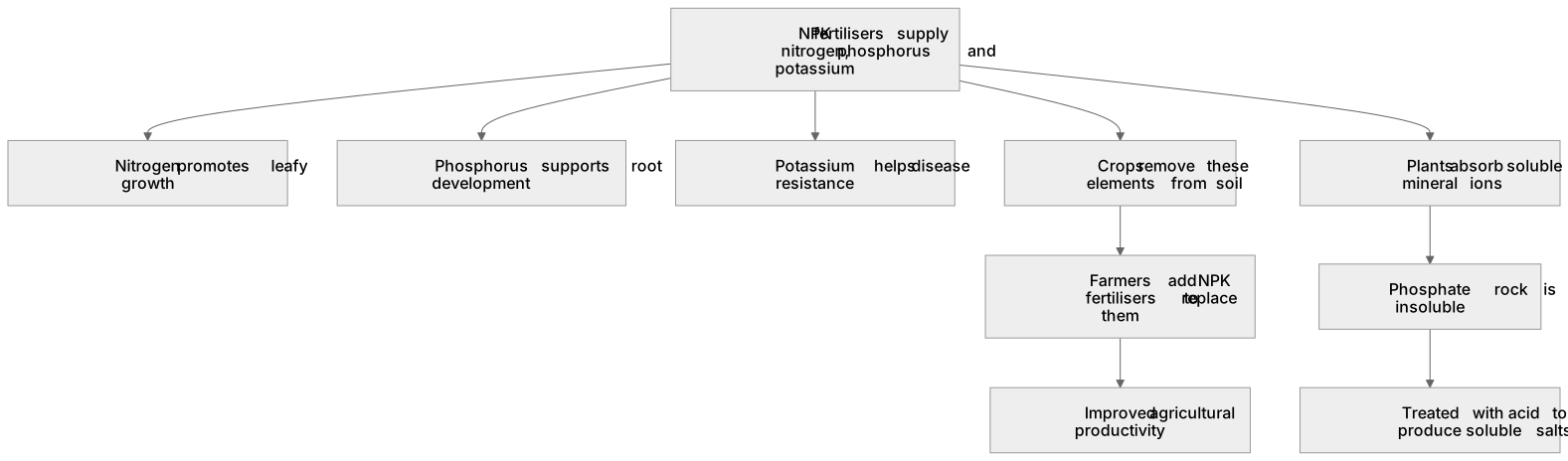
Label the diagram
Some boxes have lost their names. Pick the right name for each number.
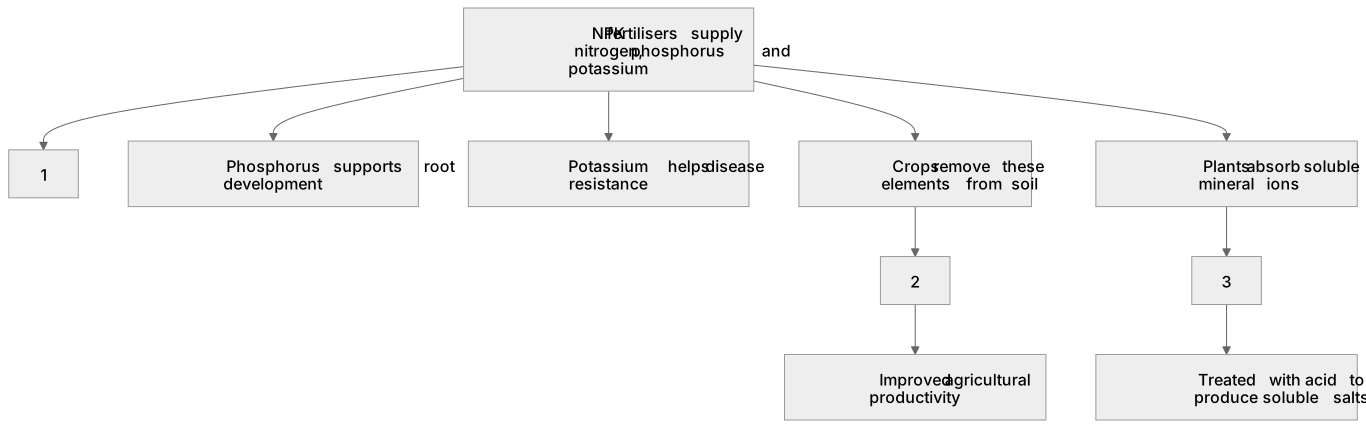
1Box 1
2Box 2
3Box 3
There is more to this lesson
The full lesson goes on to check your understanding and help you earn the marks. Create a free account to carry on, with your progress saved.
A week of Premium from your first lesson · Then the free plan continues · No card, no charge
Test your understanding of Production and uses of NPK fertilisers: Compounds of nitrogen, phosphorus and potassium are used as fertilisers to improve agricultural productivity.
Active recall beats re-reading. Take an instant quiz now to test what you’ve learned and lock it into long-term memory.
A week of Premium from your first lesson · Then the free plan continues · No card, no charge