AQA · GCSE · Chemistry
Course version: 8462 · Version from Sept 2018
NPK fertilisers contain compounds of all three elements.
Full specification wording
Production and uses of NPK fertilisers: NPK fertilisers contain compounds of all three elements.
NPK fertilisers are formulations containing compounds of nitrogen (N), phosphorus (P), and potassium (K).
Checked against the AQA 8462 specification (opens in a new tab) on .
- Point 2 of 8
Study notes
From the checked teaching notes for this specification point.
The idea
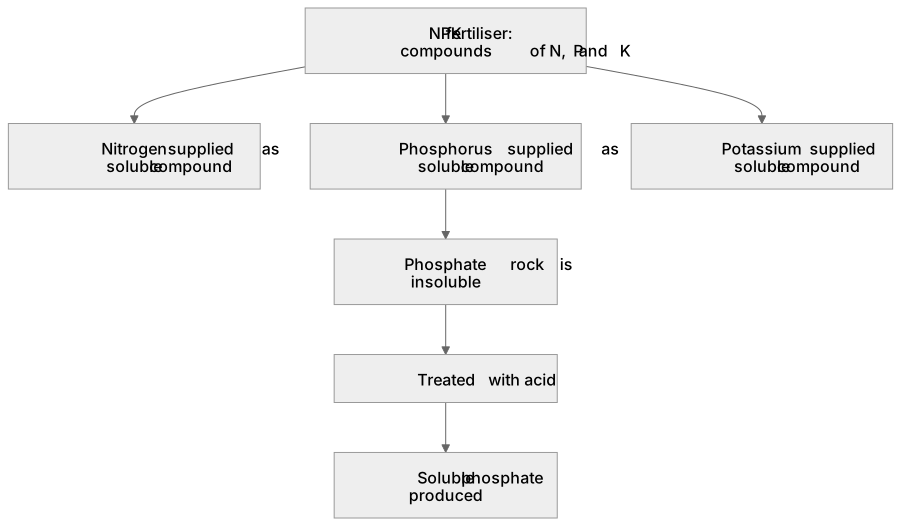
NPK fertilisers are formulations containing compounds of nitrogen (N), phosphorus (P), and potassium (K). These nutrients are supplied as soluble ionic compounds, allowing plants to absorb dissolved ions from soil water. For example, ammonium nitrate provides nitrogen as NH₄⁺ and NO₃⁻ ions, while potassium chloride supplies potassium as K⁺ ions. Crucially, phosphate rock cannot be used directly as it is insoluble; it must be treated with acids (like nitric or sulfuric acid) to produce soluble salts such as ammonium phosphate or calcium phosphate. A fertiliser is classed as NPK only when compounds of all three elements are present, though their relative percentages can vary depending on the specific crop requirements.
What earns the marks
- States that N, P, and K represent the essential elements nitrogen, phosphorus, and potassium.
- Explains that nutrients must be present as soluble compounds rather than free elements to allow for root uptake from soil water.
- Identifies typical soluble compounds used: ammonium nitrate or ammonium sulfate for nitrogen, and potassium chloride or potassium sulfate for potassium.
- Clarifies that phosphate rock is insoluble and must be treated with acid to produce soluble phosphorus compounds (e.g., ammonium phosphate) for use in NPK fertilisers.
- Recognises that an NPK fertiliser is a formulation containing compounds of all three elements, often in varying proportions.
Common mistakes and how to put them right
Stating that phosphate rock is used directly in NPK fertilisers.
Put it right by explaining it is insoluble and must first be treated with acid to form soluble phosphates.
Treating N, P, and K as the elements themselves rather than as nutrients supplied in compounds.
Put it right by naming a soluble compound that provides each nutrient (e.g., potassium chloride for K).
Assuming the three nutrients must be present in equal amounts.
Put it right by explaining that formulations are mixed to contain specific, often different, percentages tailored to crop needs.
Exam tips
- When asked to identify an NPK fertiliser from a list, check the chemical formulas to ensure compounds of nitrogen, phosphorus, and potassium are all present in the same product.
- Remember that phosphate rock must be reacted with an acid (such as nitric, sulfuric, or phosphoric acid) to make the phosphorus soluble and available to plants.
Try the lesson
The start of the Production and uses of NPK fertilisers: NPK fertilisers contain compounds of all three elements. lesson, made from checked teaching notes for this specification point.
Have a go first
Which three elements are represented by the letters N, P and K in an NPK fertiliser?
Listen
NPK fertilisers are formulations containing compounds of nitrogen (N), phosphorus (P), and potassium (K). These nutrients are supplied as soluble ionic compounds, allowing plants to absorb dissolved ions from soil water. For example, ammonium nitrate provides nitrogen as NH₄⁺ and NO₃⁻ ions, while potassium chloride supplies potassium as K⁺ ions. Crucially, phosphate rock cannot be used directly as it is insoluble; it must be treated with acids (like nitric or sulfuric acid) to produce soluble salts such as ammonium phosphate or calcium phosphate. A fertiliser is classed as NPK only when compounds of all three elements are present, though their relative percentages can vary depending on the specific crop requirements. A strong answer earns marks for these points. States that N, P, and K represent the essential elements nitrogen, phosphorus, and potassium. Explains that nutrients must be present as soluble compounds rather than free elements to allow for root uptake from soil water. Identifies typical soluble compounds used: ammonium nitrate or ammonium sulfate for nitrogen, and potassium chloride or potassium sulfate for potassium. Clarifies that phosphate rock is insoluble and must be treated with acid to produce soluble phosphorus compounds (e.g., ammonium phosphate) for use in NPK fertilisers. A common slip: Stating that phosphate rock is used directly in NPK fertilisers. Instead, explaining it is insoluble and must first be treated with acid to form soluble phosphates. Exam tip: When asked to identify an NPK fertiliser from a list, check the chemical formulas to ensure compounds of nitrogen, phosphorus, and potassium are all present in the same product.
See it
Label the diagram
Some boxes have lost their names. Pick the right name for each number.
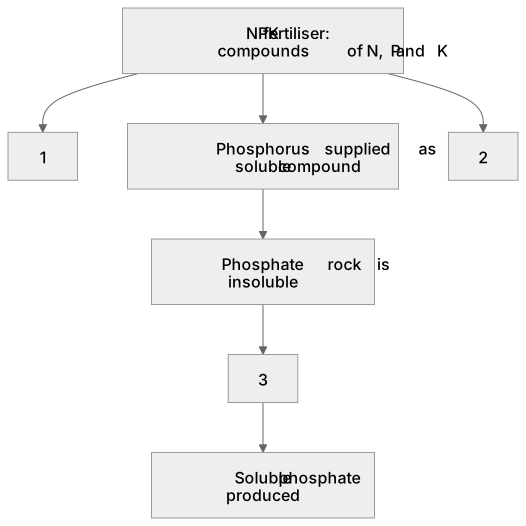
1Box 1
2Box 2
3Box 3
There is more to this lesson
The full lesson goes on to check your understanding and help you earn the marks. Create a free account to carry on, with your progress saved.
A week of Premium from your first lesson · Then the free plan continues · No card, no charge
Test your understanding of Production and uses of NPK fertilisers: NPK fertilisers contain compounds of all three elements.
Active recall beats re-reading. Take an instant quiz now to test what you’ve learned and lock it into long-term memory.
A week of Premium from your first lesson · Then the free plan continues · No card, no charge