AQA · GCSE · Chemistry
Course version: 8462 · Version from Sept 2018
NPK fertilisers are formulations of various salts containing appropriate…
Full specification wording
Production and uses of NPK fertilisers: NPK fertilisers are formulations of various salts containing appropriate percentages of the elements.
A formulation is a mixture designed to give the exact proportions needed for its purpose.
Checked against the AQA 8462 specification (opens in a new tab) on .
- Point 4 of 8
- 3 key terms
Study notes
From the checked teaching notes for this specification point.
The idea
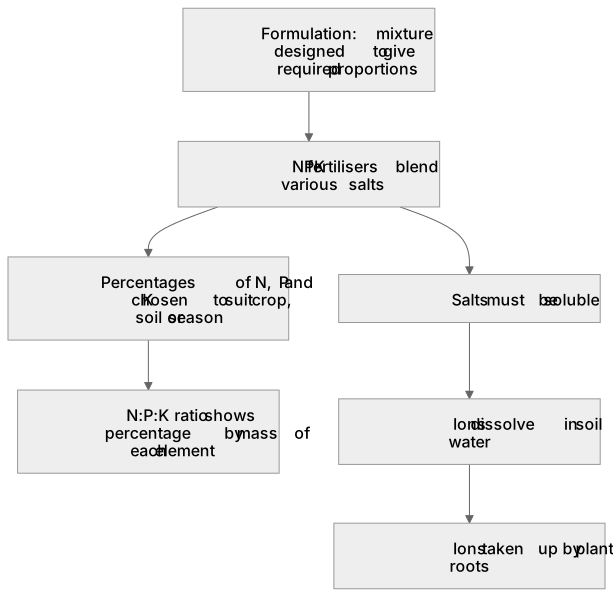
A formulation is a mixture designed to give the exact proportions needed for its purpose. NPK fertilisers are formulations because they blend different salts so that the percentages of nitrogen, phosphorus and potassium suit a particular crop, soil or growing season. The nutrient content is usually shown as an N:P:K ratio, for example 10:10:10 or 15:5:10, where each number represents the percentage by mass of that element in the fertiliser. The salts must be soluble so that the ions can dissolve in soil water and be taken up by roots. Different formulations may also include fillers or other nutrients, but the defining feature is a controlled mixture of salts giving appropriate percentages of N, P and K.
What earns the marks
- Defines a formulation as a mixture designed to give the required proportions of ingredients.
- States that NPK fertilisers blend various salts rather than containing a single compound.
- Explains that the percentages of N, P and K are chosen to suit a crop, soil or season.
- Interprets an N:P:K ratio as percentage by mass of each element.
- Links solubility of the salts to uptake of nutrient ions by plant roots.
Common mistakes and how to put them right
Reading an N:P:K ratio as a ratio of compound masses rather than percentages of the elements.
Put it right by treating each number as the percentage by mass of that element.
Assuming all fertilisers have the same formulation.
Put it right by explaining that percentages are adjusted for different needs.
Thinking a formulation is a pure compound.
Put it right by describing it as a designed mixture of salts.
Exam tips
- When given an N:P:K ratio, state clearly that the numbers are percentages by mass of the elements.
- Use the word formulation to show understanding that the mixture is deliberately designed.
- If asked why salts are used, link solubility to ion uptake by roots.
Try the lesson
The start of the Production and uses of NPK fertilisers: NPK fertilisers are formulations of various salts containing appropriate percentages of the elements. lesson, made from checked teaching notes for this specification point.
Have a go first
Which three elements do NPK fertilisers contain?
Listen
A formulation is a mixture designed to give the exact proportions needed for its purpose. NPK fertilisers are formulations because they blend different salts so that the percentages of nitrogen, phosphorus and potassium suit a particular crop, soil or growing season. The nutrient content is usually shown as an N:P:K ratio, for example 10:10:10 or 15:5:10, where each number represents the percentage by mass of that element in the fertiliser. The salts must be soluble so that the ions can dissolve in soil water and be taken up by roots. Different formulations may also include fillers or other nutrients, but the defining feature is a controlled mixture of salts giving appropriate percentages of N, P and K. A strong answer earns marks for these points. Defines a formulation as a mixture designed to give the required proportions of ingredients. States that NPK fertilisers blend various salts rather than containing a single compound. Explains that the percentages of N, P and K are chosen to suit a crop, soil or season. Interprets an N:P:K ratio as percentage by mass of each element. A common slip: Reading an N:P:K ratio as a ratio of compound masses rather than percentages of the elements. Instead, treating each number as the percentage by mass of that element. Exam tip: When given an N:P:K ratio, state clearly that the numbers are percentages by mass of the elements.
See it
Key words
Say what each word means before you turn the card.
Formulation
Try answering aloud or in your head before turning the card.
NPK fertilisers
Try answering aloud or in your head before turning the card.
N:P:K ratio
Try answering aloud or in your head before turning the card.
See every definition
- Formulation
- A mixture designed to give the exact proportions needed for its purpose.
- NPK fertilisers
- Formulations of various salts containing appropriate percentages of the elements nitrogen, phosphorus and potassium.
- N:P:K ratio
- Numbers where each represents the percentage by mass of that element in the fertiliser.
Label the diagram
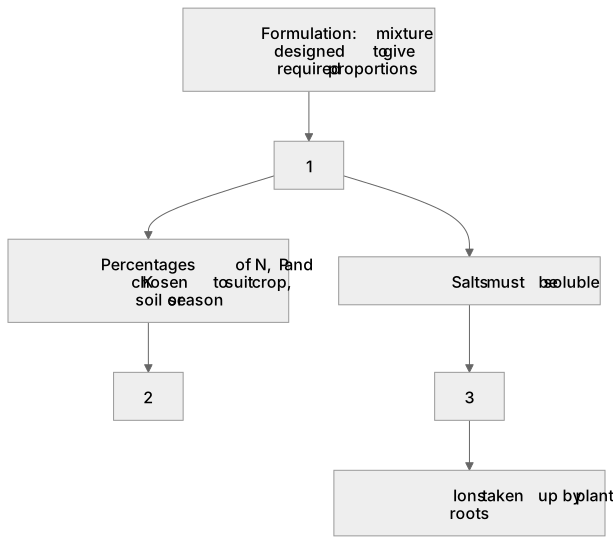
Some boxes have lost their names. Pick the right name for each number.
1Box 1
2Box 2
3Box 3
There is more to this lesson
The full lesson goes on to check your understanding and help you earn the marks. Create a free account to carry on, with your progress saved.
A week of Premium from your first lesson · Then the free plan continues · No card, no charge
Test your understanding of Production and uses of NPK fertilisers: NPK fertilisers are formulations of various salts containing appropriate percentages of the elements.
Active recall beats re-reading. Take an instant quiz now to test what you’ve learned and lock it into long-term memory.
A week of Premium from your first lesson · Then the free plan continues · No card, no charge