AQA · GCSE · Chemistry
Course version: 8462 · Version from Sept 2018
Industrial production of NPK fertilisers can be achieved using a variety…
Full specification wording
Production and uses of NPK fertilisers: Industrial production of NPK fertilisers can be achieved using a variety of raw materials in several integrated processes.
Industry makes NPK fertilisers by combining several feedstocks and process streams rather than by a single reaction.
Checked against the AQA 8462 specification (opens in a new tab) on .
- Point 3 of 8
Study notes
From the checked teaching notes for this specification point.
The idea
Industry makes NPK fertilisers by combining several feedstocks and process streams rather than by a single reaction. Nitrogen compounds come from ammonia, itself made from nitrogen and hydrogen in the Haber process. Ammonia is neutralised by acids such as nitric acid or sulfuric acid to form ammonium salts. Phosphorus compounds come from phosphate rock, which is treated with nitric acid, phosphoric acid or sulfuric acid to produce soluble phosphates. Potassium compounds come from mined potassium chloride or potassium sulfate. The resulting intermediate solutions are blended, granulated and dried so that each batch contains the required percentages of N, P and K. Because the routes are integrated, a plant can adjust raw materials and process conditions to make different formulations.
What earns the marks
- Describes ammonia from the Haber process as the starting point for nitrogen-containing compounds.
- Names neutralisation of ammonia with nitric acid or sulfuric acid as a route to ammonium salts.
- Describes treatment of phosphate rock with acids to produce soluble phosphate compounds.
- Identifies mined potassium chloride or potassium sulfate as the potassium source.
- Explains that intermediate products are blended and processed to give a chosen formulation.
- Recognises that several integrated processes, not one reaction, are involved.
Common mistakes and how to put them right
Describing NPK production as a single chemical reaction.
Put it right by outlining separate nitrogen, phosphorus and potassium routes that are later combined.
Confusing the raw material with the final fertiliser, for example treating phosphate rock as directly usable.
Put it right by stating that it is treated with acid to make soluble phosphate.
Omitting the Haber process as the source of ammonia.
Put it right by linking nitrogen fixation to ammonia manufacture.
Exam tips
- Structure longer answers by nutrient: nitrogen route, phosphorus route, potassium route, then blending.
- Use the terms raw material, intermediate and formulation accurately.
- Link each process to the compound it produces rather than listing processes alone.
Try the lesson
The start of the Production and uses of NPK fertilisers: Industrial production of NPK fertilisers can be achieved using a variety of raw materials in several integrated processes. lesson, made from checked teaching notes for this specification point.
Have a go first
Which phrase best describes how NPK fertilisers are made industrially?
Listen
Industry makes NPK fertilisers by combining several feedstocks and process streams rather than by a single reaction. Nitrogen compounds come from ammonia, itself made from nitrogen and hydrogen in the Haber process. Ammonia is neutralised by acids such as nitric acid or sulfuric acid to form ammonium salts. Phosphorus compounds come from phosphate rock, which is treated with nitric acid, phosphoric acid or sulfuric acid to produce soluble phosphates. Potassium compounds come from mined potassium chloride or potassium sulfate. The resulting intermediate solutions are blended, granulated and dried so that each batch contains the required percentages of N, P and K. Because the routes are integrated, a plant can adjust raw materials and process conditions to make different formulations. A strong answer earns marks for these points. Describes ammonia from the Haber process as the starting point for nitrogen-containing compounds. Names neutralisation of ammonia with nitric acid or sulfuric acid as a route to ammonium salts. Describes treatment of phosphate rock with acids to produce soluble phosphate compounds. Identifies mined potassium chloride or potassium sulfate as the potassium source. A common slip: Describing NPK production as a single chemical reaction. Instead, outlining separate nitrogen, phosphorus and potassium routes that are later combined. Exam tip: Structure longer answers by nutrient: nitrogen route, phosphorus route, potassium route, then blending.
See it
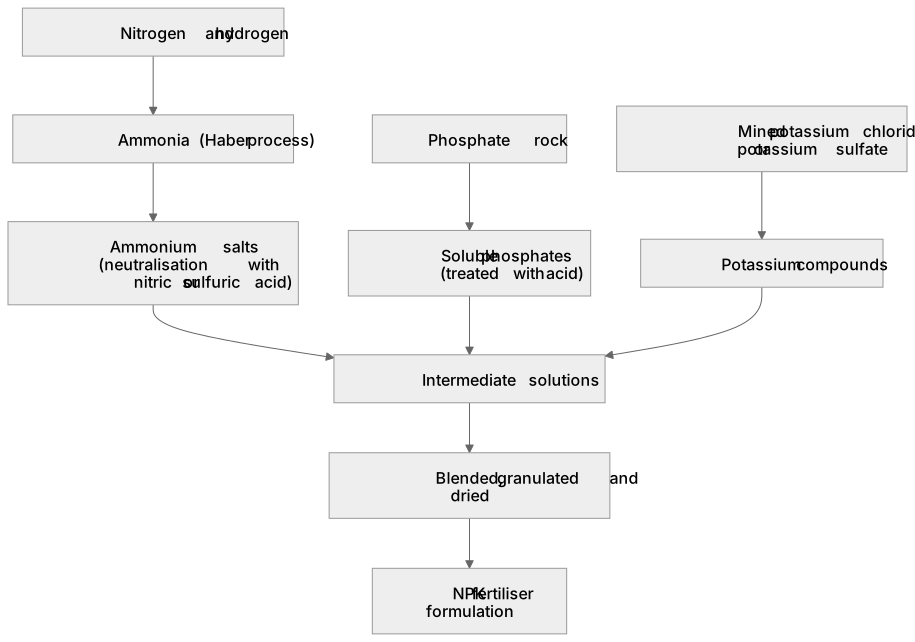
Label the diagram
Some boxes have lost their names. Pick the right name for each number.
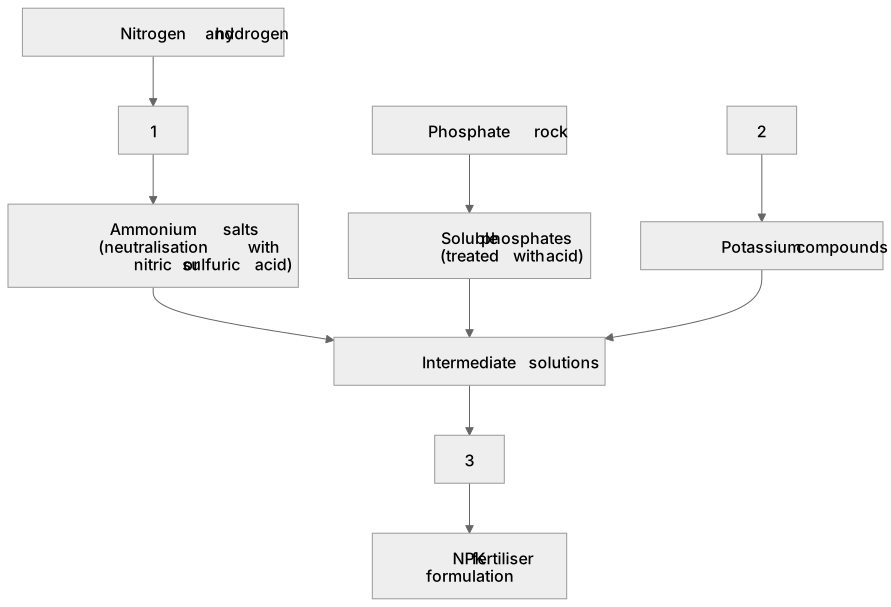
1Box 1
2Box 2
3Box 3
There is more to this lesson
The full lesson goes on to check your understanding and help you earn the marks. Create a free account to carry on, with your progress saved.
A week of Premium from your first lesson · Then the free plan continues · No card, no charge
Test your understanding of Production and uses of NPK fertilisers: Industrial production of NPK fertilisers can be achieved using a variety of raw materials in several integrated processes.
Active recall beats re-reading. Take an instant quiz now to test what you’ve learned and lock it into long-term memory.
A week of Premium from your first lesson · Then the free plan continues · No card, no charge