AQA · GCSE · Chemistry
Course version: 8462 · Version from Sept 2018
Students should be able to recall how boiling point, viscosity and…
Full specification wording
Properties of hydrocarbons: Students should be able to recall how boiling point, viscosity and flammability change with increasing molecular size.
As the molecules in a hydrocarbon fraction get larger, three properties change in a regular way.
Checked against the AQA 8462 specification (opens in a new tab) on .
- Point 3 of 7
- 4 key terms
Study notes
From the checked teaching notes for this specification point.
The idea
As the molecules in a hydrocarbon fraction get larger, three properties change in a regular way. Boiling point increases because larger molecules have stronger intermolecular forces between them, so more energy is needed to separate them. Viscosity increases because the longer molecules become tangled and slide over one another less easily, so the liquid flows more slowly. Flammability decreases because larger molecules are harder to vaporise and do not mix as readily with oxygen, so they ignite less easily and burn with a smokier flame.
For example: Methane is a gas that ignites instantly, while diesel is a viscous liquid that needs warming and fine spraying before it burns efficiently.
What earns the marks
- Boiling point increases as molecular size increases.
- Viscosity increases as molecular size increases, so larger hydrocarbons flow less easily.
- Flammability decreases as molecular size increases, so larger hydrocarbons are harder to ignite.
- The trends arise because larger molecules have stronger forces between them and are harder to vaporise and mix with oxygen.
- A named example can be used to illustrate a trend, such as methane being a gas and diesel being a viscous liquid.
Common mistakes and how to put them right
Reversing the flammability trend by saying larger hydrocarbons are more flammable.
Put it right: The correct trend is that flammability decreases as molecular size increases.
Treating viscosity as a measure of how easily a substance burns.
Put it right: Viscosity is resistance to flow and is a separate property.
Saying boiling point decreases with molecular size.
Put it right: It increases because larger molecules have stronger intermolecular forces.
Exam tips
- State the direction of each trend explicitly, using 'increases' or 'decreases' with 'as molecular size increases'.
- Keep the three properties separate in your answer so each trend is clearly credited.
- Support a trend with a short comparison, such as methane being a gas and octane a liquid, rather than a long description.
Try the lesson
The start of the Properties of hydrocarbons: Students should be able to recall how boiling point, viscosity and flammability change with increasing molecular size. lesson, made from checked teaching notes for this specification point.
Have a go first
As the molecular size of a hydrocarbon increases, what happens to its boiling point?
Listen
As the molecules in a hydrocarbon fraction get larger, three properties change in a regular way. Boiling point increases because larger molecules have stronger intermolecular forces between them, so more energy is needed to separate them. Viscosity increases because the longer molecules become tangled and slide over one another less easily, so the liquid flows more slowly. Flammability decreases because larger molecules are harder to vaporise and do not mix as readily with oxygen, so they ignite less easily and burn with a smokier flame. For example, methane is a gas that ignites instantly, while diesel is a viscous liquid that needs warming and fine spraying before it burns efficiently. A strong answer earns marks for these points. Boiling point increases as molecular size increases. Viscosity increases as molecular size increases, so larger hydrocarbons flow less easily. Flammability decreases as molecular size increases, so larger hydrocarbons are harder to ignite. The trends arise because larger molecules have stronger forces between them and are harder to vaporise and mix with oxygen. Exam tip: State the direction of each trend explicitly, using 'increases' or 'decreases' with 'as molecular size increases'.
See it
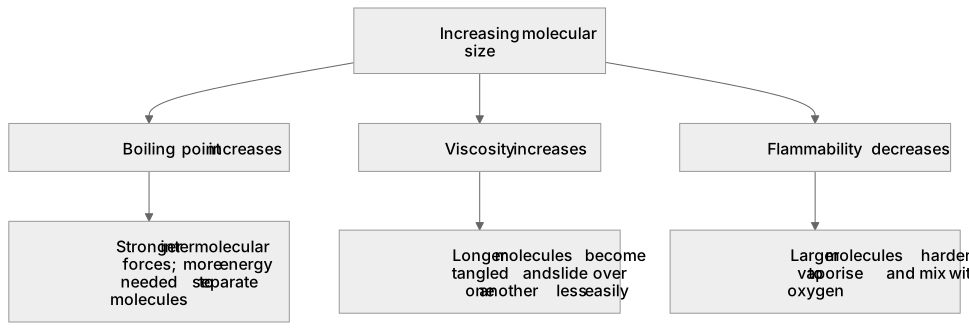
Key words
Say what each word means before you turn the card.
Trends with molecular size
Try answering aloud or in your head before turning the card.
Intermolecular forces
Try answering aloud or in your head before turning the card.
Physical properties of fractions
Try answering aloud or in your head before turning the card.
Structure and property relationships
Try answering aloud or in your head before turning the card.
See every definition
- Trends with molecular size
- As the molecules in a hydrocarbon fraction get larger, boiling point, viscosity and flammability change in a regular way.
- Intermolecular forces
- Larger molecules have stronger forces between them, so more energy is needed to separate them and boiling point increases.
- Physical properties of fractions
- Boiling point increases, viscosity increases and flammability decreases as molecular size increases.
- Structure and property relationships
- Longer molecules become tangled and slide over one another less easily, so the liquid flows more slowly.
Label the diagram
Some boxes have lost their names. Pick the right name for each number.
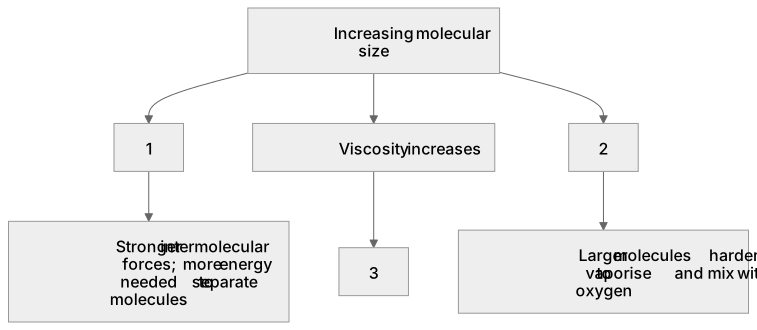
1Box 1
2Box 2
3Box 3
There is more to this lesson
The full lesson goes on to check your understanding and help you earn the marks. Create a free account to carry on, with your progress saved.
A week of Premium from your first lesson · Then the free plan continues · No card, no charge
Test your understanding of Properties of hydrocarbons: Students should be able to recall how boiling point, viscosity and flammability change with increasing molecular size.
Active recall beats re-reading. Take an instant quiz now to test what you’ve learned and lock it into long-term memory.
A week of Premium from your first lesson · Then the free plan continues · No card, no charge