AQA · GCSE · Chemistry
Course version: 8462 · Version from Sept 2018
The combustion of hydrocarbon fuels releases energy.
Full specification wording
Properties of hydrocarbons: The combustion of hydrocarbon fuels releases energy.
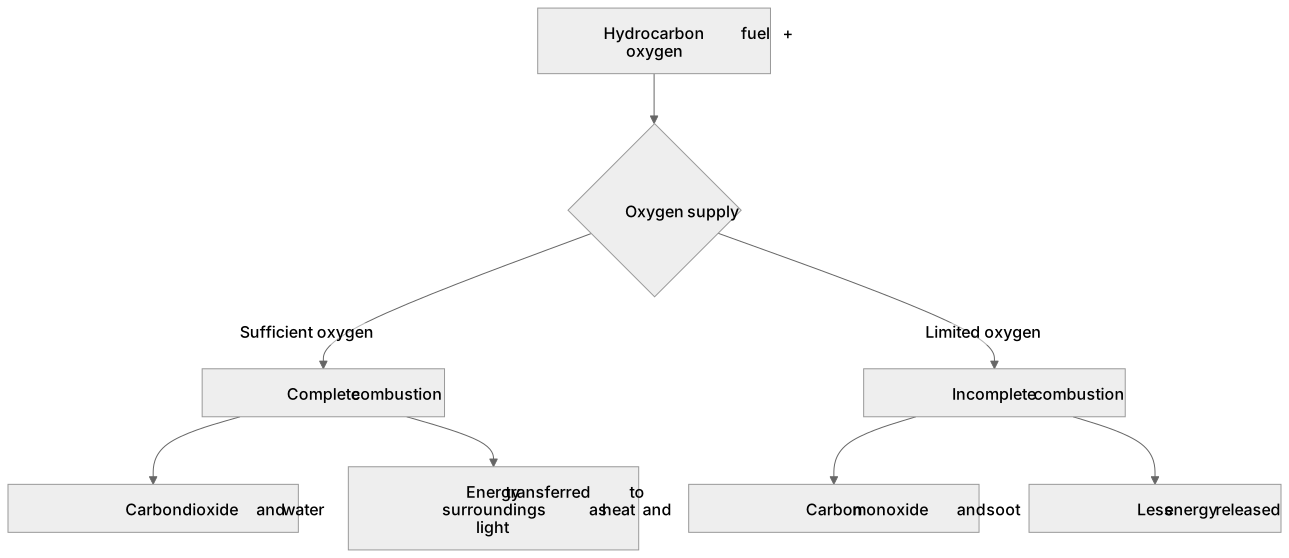
Combustion is an exothermic reaction: when a hydrocarbon fuel burns in oxygen, energy is transferred to the surroundings, usually as heat and light.
Checked against the AQA 8462 specification (opens in a new tab) on .
- Point 4 of 7
- 4 key terms
Study notes
From the checked teaching notes for this specification point.
The idea
Combustion is an exothermic reaction: when a hydrocarbon fuel burns in oxygen, energy is transferred to the surroundings, usually as heat and light. The reaction needs a supply of oxygen, and the products are carbon dioxide and water when the fuel burns completely. For example, burning methane in plenty of air releases energy and forms carbon dioxide and water. The energy released makes hydrocarbons valuable as fuels for heating, cooking, electricity generation and transport. If oxygen is limited, combustion is incomplete and can produce carbon monoxide and soot, releasing less energy and creating a hazard, so a good air supply matters for safe and efficient burning.
What earns the marks
- Combustion of a hydrocarbon fuel is an exothermic reaction that transfers energy to the surroundings.
- The energy is released mainly as heat, with light also produced in a flame.
- Complete combustion needs sufficient oxygen and produces carbon dioxide and water.
- The energy released is why hydrocarbons are used as fuels for heating, cooking, electricity generation and transport.
- Incomplete combustion, caused by limited oxygen, releases less energy and can produce carbon monoxide and soot.
Common mistakes and how to put them right
Describing combustion as endothermic.
Put it right: Burning hydrocarbons releases energy, so it is exothermic.
Forgetting that oxygen is a reactant.
Put it right: Combustion needs a supply of oxygen from the air.
Assuming combustion always gives only carbon dioxide and water.
Put it right: With limited oxygen, carbon monoxide and soot can also form.
Exam tips
- Use the term exothermic and state that energy is transferred to the surroundings.
- Name the reactants and products of complete combustion when the question asks for the reaction.
- If asked about safety or efficiency, link incomplete combustion to a limited oxygen supply.
Try the lesson
The start of the Properties of hydrocarbons: The combustion of hydrocarbon fuels releases energy. lesson, made from checked teaching notes for this specification point.
Have a go first
Which statement describes the energy change when a hydrocarbon fuel burns in oxygen?
Listen
Combustion is an exothermic reaction: when a hydrocarbon fuel burns in oxygen, energy is transferred to the surroundings, usually as heat and light. The reaction needs a supply of oxygen, and the products are carbon dioxide and water when the fuel burns completely. For example, burning methane in plenty of air releases energy and forms carbon dioxide and water. The energy released makes hydrocarbons valuable as fuels for heating, cooking, electricity generation and transport. If oxygen is limited, combustion is incomplete and can produce carbon monoxide and soot, releasing less energy and creating a hazard, so a good air supply matters for safe and efficient burning. A strong answer earns marks for these points. Combustion of a hydrocarbon fuel is an exothermic reaction that transfers energy to the surroundings. The energy is released mainly as heat, with light also produced in a flame. Complete combustion needs sufficient oxygen and produces carbon dioxide and water. The energy released is why hydrocarbons are used as fuels for heating, cooking, electricity generation and transport. Exam tip: Use the term exothermic and state that energy is transferred to the surroundings.
See it
Key words
Say what each word means before you turn the card.
Exothermic reactions
Try answering aloud or in your head before turning the card.
Energy transfer
Try answering aloud or in your head before turning the card.
Complete and incomplete combustion
Try answering aloud or in your head before turning the card.
Fuels and energy resources
Try answering aloud or in your head before turning the card.
See every definition
- Exothermic reactions
- Combustion is an exothermic reaction, meaning it releases energy when a hydrocarbon fuel burns.
- Energy transfer
- When a hydrocarbon fuel burns in oxygen, energy is transferred to the surroundings, usually as heat and light.
- Complete and incomplete combustion
- Complete combustion needs sufficient oxygen and produces carbon dioxide and water, while incomplete combustion, caused by limited oxygen, releases less energy and can produce carbon monoxide and soot.
- Fuels and energy resources
- The energy released makes hydrocarbons valuable as fuels for heating, cooking, electricity generation and transport.
There is more to this lesson
The full lesson goes on to check your understanding and help you earn the marks. Create a free account to carry on, with your progress saved.
A week of Premium from your first lesson · Then the free plan continues · No card, no charge
Test your understanding of Properties of hydrocarbons: The combustion of hydrocarbon fuels releases energy.
Active recall beats re-reading. Take an instant quiz now to test what you’ve learned and lock it into long-term memory.
A week of Premium from your first lesson · Then the free plan continues · No card, no charge