AQA · GCSE · Chemistry
Course version: 8462 · Version from Sept 2018
The minimum amount of energy that particles must have to react is called…
Full specification wording
Reaction profiles: The minimum amount of energy that particles must have to react is called the activation energy.
Particles collide constantly, but most collisions do nothing because the particles simply bounce apart.
Checked against the AQA 8462 specification (opens in a new tab) on .
- Point 2 of 4
- 4 key terms
Study notes
From the checked teaching notes for this specification point.
The idea
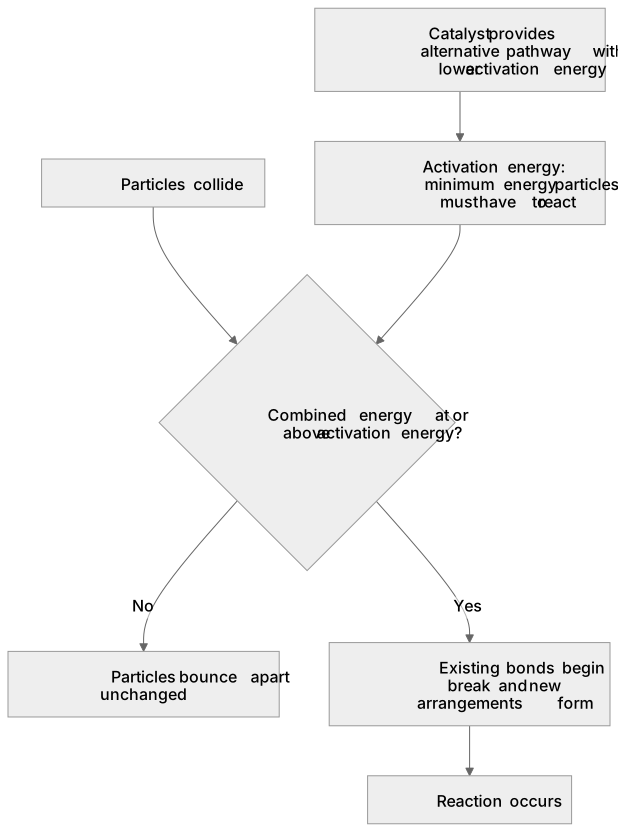
Particles collide constantly, but most collisions do nothing because the particles simply bounce apart. For a reaction to happen, the colliding particles must have at least a certain amount of kinetic energy so that existing bonds can begin to break and new arrangements can form. This threshold is the activation energy. Picture two molecules approaching: if their combined energy is below the threshold, they rebound unchanged; if it equals or exceeds the threshold, they can react. Activation energy is measured in joules, commonly kJ/mol, and is shown on a reaction profile as the vertical gap from the reactant energy level up to the peak of the curve. A high activation energy means few collisions succeed, so the reaction is slow at a given temperature; adding a catalyst provides an alternative pathway with a lower activation energy.
What earns the marks
- Activation energy is defined as the minimum energy that colliding particles must possess for a reaction to occur.
- On a reaction profile it is represented by the vertical distance from the reactants' energy level to the highest point of the curve.
- Collisions with energy below the activation energy do not lead to reaction; the particles separate unchanged.
- Activation energy is usually expressed in kJ/mol and is not the same as the overall energy change of the reaction.
- A catalyst lowers the activation energy by providing an alternative reaction pathway.
Common mistakes and how to put them right
Confusing activation energy with the overall energy change.
Put it right: The overall change is the difference between reactant and product energy levels, whereas activation energy is measured from the reactants up to the peak.
Thinking that every collision causes a reaction.
Put it right: Only collisions with energy at or above the activation energy are successful.
Believing a catalyst increases the energy of the particles.
Put it right: A catalyst lowers the activation energy instead, leaving particle energies unchanged.
Exam tips
- When labelling a profile, draw the activation energy arrow from the reactant level to the top of the curve, not from the products.
- Use the phrase 'minimum energy' in definitions; answers that say only 'the energy needed' may be treated as incomplete.
- Check the units: if the axis is in kJ/mol, give activation energy values in kJ/mol rather than J.
Try the lesson
The start of the Reaction profiles: The minimum amount of energy that particles must have to react is called the activation energy. lesson, made from checked teaching notes for this specification point.
Have a go first
What name is given to the minimum amount of energy that particles must have in order to react?
Listen
Particles collide constantly, but most collisions do nothing because the particles simply bounce apart. For a reaction to happen, the colliding particles must have at least a certain amount of kinetic energy so that existing bonds can begin to break and new arrangements can form. This threshold is the activation energy. Picture two molecules approaching: if their combined energy is below the threshold, they rebound unchanged; if it equals or exceeds the threshold, they can react. Activation energy is measured in joules, commonly kJ/mol, and is shown on a reaction profile as the vertical gap from the reactant energy level up to the peak of the curve. A high activation energy means few collisions succeed, so the reaction is slow at a given temperature; adding a catalyst provides an alternative pathway with a lower activation energy. A strong answer earns marks for these points. Activation energy is defined as the minimum energy that colliding particles must possess for a reaction to occur. On a reaction profile it is represented by the vertical distance from the reactants' energy level to the highest point of the curve. Collisions with energy below the activation energy do not lead to reaction; the particles separate unchanged. Activation energy is usually expressed in kJ/mol and is not the same as the overall energy change of the reaction. Exam tip: When labelling a profile, draw the activation energy arrow from the reactant level to the top of the curve, not from the products.
See it
Key words
Say what each word means before you turn the card.
Activation energy
Try answering aloud or in your head before turning the card.
Catalyst
Try answering aloud or in your head before turning the card.
Collisions
Try answering aloud or in your head before turning the card.
Reaction profile
Try answering aloud or in your head before turning the card.
See every definition
- Activation energy
- The minimum amount of energy that particles must have to react, shown on a reaction profile as the vertical gap from the reactant energy level up to the peak of the curve.
- Catalyst
- Something that provides an alternative pathway with a lower activation energy.
- Collisions
- Particles collide constantly, but most do nothing because the particles simply bounce apart; only those with energy at or above the activation energy can react.
- Reaction profile
- A curve on which activation energy is shown as the vertical gap from the reactant energy level up to the peak.
There is more to this lesson
The full lesson goes on to check your understanding and help you earn the marks. Create a free account to carry on, with your progress saved.
A week of Premium from your first lesson · Then the free plan continues · No card, no charge
Test your understanding of Reaction profiles: The minimum amount of energy that particles must have to react is called the activation energy.
Active recall beats re-reading. Take an instant quiz now to test what you’ve learned and lock it into long-term memory.
A week of Premium from your first lesson · Then the free plan continues · No card, no charge