AQA · GCSE · Chemistry
Course version: 8462 · Version from Sept 2018
Students should be able to use the nuclear model to describe atoms.
Full specification wording
Relative electrical charges of subatomic particles: Students should be able to use the nuclear model to describe atoms.
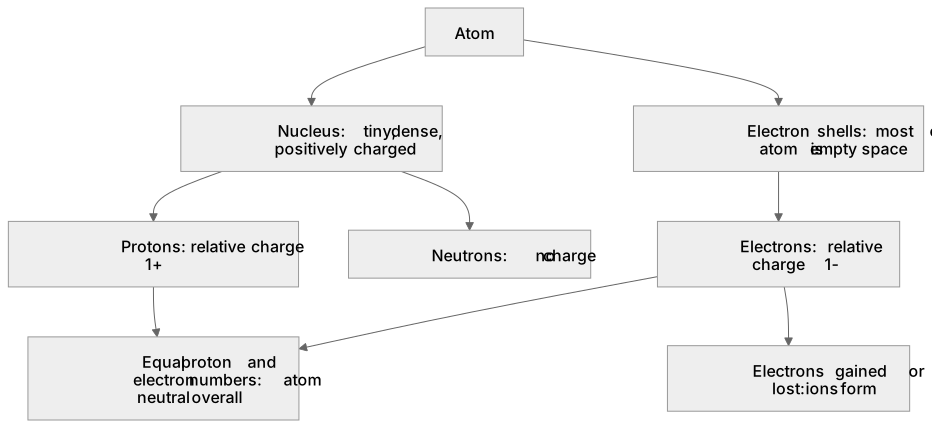
The nuclear model describes an atom as a tiny, dense, positively charged nucleus surrounded by electrons in shells.
Checked against the AQA 8462 specification (opens in a new tab) on .
- Point 5 of 5
- 4 key terms
Study notes
From the checked teaching notes for this specification point.
The idea
The nuclear model describes an atom as a tiny, dense, positively charged nucleus surrounded by electrons in shells. The nucleus contains protons, each with relative charge 1⁺, and neutrons, which have no charge; together they give the nucleus almost all of the atom's mass. Electrons carry relative charge 1⁻ and occupy shells at relatively large distances from the nucleus, so most of the atom is empty space. For example, a sodium atom has 11 protons and 12 neutrons in its nucleus, with 11 electrons in shells around it. The model explains why atoms are neutral overall and how ions form when electrons are gained or lost. It does not include a fixed scale diagram, so descriptions should focus on relative charge, mass and position.
What earns the marks
- Describe the nucleus as tiny, dense and positively charged, containing protons and neutrons.
- State the relative charges: proton 1⁺, neutron 0, electron 1⁻.
- Explain that electrons occupy shells around the nucleus and that most of the atom is empty space.
- Use the model to account for an atom being neutral overall when proton and electron numbers are equal.
- Apply the model to a named atom by giving proton, neutron and electron numbers.
Common mistakes and how to put them right
Placing electrons inside the nucleus.
Put it right by stating that electrons occupy shells around the nucleus.
Saying neutrons are positively charged.
Put it right by stating that neutrons have no charge, while protons are positive.
Describing the nucleus as large compared with the whole atom.
Put it right by stating that the nucleus is very small and dense relative to the atom.
Exam tips
- Use the terms nucleus, shells and relative charge in your description to cover the key features.
- When drawing or describing an atom, label the nucleus and electron shells clearly.
- Check that your description explains why the atom is neutral overall, not just what it contains.
Try the lesson
The start of the Relative electrical charges of subatomic particles: Students should be able to use the nuclear model to describe atoms. lesson, made from checked teaching notes for this specification point.
Have a go first
According to the nuclear model, where is most of the mass of an atom concentrated?
Listen
The nuclear model describes an atom as a tiny, dense, positively charged nucleus surrounded by electrons in shells. The nucleus contains protons, each with relative charge 1⁺, and neutrons, which have no charge; together they give the nucleus almost all of the atom's mass. Electrons carry relative charge 1⁻ and occupy shells at relatively large distances from the nucleus, so most of the atom is empty space. For example, a sodium atom has 11 protons and 12 neutrons in its nucleus, with 11 electrons in shells around it. The model explains why atoms are neutral overall and how ions form when electrons are gained or lost. It does not include a fixed scale diagram, so descriptions should focus on relative charge, mass and position. A strong answer earns marks for these points. Describe the nucleus as tiny, dense and positively charged, containing protons and neutrons. State the relative charges: proton 1⁺, neutron 0, electron 1⁻. Explain that electrons occupy shells around the nucleus and that most of the atom is empty space. Use the model to account for an atom being neutral overall when proton and electron numbers are equal. A common slip: Placing electrons inside the nucleus. Instead, stating that electrons occupy shells around the nucleus. Exam tip: Use the terms nucleus, shells and relative charge in your description to cover the key features.
See it
Key words
Say what each word means before you turn the card.
Nuclear model
Try answering aloud or in your head before turning the card.
Subatomic particles
Try answering aloud or in your head before turning the card.
Relative charge and mass
Try answering aloud or in your head before turning the card.
Atomic neutrality
Try answering aloud or in your head before turning the card.
See every definition
- Nuclear model
- Describes an atom as a tiny, dense, positively charged nucleus surrounded by electrons in shells, with most of the atom being empty space.
- Subatomic particles
- Protons, each with relative charge 1⁺, and neutrons, which have no charge, are found in the nucleus, while electrons carry relative charge 1⁻ and occupy shells.
- Relative charge and mass
- Protons have relative charge 1⁺, neutrons have no charge and electrons carry relative charge 1⁻, with protons and neutrons together giving the nucleus almost all of the atom's mass.
- Atomic neutrality
- Atoms are neutral overall when proton and electron numbers are equal, and ions form when electrons are gained or lost.
Label the diagram
Some boxes have lost their names. Pick the right name for each number.
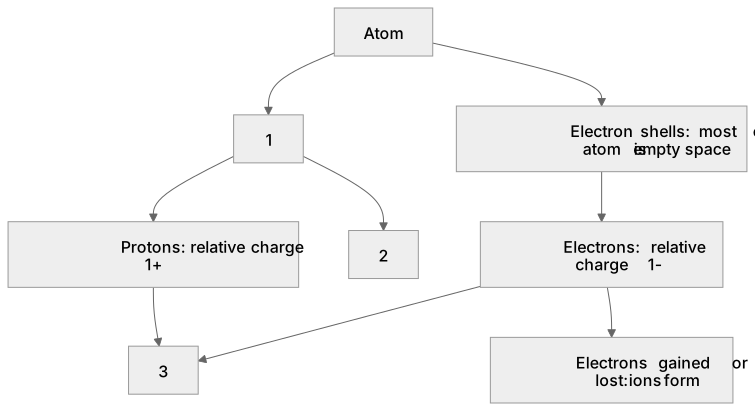
1Box 1
2Box 2
3Box 3
There is more to this lesson
The full lesson goes on to check your understanding and help you earn the marks. Create a free account to carry on, with your progress saved.
A week of Premium from your first lesson · Then the free plan continues · No card, no charge
Test your understanding of Relative electrical charges of subatomic particles: Students should be able to use the nuclear model to describe atoms.
Active recall beats re-reading. Take an instant quiz now to test what you’ve learned and lock it into long-term memory.
A week of Premium from your first lesson · Then the free plan continues · No card, no charge