AQA · GCSE · Chemistry
Course version: 8462 · Version from Sept 2018
As the side of cube decreases by a factor of 10 the surface area to volume…
Full specification wording
Sizes of particles and their properties: As the side of cube decreases by a factor of 10 the surface area to volume ratio increases by a factor of 10.
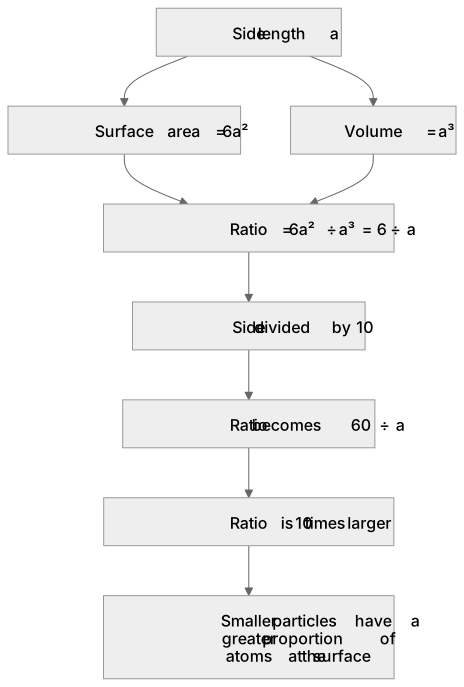
For a cube of side length a, surface area is 6a² and volume is a³, so the surface area to volume ratio is 6a² ÷ a³ = 6 ÷ a.
Checked against the AQA 8462 specification (opens in a new tab) on .
- Point 3 of 6
- 3 key terms
Study notes
From the checked teaching notes for this specification point.
The idea
For a cube of side length a, surface area is 6a² and volume is a³, so the surface area to volume ratio is 6a² ÷ a³ = 6 ÷ a. If the side length is divided by 10, the ratio becomes 6 ÷ (a ÷ 10) = 60 ÷ a, which is 10 times larger. This inverse relationship explains why smaller particles have a greater proportion of their atoms at the surface.
For example: A cube with side 10 cm has a ratio of 0.6 cm⁻¹, while a cube with side 1 cm has a ratio of 6 cm⁻¹.
What earns the marks
- Recalls that surface area of a cube is 6a² and volume is a³ for side length a.
- Calculates the surface area to volume ratio as 6 ÷ a and recognises its inverse relationship with side length.
- Shows that dividing the side length by 10 multiplies the ratio by 10.
- Applies the relationship to compare cubes of different sizes using correct units.
- Uses the ratio to explain why smaller particles have a higher proportion of surface atoms.
Common mistakes and how to put them right
Squaring the side length when calculating volume.
Put it right by using a³ for volume and 6a² for surface area.
Thinking the ratio increases by a factor of 100 when the side decreases by 10.
Put it right by showing the ratio is inversely proportional to side length, so the factor is 10.
Omitting units or using inconsistent units.
Put it right by keeping all lengths in the same unit and expressing the ratio with a unit such as cm⁻¹.
Exam tips
- Write the formulae surface area = 6a² and volume = a³ before substituting values.
- Show the ratio as a fraction and simplify to 6 ÷ a to make the inverse relationship clear.
- Test the factor-of-10 claim with a numerical example, such as side 10 cm and side 1 cm, to confirm the result.
Try the lesson
The start of the Sizes of particles and their properties: As the side of cube decreases by a factor of 10 the surface area to volume ratio increases by a factor of 10. lesson, made from checked teaching notes for this specification point.
Have a go first
A cube has its side length decreased by a factor of 10. What happens to its surface area to volume ratio?
Listen
For a cube of side length a, surface area is 6a² and volume is a³, so the surface area to volume ratio is 6a² ÷ a³ = 6 ÷ a. If the side length is divided by 10, the ratio becomes 6 ÷ (a ÷ 10) = 60 ÷ a, which is 10 times larger. This inverse relationship explains why smaller particles have a greater proportion of their atoms at the surface. For example, a cube with side 10 cm has a ratio of 0.6 cm⁻¹, while a cube with side 1 cm has a ratio of 6 cm⁻¹. A strong answer earns marks for these points. Recalls that surface area of a cube is 6a² and volume is a³ for side length a. Calculates the surface area to volume ratio as 6 ÷ a and recognises its inverse relationship with side length. Shows that dividing the side length by 10 multiplies the ratio by 10. Applies the relationship to compare cubes of different sizes using correct units. A common slip: Squaring the side length when calculating volume. Instead, using a³ for volume and 6a² for surface area. Exam tip: Write the formulae surface area = 6a² and volume = a³ before substituting values.
See it
Key words
Say what each word means before you turn the card.
Surface area to volume ratio
Try answering aloud or in your head before turning the card.
Inverse proportionality
Try answering aloud or in your head before turning the card.
Size-dependent properties
Try answering aloud or in your head before turning the card.
See every definition
- Surface area to volume ratio
- For a cube of side length a, surface area is 6a² and volume is a³, so the ratio is 6a² ÷ a³ = 6 ÷ a.
- Inverse proportionality
- The ratio is inversely proportional to side length, so dividing the side length by 10 multiplies the ratio by 10.
- Size-dependent properties
- The ratio explains why smaller particles have a greater proportion of their atoms at the surface, so properties change with particle size.
Label the diagram
Some boxes have lost their names. Pick the right name for each number.
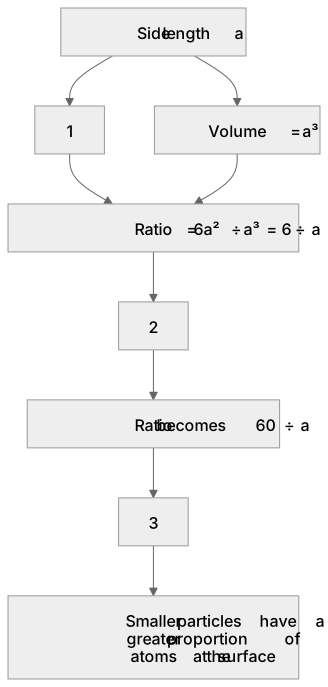
1Box 1
2Box 2
3Box 3
There is more to this lesson
The full lesson goes on to check your understanding and help you earn the marks. Create a free account to carry on, with your progress saved.
A week of Premium from your first lesson · Then the free plan continues · No card, no charge
Test your understanding of Sizes of particles and their properties: As the side of cube decreases by a factor of 10 the surface area to volume ratio increases by a factor of 10.
Active recall beats re-reading. Take an instant quiz now to test what you’ve learned and lock it into long-term memory.
A week of Premium from your first lesson · Then the free plan continues · No card, no charge