AQA · GCSE · Chemistry
Course version: 8462 · Version from Sept 2018
Coarse particles are often referred to as dust.
Full specification wording
Sizes of particles and their properties: Coarse particles are often referred to as dust.
Coarse particles are larger particles, typically with diameters from about 1 × 10⁻⁵ m to 2.5 × 10⁻⁶ m, and they are commonly called dust.
Checked against the AQA 8462 specification (opens in a new tab) on .
- Point 2 of 6
- 3 key terms
Study notes
From the checked teaching notes for this specification point.
The idea
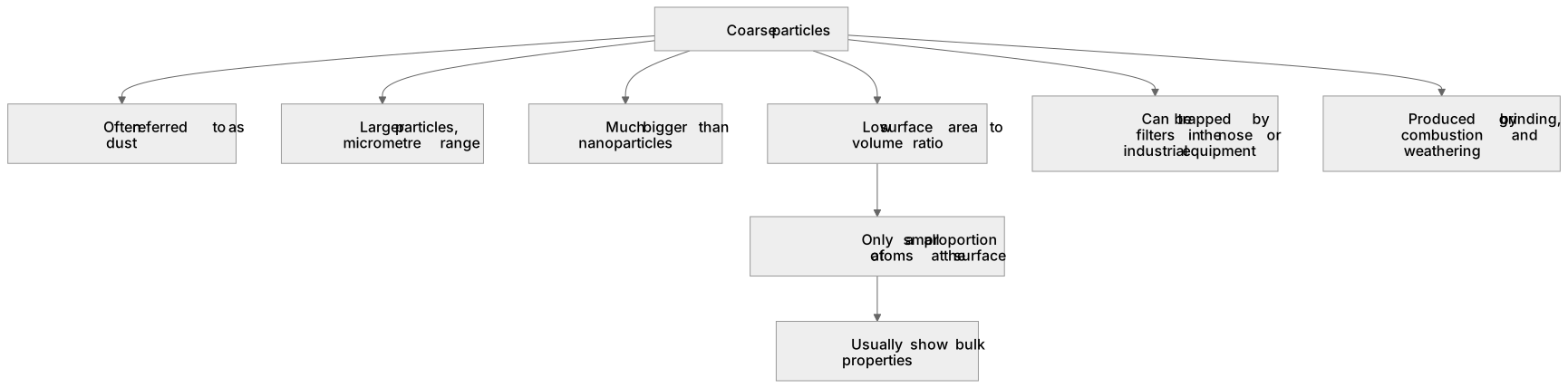
Coarse particles are larger particles, typically with diameters from about 1 × 10⁻⁵ m to 2.5 × 10⁻⁶ m, and they are commonly called dust. They are much bigger than nanoparticles and can be trapped by filters in the nose or in industrial equipment. Their relatively small surface area to volume ratio means only a small proportion of their atoms lie at the surface, so they usually show the familiar bulk properties of the material. Understanding this term helps when comparing the behaviour and health effects of particles of different sizes.
What earns the marks
- States that coarse particles are larger particles commonly known as dust.
- Places coarse particles above the nanoscale, typically in the micrometre range.
- Contrasts coarse particles with nanoparticles in terms of size and surface area to volume ratio.
- Explains that coarse particles generally show bulk properties because most atoms are inside the particle rather than at its surface.
- Links coarse particles to everyday sources such as dust from roads, mining or combustion.
Common mistakes and how to put them right
Calling nanoparticles dust; correct by reserving the term coarse particles or dust for the larger micrometre-scale particles.
Assuming dust is a single chemical.
Put it right by describing dust as a mixture of particles of various materials and sizes.
Believing coarse particles have a high surface area to volume ratio.
Put it right by stating that their ratio is low compared with nanoparticles.
Exam tips
- Use the phrase coarse particles are often referred to as dust when defining the term.
- Give a size comparison, such as coarse particles being micrometres across while nanoparticles are 1–100 nm.
- Link the low surface area to volume ratio of coarse particles to their bulk behaviour when explaining properties.
Try the lesson
The start of the Sizes of particles and their properties: Coarse particles are often referred to as dust. lesson, made from checked teaching notes for this specification point.
Have a go first
Which everyday word is often used for coarse particles?
Listen
Coarse particles are larger particles, typically with diameters from about 1 × 10⁻⁵ m to 2.5 × 10⁻⁶ m, and they are commonly called dust. They are much bigger than nanoparticles and can be trapped by filters in the nose or in industrial equipment. Their relatively small surface area to volume ratio means only a small proportion of their atoms lie at the surface, so they usually show the familiar bulk properties of the material. Understanding this term helps when comparing the behaviour and health effects of particles of different sizes. A strong answer earns marks for these points. States that coarse particles are larger particles commonly known as dust. Places coarse particles above the nanoscale, typically in the micrometre range. Contrasts coarse particles with nanoparticles in terms of size and surface area to volume ratio. Explains that coarse particles generally show bulk properties because most atoms are inside the particle rather than at its surface. A common slip: Assuming dust is a single chemical. Instead, describing dust as a mixture of particles of various materials and sizes. Exam tip: Use the phrase coarse particles are often referred to as dust when defining the term.
See it
Key words
Say what each word means before you turn the card.
Coarse particles
Try answering aloud or in your head before turning the card.
Bulk properties
Try answering aloud or in your head before turning the card.
Nanoparticles
Try answering aloud or in your head before turning the card.
See every definition
- Coarse particles
- Larger particles, typically with diameters from about 1 × 10⁻⁵ m to 2.5 × 10⁻⁶ m, commonly called dust.
- Bulk properties
- The familiar properties of the material that coarse particles usually show because most of their atoms are inside the particle rather than at its surface.
- Nanoparticles
- Much smaller particles than coarse particles, which coarse particles are distinguished from by size.
Label the diagram
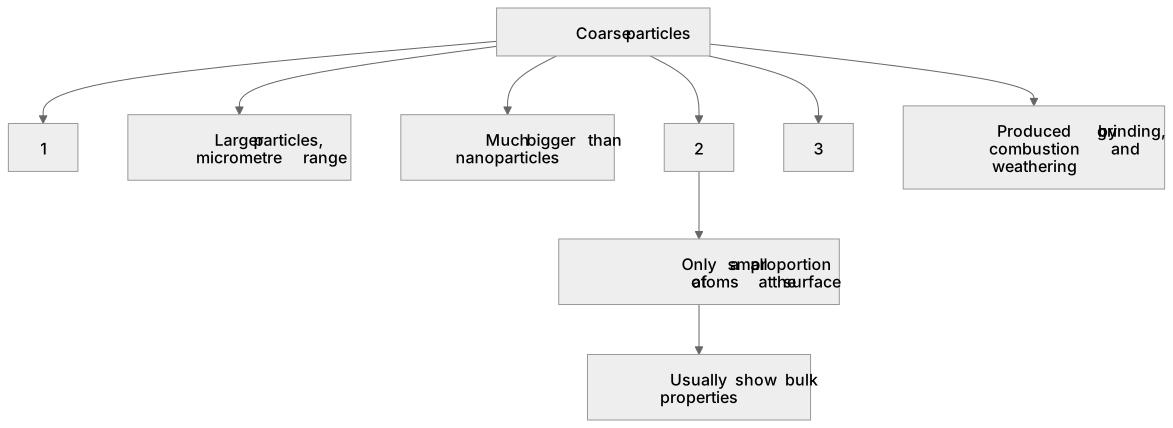
Some boxes have lost their names. Pick the right name for each number.
1Box 1
2Box 2
3Box 3
There is more to this lesson
The full lesson goes on to check your understanding and help you earn the marks. Create a free account to carry on, with your progress saved.
A week of Premium from your first lesson · Then the free plan continues · No card, no charge
Test your understanding of Sizes of particles and their properties: Coarse particles are often referred to as dust.
Active recall beats re-reading. Take an instant quiz now to test what you’ve learned and lock it into long-term memory.
A week of Premium from your first lesson · Then the free plan continues · No card, no charge