AQA · GCSE · Chemistry
Course version: 8462 · Version from Sept 2018
Nanoscience refers to structures that are 1–100 nm in size, of the order…
Full specification wording
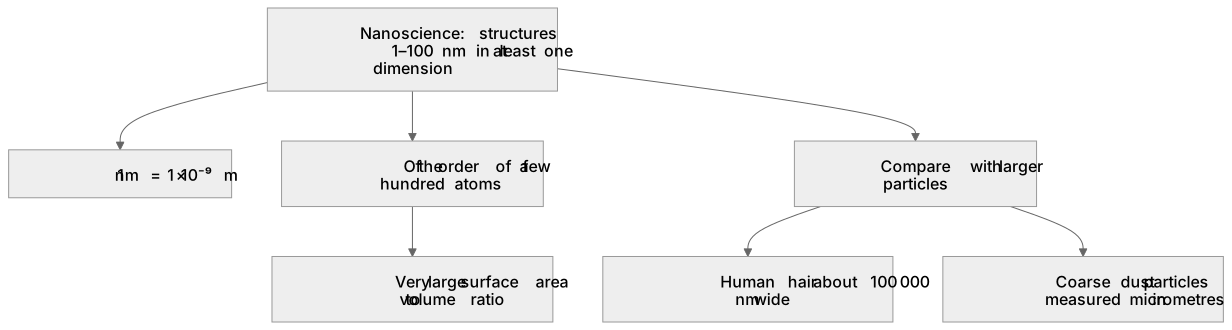
Sizes of particles and their properties: Nanoscience refers to structures that are 1–100 nm in size, of the order of a few hundred atoms.
Nanoscience studies structures with at least one dimension between 1 nm and 100 nm.
Checked against the AQA 8462 specification (opens in a new tab) on .
- Point 1 of 6
- 3 key terms
Study notes
From the checked teaching notes for this specification point.
The idea
Nanoscience studies structures with at least one dimension between 1 nm and 100 nm. A nanometre is 1 × 10⁻⁹ m, so these objects are far smaller than everyday particles but larger than single atoms. Because a typical atom is roughly 0.1–0.3 nm across, a 1–100 nm structure contains of the order of a few hundred atoms, which explains why nanoparticles behave differently from bulk solids.
For example: A gold nanoparticle about 10 nm wide contains thousands of atoms arranged in a tiny crystal, yet its surface atoms form a large fraction of the total.
What earns the marks
- States that nanoscience involves structures with at least one dimension from 1 nm to 100 nm.
- Recalls that 1 nm = 1 × 10⁻⁹ m and can convert a nanoscale length into metres.
- Explains that nanoscale structures contain of the order of a few hundred atoms, linking size to atomic scale.
- Compares nanoparticle dimensions with larger particles such as dust or a human hair to place the scale in context.
- Uses the nanometre scale to justify why nanoparticles have a very large surface area to volume ratio.
Common mistakes and how to put them right
Treating 1–100 nm as a mass or volume range rather than a length range.
Put it right by specifying that at least one dimension of the structure lies in that range.
Confusing nanometres with micrometres or millimetres.
Put it right by recalling 1 nm = 1 × 10⁻⁹ m and 1 µm = 1 × 10⁻⁶ m.
Assuming a nanoparticle contains only a few atoms.
Put it right by explaining that a few hundred atoms is the order of magnitude for structures in this size range.
Exam tips
- Quote the range 1–100 nm and define the nanometre in metres when a question asks for the scale of nanoscience.
- Use a familiar comparison, such as a human hair being about 100 000 nm wide, to show the tiny scale.
- When calculating, convert nanometres to metres before substituting into any surface area or volume formula.
Try the lesson
The start of the Sizes of particles and their properties: Nanoscience refers to structures that are 1–100 nm in size, of the order of a few hundred atoms. lesson, made from checked teaching notes for this specification point.
Have a go first
Which size range describes the structures studied in nanoscience?
Listen
Nanoscience studies structures with at least one dimension between 1 nm and 100 nm. A nanometre is 1 × 10⁻⁹ m, so these objects are far smaller than everyday particles but larger than single atoms. Because a typical atom is roughly 0.1–0.3 nm across, a 1–100 nm structure contains of the order of a few hundred atoms, which explains why nanoparticles behave differently from bulk solids. For example, a gold nanoparticle about 10 nm wide contains thousands of atoms arranged in a tiny crystal, yet its surface atoms form a large fraction of the total. A strong answer earns marks for these points. States that nanoscience involves structures with at least one dimension from 1 nm to 100 nm. Recalls that 1 nm = 1 × 10⁻⁹ m and can convert a nanoscale length into metres. Explains that nanoscale structures contain of the order of a few hundred atoms, linking size to atomic scale. Compares nanoparticle dimensions with larger particles such as dust or a human hair to place the scale in context. A common slip: Treating 1–100 nm as a mass or volume range rather than a length range. Instead, specifying that at least one dimension of the structure lies in that range. Exam tip: Quote the range 1–100 nm and define the nanometre in metres when a question asks for the scale of nanoscience.
See it
Key words
Say what each word means before you turn the card.
Nanoscience
Try answering aloud or in your head before turning the card.
Scale and measurement
Try answering aloud or in your head before turning the card.
Particle size and atomic dimensions
Try answering aloud or in your head before turning the card.
See every definition
- Nanoscience
- Refers to structures that are 1–100 nm in size, of the order of a few hundred atoms.
- Scale and measurement
- A nanometre is 1 × 10⁻⁹ m, so nanoscale objects are far smaller than everyday particles but larger than single atoms.
- Particle size and atomic dimensions
- A typical atom is roughly 0.1–0.3 nm across, so a 1–100 nm structure contains of the order of a few hundred atoms.
Label the diagram
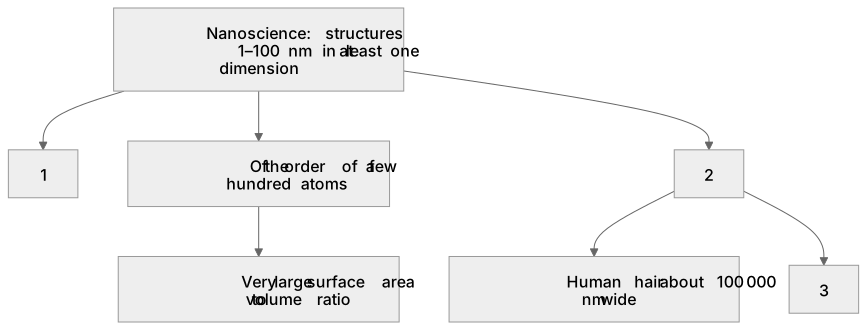
Some boxes have lost their names. Pick the right name for each number.
1Box 1
2Box 2
3Box 3
There is more to this lesson
The full lesson goes on to check your understanding and help you earn the marks. Create a free account to carry on, with your progress saved.
A week of Premium from your first lesson · Then the free plan continues · No card, no charge
Test your understanding of Sizes of particles and their properties: Nanoscience refers to structures that are 1–100 nm in size, of the order of a few hundred atoms.
Active recall beats re-reading. Take an instant quiz now to test what you’ve learned and lock it into long-term memory.
A week of Premium from your first lesson · Then the free plan continues · No card, no charge