AQA · GCSE · Chemistry
Course version: 8462 · Version from Sept 2018
In chemical equations, the three states of matter are shown as (s), (l)…
Full specification wording
State symbols: In chemical equations, the three states of matter are shown as (s), (l) and (g), with (aq) for aqueous solutions.
State symbols record the physical state of each substance in a chemical equation.
Checked against the AQA 8462 specification (opens in a new tab) on .
- Point 1 of 2
Study notes
From the checked teaching notes for this specification point.
The idea
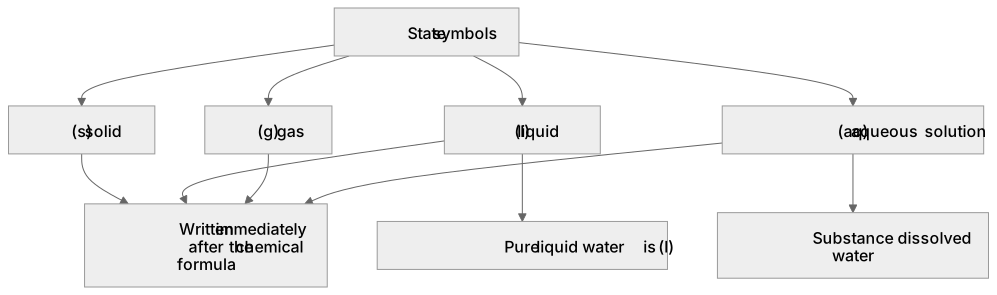
State symbols record the physical state of each substance in a chemical equation. Solid is (s), liquid is (l), gas is (g) and aqueous, meaning dissolved in water, is (aq). They are written immediately after the chemical formula, for example 2Na(s) + 2H₂O(l) → 2NaOH(aq) + H₂(g). State symbols are added after balancing, because changing a formula to show a state must not change the formula itself. They help chemists check that the equation matches the reaction described, such as a gas being produced or a precipitate forming. Aqueous does not mean liquid water: it means a substance dissolved in water, so an ionic compound in solution is shown as (aq) even though the solution is a liquid.
What earns the marks
- Use (s) for solid, (l) for liquid, (g) for gas and (aq) for aqueous solution.
- Place the state symbol immediately after the chemical formula it describes.
- Use (aq) for a substance dissolved in water, not for pure liquid water, which is (l).
- Check that state symbols are consistent with the reaction described, such as a gas product or a precipitate.
- Keep the chemical formula unchanged when adding state symbols.
Common mistakes and how to put them right
Writing (aq) for pure water.
Put it right by using (l) for liquid water and (aq) only for a substance dissolved in water.
Placing the state symbol before the formula or inside it.
Put it right by writing it immediately after the formula.
Changing a subscript while adding a state symbol.
Put it right by leaving the formula exactly as it was and adding the symbol after it.
Exam tips
- Add state symbols after balancing the equation so the formulae are already correct.
- Check each symbol against the reaction context, especially whether a product is a gas or a precipitate.
- Remember that (aq) means dissolved in water, so it applies to solutions rather than to pure liquids.
Try the lesson
The start of the State symbols: In chemical equations, the three states of matter are shown as (s), (l) and (g), with (aq) for aqueous solutions. lesson, made from checked teaching notes for this specification point.
Have a go first
In a chemical equation, which state symbol represents a solid?
Listen
State symbols record the physical state of each substance in a chemical equation. Solid is (s), liquid is (l), gas is (g) and aqueous, meaning dissolved in water, is (aq). They are written immediately after the chemical formula, for example 2Na(s) + 2H₂O(l) → 2NaOH(aq) + H₂(g). State symbols are added after balancing, because changing a formula to show a state must not change the formula itself. They help chemists check that the equation matches the reaction described, such as a gas being produced or a precipitate forming. Aqueous does not mean liquid water: it means a substance dissolved in water, so an ionic compound in solution is shown as (aq) even though the solution is a liquid. A strong answer earns marks for these points. Use (s) for solid, (l) for liquid, (g) for gas and (aq) for aqueous solution. Place the state symbol immediately after the chemical formula it describes. Use (aq) for a substance dissolved in water, not for pure liquid water, which is (l). Check that state symbols are consistent with the reaction described, such as a gas product or a precipitate. A common slip: Writing (aq) for pure water. Instead, using (l) for liquid water and (aq) only for a substance dissolved in water. Exam tip: Add state symbols after balancing the equation so the formulae are already correct.
See it
Label the diagram
Some boxes have lost their names. Pick the right name for each number.
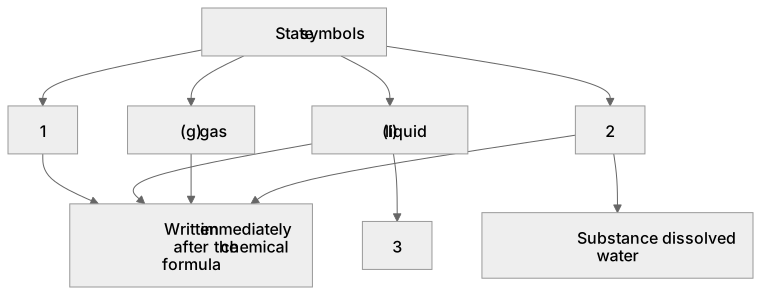
1Box 1
2Box 2
3Box 3
There is more to this lesson
The full lesson goes on to check your understanding and help you earn the marks. Create a free account to carry on, with your progress saved.
A week of Premium from your first lesson · Then the free plan continues · No card, no charge
Test your understanding of State symbols: In chemical equations, the three states of matter are shown as (s), (l) and (g), with (aq) for aqueous solutions.
Active recall beats re-reading. Take an instant quiz now to test what you’ve learned and lock it into long-term memory.
A week of Premium from your first lesson · Then the free plan continues · No card, no charge