AQA · GCSE · Chemistry
Course version: 8462 · Version from Sept 2018
Students should be able to include appropriate state symbols in chemical…
Full specification wording
State symbols: Students should be able to include appropriate state symbols in chemical equations for the reactions in this specification.
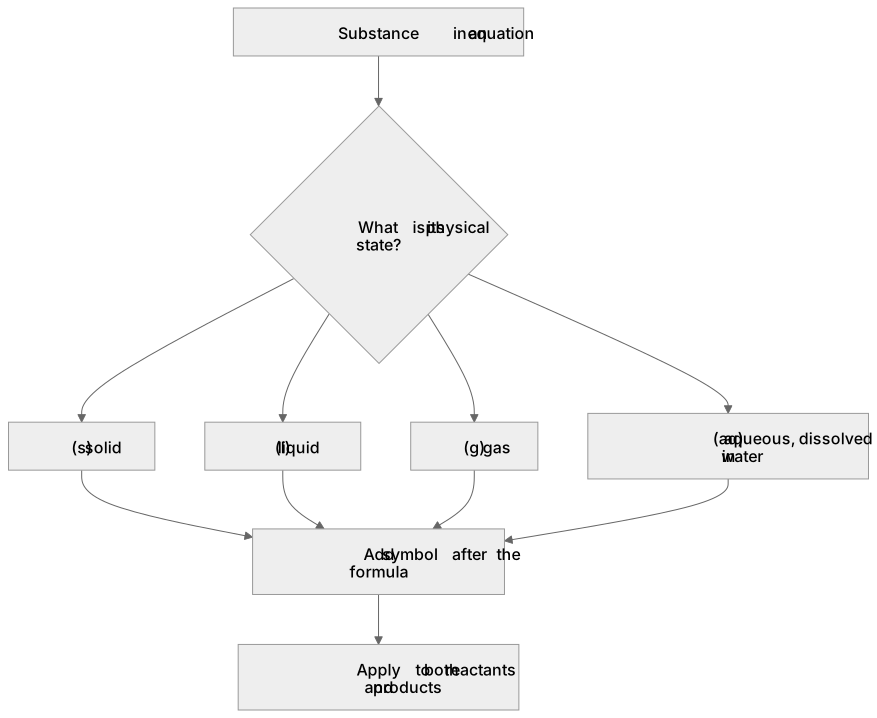
State symbols show the physical state of each substance in an equation: (s) solid, (l) liquid, (g) gas, (aq) aqueous (dissolved in water).
Checked against the AQA 8462 specification (opens in a new tab) on .
- Point 2 of 2
- 4 key terms
Study notes
From the checked teaching notes for this specification point.
The idea
State symbols show the physical state of each substance in an equation: (s) solid, (l) liquid, (g) gas, (aq) aqueous (dissolved in water). They are added after each formula, for example 2Na(s) + 2H₂O(l) → 2NaOH(aq) + H₂(g). To choose correctly, identify the state under the stated conditions: metals are usually solid; water is liquid; gases include H₂, O₂, CO₂; solutions are aqueous. For ionic equations, only ions and molecules in solution or as gases or solids are shown, with state symbols where required. The skill is assessed by requiring correct symbols in equations for specified reactions, not by memorising a fixed list.
What earns the marks
- Correctly assigns (s), (l), (g) or (aq) to each substance in an equation according to its physical state under the stated conditions.
- Uses (aq) for a substance dissolved in water, including acids and solutions of ionic compounds, rather than (l).
- Applies state symbols consistently to both reactants and products, including in equations with coefficients.
- Recognises that state symbols may be omitted in some contexts but must be included when the question asks for them or when they clarify the reaction.
- Uses state symbols correctly in ionic equations, for example Ag⁺(aq) + Cl⁻(aq) → AgCl(s).
Common mistakes and how to put them right
Writing (aq) for liquid water in a reaction where water is not the solvent.
Put it right: Use (l) for pure liquid water.
Omitting state symbols entirely when the question requires them.
Put it right: Add the appropriate symbol after every formula.
Using (s) for a dissolved ionic compound such as sodium chloride in solution.
Put it right: Use (aq) because it is dissolved in water.
Exam tips
- Read the question carefully: if it asks for state symbols, include them for every substance in the equation.
- Check the physical state at room temperature and pressure unless other conditions are given.
- For ionic equations, include state symbols only for the species shown, and ensure they match the full equation.
Try the lesson
The start of the State symbols: Students should be able to include appropriate state symbols in chemical equations for the reactions in this specification. lesson, made from checked teaching notes for this specification point.
Have a go first
Which state symbol is used after the formula of a substance that is a solid?
Listen
State symbols show the physical state of each substance in an equation: (s) solid, (l) liquid, (g) gas, (aq) aqueous (dissolved in water). They are added after each formula, for example 2Na(s) + 2H₂O(l) → 2NaOH(aq) + H₂(g). To choose correctly, identify the state under the stated conditions: metals are usually solid; water is liquid; gases include H₂, O₂, CO₂; solutions are aqueous. For ionic equations, only ions and molecules in solution or as gases or solids are shown, with state symbols where required. The skill is assessed by requiring correct symbols in equations for specified reactions, not by memorising a fixed list. A strong answer earns marks for these points. Correctly assigns (s), (l), (g) or (aq) to each substance in an equation according to its physical state under the stated conditions. Uses (aq) for a substance dissolved in water, including acids and solutions of ionic compounds, rather than (l). Applies state symbols consistently to both reactants and products, including in equations with coefficients. Recognises that state symbols may be omitted in some contexts but must be included when the question asks for them or when they clarify the reaction. A common slip: Writing (aq) for liquid water in a reaction where water is not the solvent. Instead, use (l) for pure liquid water. Exam tip: Read the question carefully: if it asks for state symbols, include them for every substance in the equation.
See it
Key words
Say what each word means before you turn the card.
State symbols
Try answering aloud or in your head before turning the card.
Aqueous
Try answering aloud or in your head before turning the card.
Ionic equations
Try answering aloud or in your head before turning the card.
Physical state
Try answering aloud or in your head before turning the card.
See every definition
- State symbols
- Symbols that show the physical state of each substance in an equation: (s) solid, (l) liquid, (g) gas, (aq) aqueous (dissolved in water).
- Aqueous
- Dissolved in water, shown by (aq), used for acids and solutions of ionic compounds rather than (l).
- Ionic equations
- Equations in which only ions and molecules in solution or as gases or solids are shown, with state symbols where required.
- Physical state
- The state of a substance under the stated conditions, such as metals usually solid, water liquid, and gases including H₂, O₂ and CO₂.
There is more to this lesson
The full lesson goes on to check your understanding and help you earn the marks. Create a free account to carry on, with your progress saved.
A week of Premium from your first lesson · Then the free plan continues · No card, no charge
Test your understanding of State symbols: Students should be able to include appropriate state symbols in chemical equations for the reactions in this specification.
Active recall beats re-reading. Take an instant quiz now to test what you’ve learned and lock it into long-term memory.
A week of Premium from your first lesson · Then the free plan continues · No card, no charge