AQA · GCSE · Chemistry
Course version: 8462 · Version from Sept 2018
Alkenes are hydrocarbons with a double carbon-carbon bond.
Full specification wording
Structure and formulae of alkenes: Alkenes are hydrocarbons with a double carbon-carbon bond.
Alkenes are a homologous series of unsaturated hydrocarbons.
Checked against the AQA 8462 specification (opens in a new tab) on .
- Point 1 of 2
Study notes
From the checked teaching notes for this specification point.
The idea
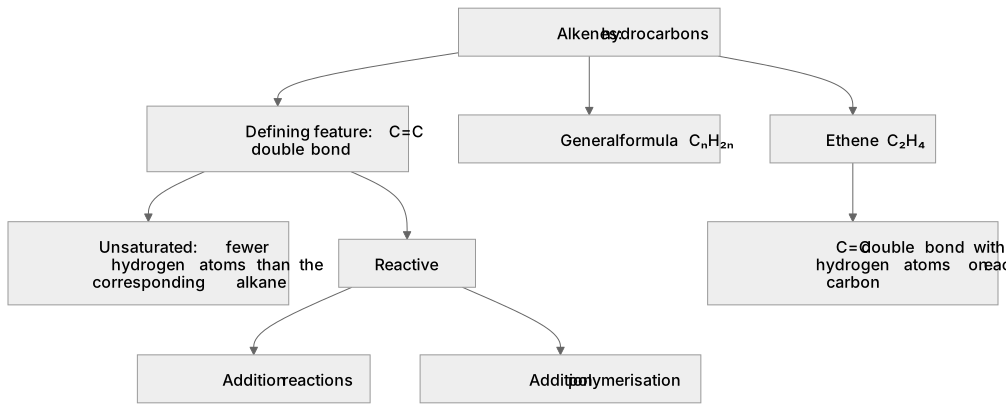
Alkenes are a homologous series of unsaturated hydrocarbons. Their defining feature is a double covalent bond between two carbon atoms, written as C=C. Ethene has the formula C₂H₄, with two carbon atoms joined by a double bond and two hydrogen atoms bonded to each carbon. The double bond means alkenes have two fewer hydrogen atoms than the corresponding alkane, so ethene is C₂H₄ while ethane is C₂H₆. The double bond makes alkenes reactive, so they undergo addition reactions, decolourise bromine water and can join together in addition polymerisation. General formula is CₙH₂ₙ for the chain members studied.
What earns the marks
- Alkenes contain only carbon and hydrogen, so they are hydrocarbons.
- The defining feature is a double covalent bond between two carbon atoms, shown as C=C.
- Ethene is C₂H₄ and has a C=C double bond with two hydrogen atoms on each carbon.
- Alkenes are unsaturated because they have fewer hydrogen atoms than the corresponding alkane.
- The double bond makes alkenes reactive, so they undergo addition reactions and addition polymerisation.
- The general formula of the alkene homologous series is CₙH₂ₙ.
Common mistakes and how to put them right
Drawing ethene with a single C-C bond.
Put it right: Draw C=C with two shared pairs of electrons.
Saying alkenes are saturated.
Put it right: Alkenes are unsaturated because of the C=C double bond.
Using the alkane general formula CₙH₂ₙ₊₂ for alkenes.
Put it right: Use CₙH₂ₙ for alkenes.
Exam tips
- Show the double bond clearly in displayed and structural formulae.
- Use the word unsaturated and link it to the C=C bond.
- Check hydrogen counts: ethene C₂H₄, propene C₃H₆, butene C₄H₈.
Try the lesson
The start of the Structure and formulae of alkenes: Alkenes are hydrocarbons with a double carbon-carbon bond. lesson, made from checked teaching notes for this specification point.
Have a go first
Which of these molecules is an alkene?
Listen
Alkenes are a homologous series of unsaturated hydrocarbons. Their defining feature is a double covalent bond between two carbon atoms, written as C=C. Ethene has the formula C₂H₄, with two carbon atoms joined by a double bond and two hydrogen atoms bonded to each carbon. The double bond means alkenes have two fewer hydrogen atoms than the corresponding alkane, so ethene is C₂H₄ while ethane is C₂H₆. The double bond makes alkenes reactive, so they undergo addition reactions, decolourise bromine water and can join together in addition polymerisation. General formula is CₙH₂ₙ for the chain members studied. A strong answer earns marks for these points. Alkenes contain only carbon and hydrogen, so they are hydrocarbons. The defining feature is a double covalent bond between two carbon atoms, shown as C=C. Ethene is C₂H₄ and has a C=C double bond with two hydrogen atoms on each carbon. Alkenes are unsaturated because they have fewer hydrogen atoms than the corresponding alkane. A common slip: Drawing ethene with a single C-C bond. Instead, draw C=C with two shared pairs of electrons. Exam tip: Show the double bond clearly in displayed and structural formulae.
See it
Label the diagram
Some boxes have lost their names. Pick the right name for each number.
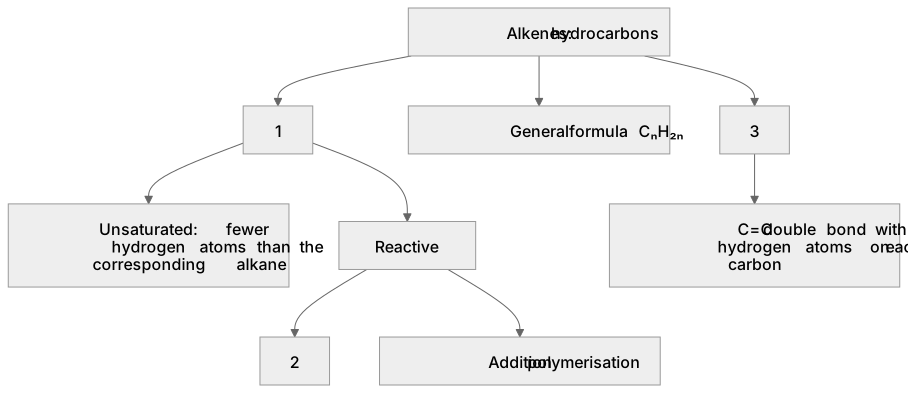
1Box 1
2Box 2
3Box 3
There is more to this lesson
The full lesson goes on to check your understanding and help you earn the marks. Create a free account to carry on, with your progress saved.
A week of Premium from your first lesson · Then the free plan continues · No card, no charge
Test your understanding of Structure and formulae of alkenes: Alkenes are hydrocarbons with a double carbon-carbon bond.
Active recall beats re-reading. Take an instant quiz now to test what you’ve learned and lock it into long-term memory.
A week of Premium from your first lesson · Then the free plan continues · No card, no charge