AQA · GCSE · Chemistry
Course version: 8462 · Version from Sept 2018
The first four members of the homologous series of alkenes are ethene,…
Full specification wording
Structure and formulae of alkenes: The first four members of the homologous series of alkenes are ethene, propene, butene and pentene.
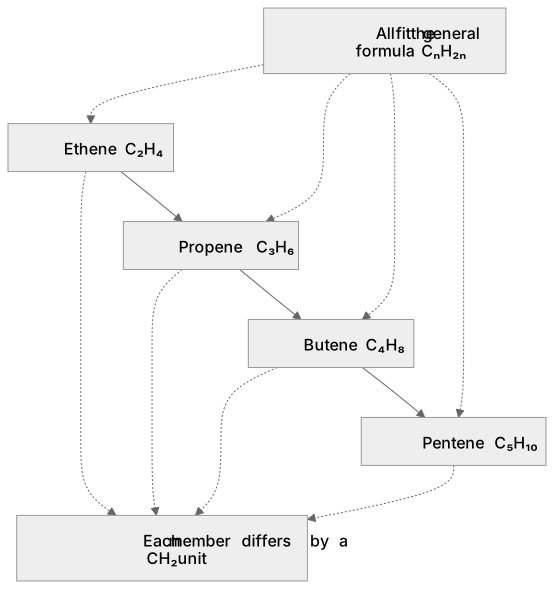
A homologous series is a family of compounds with the same general formula and similar chemical properties, in which each member differs from the next by a CH₂ unit.
Checked against the AQA 8462 specification (opens in a new tab) on .
- Point 2 of 2
- 4 key terms
Study notes
From the checked teaching notes for this specification point.
The idea
A homologous series is a family of compounds with the same general formula and similar chemical properties, in which each member differs from the next by a CH₂ unit. The first four alkenes are ethene C₂H₄, propene C₃H₆, butene C₄H₈ and pentene C₅H₁₀. Their names use the stem for the number of carbon atoms, eth-, prop-, but- and pent-, with the ending -ene showing the C=C double bond. Butene and pentene have structural isomers because the C=C can be in different positions, but all members fit CₙH₂ₙ. Trends in boiling point and viscosity increase with chain length.
What earns the marks
- The first four alkenes are ethene, propene, butene and pentene, in order of increasing carbon chain length.
- Their molecular formulae are C₂H₄, C₃H₆, C₄H₈ and C₅H₁₀.
- Each member differs from the next by a CH₂ unit, which defines a homologous series.
- All members fit the general formula CₙH₂ₙ and contain a C=C double bond.
- The names use the stem for the number of carbon atoms and the ending -ene for the double bond.
- Physical properties such as boiling point increase as the chain length increases.
Common mistakes and how to put them right
Writing methene as the first alkene.
Put it right: The first alkene is ethene, C₂H₄, because a C=C needs two carbon atoms.
Using -ane endings for alkenes.
Put it right: Use -ene endings such as ethene and propene.
Giving butene as C₄H₁₀.
Put it right: Butene is C₄H₈ because it is unsaturated.
Exam tips
- Learn the names and formulae of the first four alkenes in order.
- Use the general formula CₙH₂ₙ to check any alkene formula.
- Remember that each member differs by CH₂, not by CH₃ or C₂H₄.
Try the lesson
The start of the Structure and formulae of alkenes: The first four members of the homologous series of alkenes are ethene, propene, butene and pentene. lesson, made from checked teaching notes for this specification point.
Have a go first
Which of these is the first member of the homologous series of alkenes?
Listen
A homologous series is a family of compounds with the same general formula and similar chemical properties, in which each member differs from the next by a CH₂ unit. The first four alkenes are ethene C₂H₄, propene C₃H₆, butene C₄H₈ and pentene C₅H₁₀. Their names use the stem for the number of carbon atoms, eth-, prop-, but- and pent-, with the ending -ene showing the C=C double bond. Butene and pentene have structural isomers because the C=C can be in different positions, but all members fit CₙH₂ₙ. Trends in boiling point and viscosity increase with chain length. A strong answer earns marks for these points. The first four alkenes are ethene, propene, butene and pentene, in order of increasing carbon chain length. Their molecular formulae are C₂H₄, C₃H₆, C₄H₈ and C₅H₁₀. Each member differs from the next by a CH₂ unit, which defines a homologous series. All members fit the general formula CₙH₂ₙ and contain a C=C double bond. A common slip: Writing methene as the first alkene. Instead, the first alkene is ethene, C₂H₄, because a C=C needs two carbon atoms. Exam tip: Learn the names and formulae of the first four alkenes in order.
See it
Key words
Say what each word means before you turn the card.
Homologous series
Try answering aloud or in your head before turning the card.
Molecular formulae
Try answering aloud or in your head before turning the card.
Nomenclature
Try answering aloud or in your head before turning the card.
Trends in properties
Try answering aloud or in your head before turning the card.
See every definition
- Homologous series
- A family of compounds with the same general formula and similar chemical properties, in which each member differs from the next by a CH₂ unit.
- Molecular formulae
- The formulae C₂H₄, C₃H₆, C₄H₈ and C₅H₁₀ for the first four alkenes, all fitting the general formula CₙH₂ₙ.
- Nomenclature
- The names use the stem for the number of carbon atoms, eth-, prop-, but- and pent-, with the ending -ene showing the C=C double bond.
- Trends in properties
- Boiling point and viscosity increase with chain length.
Label the diagram
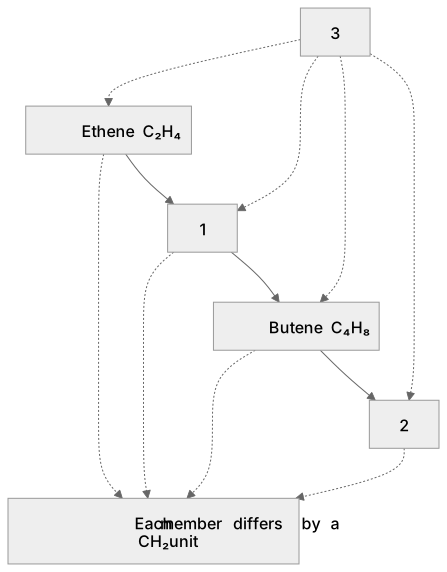
Some boxes have lost their names. Pick the right name for each number.
1Box 1
2Box 2
3Box 3
There is more to this lesson
The full lesson goes on to check your understanding and help you earn the marks. Create a free account to carry on, with your progress saved.
A week of Premium from your first lesson · Then the free plan continues · No card, no charge
Test your understanding of Structure and formulae of alkenes: The first four members of the homologous series of alkenes are ethene, propene, butene and pentene.
Active recall beats re-reading. Take an instant quiz now to test what you’ve learned and lock it into long-term memory.
A week of Premium from your first lesson · Then the free plan continues · No card, no charge