AQA · GCSE · Chemistry
Course version: 8462 · Version from Sept 2018
The Earth's early atmosphere: 6 billion years.
This statement gives the age of the Earth as about 4.6 billion years.
Checked against the AQA 8462 specification (opens in a new tab) on .
- Point 2 of 7
- 2 key terms
Study notes
From the checked teaching notes for this specification point.
The idea
This statement gives the age of the Earth as about 4.6 billion years. It is a key timescale for the early atmosphere: the Earth formed about 4.6 billion years ago, and the atmosphere developed over millions of years afterwards. For example, the first atmosphere is thought to have formed from volcanic gases released early in Earth's history, long before the stable composition of the last 200 million years. When answering questions, use 4.6 billion years as the age of the Earth and place events such as formation of the early atmosphere, appearance of life and changes in oxygen levels in order after that date. The value is approximate and is supported by evidence from meteorites and rocks.
What earns the marks
- State that the Earth is about 4.6 billion years old.
- Use the timescale to place the formation of the early atmosphere after the Earth formed.
- Recognise that the value is approximate and based on evidence such as meteorites and rocks.
- Order events correctly, for example Earth's formation before the development of the atmosphere.
- Distinguish 4.6 billion years from the 200 million years of stable atmospheric composition.
- Use the timescale when describing how the atmosphere changed over time.
Common mistakes and how to put them right
Writing 4.6 million years instead of 4.6 billion years.
Put it right: Use 4.6 billion years.
Confusing the age of the Earth with the 200 million years of stable atmosphere.
Put it right: Keep the two timescales separate.
Placing the early atmosphere before the Earth formed.
Put it right: The Earth formed first, about 4.6 billion years ago.
Exam tips
- Write the value as 4.6 billion years and keep the unit clear.
- Use the timescale to sequence events when describing atmospheric change.
- Check whether a question asks about the age of the Earth or the period of stable composition.
Try the lesson
The start of the The Earth's early atmosphere: 6 billion years. lesson, made from checked teaching notes for this specification point.
Have a go first
Why is there limited evidence about the exact composition of the Earth's early atmosphere?
Listen
This statement gives the age of the Earth as about 4.6 billion years. It is a key timescale for the early atmosphere: the Earth formed about 4.6 billion years ago, and the atmosphere developed over millions of years afterwards. For example, the first atmosphere is thought to have formed from volcanic gases released early in Earth's history, long before the stable composition of the last 200 million years. When answering questions, use 4.6 billion years as the age of the Earth and place events such as formation of the early atmosphere, appearance of life and changes in oxygen levels in order after that date. The value is approximate and is supported by evidence from meteorites and rocks. A strong answer earns marks for these points. State that the Earth is about 4.6 billion years old. Use the timescale to place the formation of the early atmosphere after the Earth formed. Recognise that the value is approximate and based on evidence such as meteorites and rocks. Order events correctly, for example Earth's formation before the development of the atmosphere. A common slip: Writing 4.6 million years instead of 4.6 billion years. Instead, use 4.6 billion years. Exam tip: Write the value as 4.6 billion years and keep the unit clear.
See it
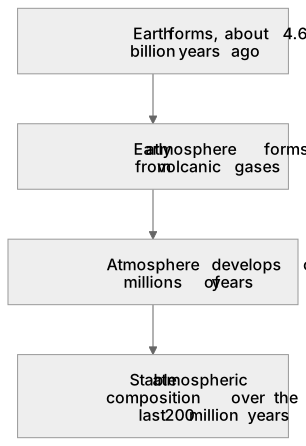
Put it in order
Put these steps in the order they happen.
- 1. Atmosphere develops over millions of years
- 2. Stable atmospheric composition over the last 200 million years
- 3. Early atmosphere forms from volcanic gases
- 4. Earth forms, about 4.6 billion years ago
Key words
Say what each word means before you turn the card.
Age of the Earth
Try answering aloud or in your head before turning the card.
Formation of the early atmosphere
Try answering aloud or in your head before turning the card.
See every definition
- Age of the Earth
- The Earth is about 4.6 billion years old, an approximate value supported by evidence from meteorites and rocks.
- Formation of the early atmosphere
- The first atmosphere is thought to have formed from volcanic gases released early in Earth's history, after the Earth formed.
Label the diagram
Some boxes have lost their names. Pick the right name for each number.
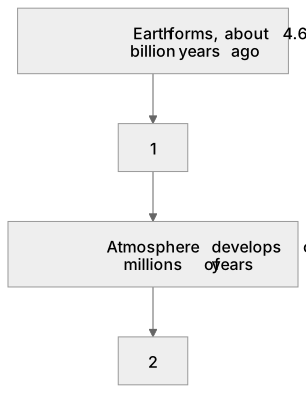
1Box 1
2Box 2
There is more to this lesson
The full lesson goes on to check your understanding and help you earn the marks. Create a free account to carry on, with your progress saved.
A week of Premium from your first lesson · Then the free plan continues · No card, no charge
Test your understanding of The Earth's early atmosphere: 6 billion years.
Active recall beats re-reading. Take an instant quiz now to test what you’ve learned and lock it into long-term memory.
A week of Premium from your first lesson · Then the free plan continues · No card, no charge