AQA · GCSE · Chemistry
Course version: 8462 · Version from Sept 2018
Theories about what was in the Earth’s early atmosphere and how the…
Full specification wording
The Earth's early atmosphere: Theories about what was in the Earth’s early atmosphere and how the atmosphere was formed have changed and developed over time.
Scientific theories about the early atmosphere are not fixed; they have changed as new evidence has been collected.
Checked against the AQA 8462 specification (opens in a new tab) on .
- Point 1 of 7
- 4 key terms
Study notes
From the checked teaching notes for this specification point.
The idea
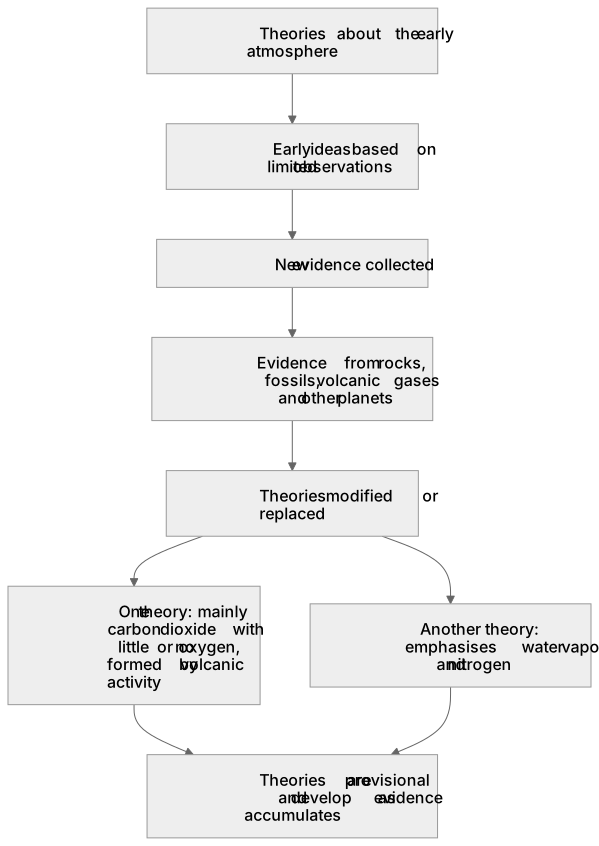
Scientific theories about the early atmosphere are not fixed; they have changed as new evidence has been collected. Early ideas were based on limited observations, but evidence from rocks, fossils, volcanic gases and other planets has led to revised models. For example, one theory suggests the early atmosphere was mainly carbon dioxide with little or no oxygen, formed by volcanic activity, while another emphasises water vapour and nitrogen. As evidence accumulates, theories are modified or replaced. This shows that scientific explanations are provisional and develop over time. The statement does not require one accepted composition; it requires understanding that theories have changed and developed as evidence has changed.
What earns the marks
- State that theories about the early atmosphere have changed over time.
- Explain that new evidence leads to theories being modified or replaced.
- Give an example of evidence used, such as analysis of rocks, fossils, volcanic gases or other planets.
- Describe at least one early-atmosphere theory, such as one involving carbon dioxide, water vapour or volcanic activity.
- Recognise that scientific theories are provisional and develop as evidence accumulates.
- Avoid presenting any single theory as fixed or final.
Common mistakes and how to put them right
Stating that scientists have always agreed on the early atmosphere.
Put it right: Theories have changed and developed over time.
Treating one theory as proven fact.
Put it right: Theories are provisional and may be revised with new evidence.
Confusing the early atmosphere with today's atmosphere.
Put it right: The early atmosphere was different and is studied through indirect evidence.
Exam tips
- Use the words 'changed' and 'developed' to show that theories are not fixed.
- Link each change in theory to a type of evidence, such as rock or fossil data.
- Avoid naming a single definitive composition; describe how ideas have been revised.
Try the lesson
The start of the The Earth's early atmosphere: Theories about what was in the Earth’s early atmosphere and how the atmosphere was formed have changed and developed over time. lesson, made from checked teaching notes for this specification point.
Have a go first
Why have theories about the Earth's early atmosphere changed over time?
Listen
Scientific theories about the early atmosphere are not fixed; they have changed as new evidence has been collected. Early ideas were based on limited observations, but evidence from rocks, fossils, volcanic gases and other planets has led to revised models. For example, one theory suggests the early atmosphere was mainly carbon dioxide with little or no oxygen, formed by volcanic activity, while another emphasises water vapour and nitrogen. As evidence accumulates, theories are modified or replaced. This shows that scientific explanations are provisional and develop over time. The statement does not require one accepted composition; it requires understanding that theories have changed and developed as evidence has changed. A strong answer earns marks for these points. State that theories about the early atmosphere have changed over time. Explain that new evidence leads to theories being modified or replaced. Give an example of evidence used, such as analysis of rocks, fossils, volcanic gases or other planets. Describe at least one early-atmosphere theory, such as one involving carbon dioxide, water vapour or volcanic activity. A common slip: Stating that scientists have always agreed on the early atmosphere. Instead, theories have changed and developed over time. Exam tip: Use the words 'changed' and 'developed' to show that theories are not fixed.
See it
Key words
Say what each word means before you turn the card.
Development of scientific theories
Try answering aloud or in your head before turning the card.
Evidence and revision
Try answering aloud or in your head before turning the card.
Earth's early atmosphere
Try answering aloud or in your head before turning the card.
Provisional nature of science
Try answering aloud or in your head before turning the card.
See every definition
- Development of scientific theories
- Theories about what was in the Earth's early atmosphere and how the atmosphere was formed have changed and developed over time.
- Evidence and revision
- As evidence accumulates, theories are modified or replaced, and new evidence leads to theories being modified or replaced.
- Earth's early atmosphere
- One theory suggests it was mainly carbon dioxide with little or no oxygen, formed by volcanic activity, while another emphasises water vapour and nitrogen.
- Provisional nature of science
- Scientific explanations are provisional and develop over time, so theories are not fixed and may be revised with new evidence.
Label the diagram
Some boxes have lost their names. Pick the right name for each number.
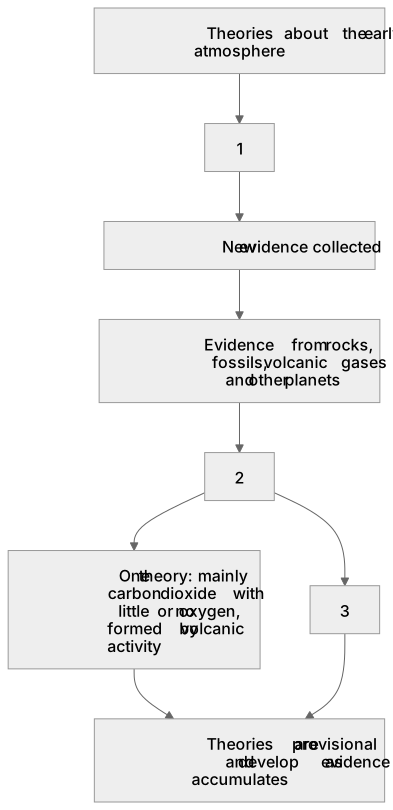
1Box 1
2Box 2
3Box 3
There is more to this lesson
The full lesson goes on to check your understanding and help you earn the marks. Create a free account to carry on, with your progress saved.
A week of Premium from your first lesson · Then the free plan continues · No card, no charge
Test your understanding of The Earth's early atmosphere: Theories about what was in the Earth’s early atmosphere and how the atmosphere was formed have changed and developed over time.
Active recall beats re-reading. Take an instant quiz now to test what you’ve learned and lock it into long-term memory.
A week of Premium from your first lesson · Then the free plan continues · No card, no charge