AQA · GCSE · Chemistry
Course version: 8462 · Version from Sept 2018
Students should be able to, given appropriate information, interpret…
Full specification wording
The Earth's early atmosphere: Students should be able to, given appropriate information, interpret evidence and evaluate different theories about the Earth’s early atmosphere.
You will not be asked to recall these theories from memory; instead, you must apply the information given to judge which theory is best supported by the evidence.
Checked against the AQA 8462 specification (opens in a new tab) on .
- Point 7 of 7
- 3 key terms
Study notes
From the checked teaching notes for this specification point.
The idea
You will not be asked to recall these theories from memory; instead, you must apply the information given to judge which theory is best supported by the evidence. For example, a question might present data on gas proportions from different sources and ask you to evaluate which theory about the early atmosphere is most consistent with the evidence. You should consider the strengths and weaknesses of each theory, such as how well it explains the data, and whether there are alternative explanations. This skill is assessed by your ability to reason with the provided information and draw justified conclusions.
What earns the marks
- Interpret evidence by identifying patterns, trends, or relationships in the given data or information.
- Evaluate theories by comparing how well each theory explains the evidence provided.
- Consider the limitations of evidence, such as incomplete data or uncertainty in measurements, when evaluating theories.
- Draw a justified conclusion about which theory is best supported, using the evidence given.
Common mistakes and how to put them right
Evaluating theories based on personal opinion or outside knowledge rather than the evidence provided.
Put it right: Base your evaluation solely on the information given in the question.
Failing to compare theories directly, instead describing each theory separately.
Put it right: Explicitly state which theory is better supported and why, using comparative language.
Ignoring limitations of the evidence, such as small sample sizes or assumptions made.
Put it right: Mention any limitations and explain how they affect the reliability of the theories.
Exam tips
- Underline the command words 'interpret' and 'evaluate' to remind yourself to analyse the evidence and make a judgement.
- Use the data provided to support your points; quote specific figures or observations from the information.
- Structure your answer by first interpreting the evidence, then evaluating each theory against it, and finally stating a conclusion.
Try the lesson
The start of the The Earth's early atmosphere: Students should be able to, given appropriate information, interpret evidence and evaluate different theories about the Earth’s early atmosphere. lesson, made from checked teaching notes for this specification point.
Have a go first
One theory suggests the early atmosphere was mainly carbon dioxide, while an alternative theory suggests it was a mixture of ammonia and methane. Which piece of geological evidence best supports the theory that the early atmosphere was mainly carbon dioxide?
Listen
You will not be asked to recall these theories from memory; instead, you must apply the information given to judge which theory is best supported by the evidence. For example, a question might present data on gas proportions from different sources and ask you to evaluate which theory about the early atmosphere is most consistent with the evidence. You should consider the strengths and weaknesses of each theory, such as how well it explains the data, and whether there are alternative explanations. This skill is assessed by your ability to reason with the provided information and draw justified conclusions. A strong answer earns marks for these points. Interpret evidence by identifying patterns, trends, or relationships in the given data or information. Evaluate theories by comparing how well each theory explains the evidence provided. Consider the limitations of evidence, such as incomplete data or uncertainty in measurements, when evaluating theories. Draw a justified conclusion about which theory is best supported, using the evidence given. A common slip: Evaluating theories based on personal opinion or outside knowledge rather than the evidence provided. Instead, base your evaluation solely on the information given in the question. Exam tip: Underline the command words 'interpret' and 'evaluate' to remind yourself to analyse the evidence and make a judgement.
See it
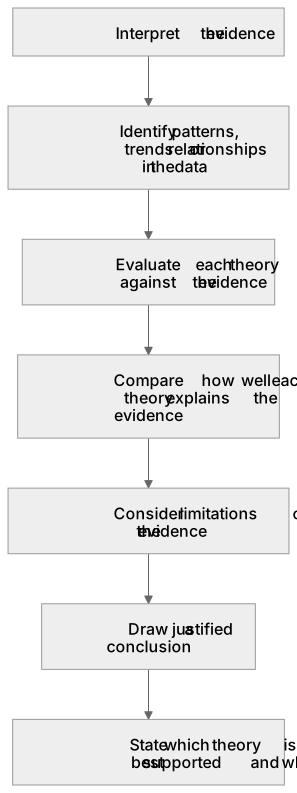
Put it in order
Put these steps in the order they happen.
- 1. State which theory is best supported and why
- 2. Draw a justified conclusion
- 3. Evaluate each theory against the evidence
- 4. Consider limitations of the evidence
- 5. Interpret the evidence
- 6. Identify patterns, trends or relationships in the data
- 7. Compare how well each theory explains the evidence
Key words
Say what each word means before you turn the card.
Evidence interpretation
Try answering aloud or in your head before turning the card.
Theory evaluation
Try answering aloud or in your head before turning the card.
Scientific reasoning
Try answering aloud or in your head before turning the card.
See every definition
- Evidence interpretation
- Identifying patterns, trends, or relationships in the given data or information.
- Theory evaluation
- Comparing how well each theory explains the evidence provided, considering strengths and weaknesses such as how well it explains the data.
- Scientific reasoning
- Reasoning with the provided information to draw justified conclusions about which theory is best supported.
Label the diagram
Some boxes have lost their names. Pick the right name for each number.
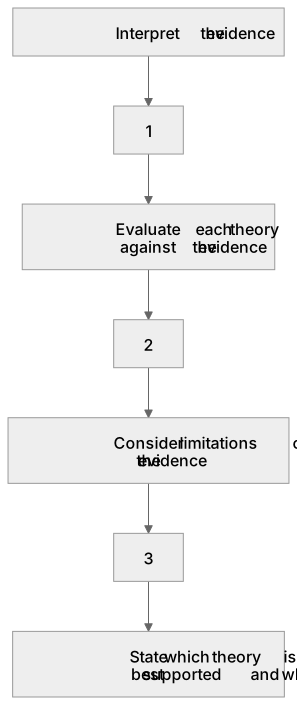
1Box 1
2Box 2
3Box 3
There is more to this lesson
The full lesson goes on to check your understanding and help you earn the marks. Create a free account to carry on, with your progress saved.
A week of Premium from your first lesson · Then the free plan continues · No card, no charge
Test your understanding of The Earth's early atmosphere: Students should be able to, given appropriate information, interpret evidence and evaluate different theories about the Earth’s early atmosphere.
Active recall beats re-reading. Take an instant quiz now to test what you’ve learned and lock it into long-term memory.
A week of Premium from your first lesson · Then the free plan continues · No card, no charge