AQA · GCSE · Chemistry
Course version: 8462 · Version from Sept 2018
If a system is at equilibrium and a change is made to any of the…
Full specification wording
The effect of changing conditions on equilibrium (HT only): If a system is at equilibrium and a change is made to any of the conditions, then the system responds to counteract the change.
When a system is at equilibrium and a condition such as temperature, pressure or concentration is changed, the equilibrium position shifts in the direction that opposes the change.
Checked against the AQA 8462 specification (opens in a new tab) on .
- Point 2 of 4
Study notes
From the checked teaching notes for this specification point.
The idea
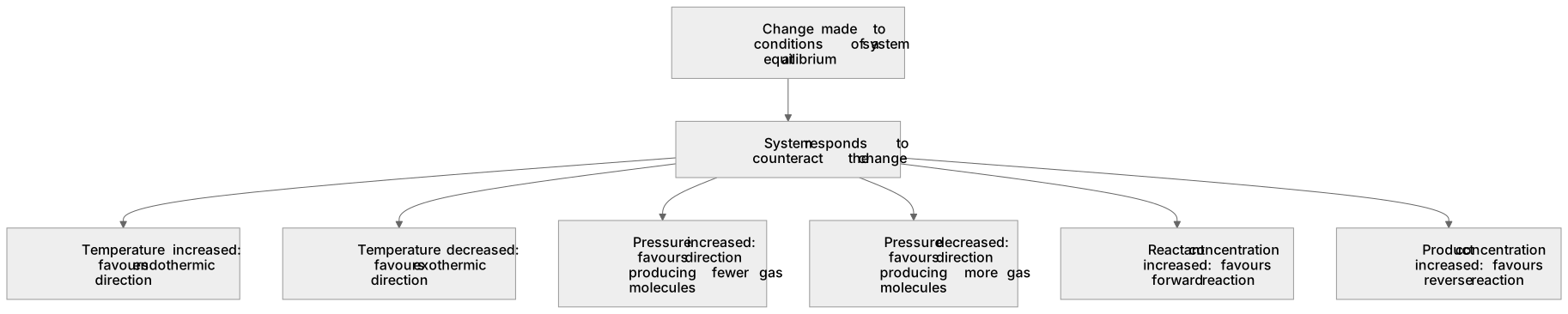
When a system is at equilibrium and a condition such as temperature, pressure or concentration is changed, the equilibrium position shifts in the direction that opposes the change. This is a qualitative principle used to predict the response of a reversible reaction. If the temperature is increased, the system favours the endothermic direction, which absorbs the added energy. If the pressure is increased, the system favours the direction producing fewer gas molecules, which reduces the pressure. If the concentration of a reactant is increased, the system favours the forward reaction to use up some of that reactant.
For example: Adding more nitrogen to the Haber process shifts the equilibrium towards ammonia production.
What earns the marks
- States that a change in conditions disturbs an equilibrium and the system responds to counteract the change.
- Explains that an increase in temperature favours the endothermic direction, while a decrease favours the exothermic direction.
- Explains that an increase in pressure favours the direction producing fewer gas molecules, while a decrease favours the direction producing more gas molecules.
- Explains that increasing the concentration of a reactant favours the forward reaction, while increasing the concentration of a product favours the reverse reaction.
- Applies the principle to a named equilibrium, such as the Haber process, to predict the direction of shift.
- Uses the term position of equilibrium to describe the direction in which the system responds.
Common mistakes and how to put them right
Saying that the system acts to increase the change.
Put it right: The system responds to counteract or oppose the change.
Mixing up the temperature rule by saying that heating favours the exothermic direction.
Put it right: Heating favours the endothermic direction.
Applying the pressure rule without counting gas molecules.
Put it right: Compare the number of gas molecules on each side and favour the side with fewer when pressure increases.
Exam tips
- Identify the change first, then state the direction that counteracts it, and finally link this to the relative amounts of reactants and products.
- For pressure questions, count the gas molecules on each side of the equation before predicting the shift.
- For temperature questions, identify which direction is endothermic and which is exothermic before predicting the shift.
Try the lesson
The start of the The effect of changing conditions on equilibrium (HT only): If a system is at equilibrium and a change is made to any of the conditions, then the system responds to counteract the change. lesson, made from checked teaching notes for this specification point.
Have a go first
A reversible reaction is at equilibrium in a closed system. What happens if a change is made to the conditions of the system, such as altering the temperature or pressure?
Listen
When a system is at equilibrium and a condition such as temperature, pressure or concentration is changed, the equilibrium position shifts in the direction that opposes the change. This is a qualitative principle used to predict the response of a reversible reaction. If the temperature is increased, the system favours the endothermic direction, which absorbs the added energy. If the pressure is increased, the system favours the direction producing fewer gas molecules, which reduces the pressure. If the concentration of a reactant is increased, the system favours the forward reaction to use up some of that reactant. For example, adding more nitrogen to the Haber process shifts the equilibrium towards ammonia production. A strong answer earns marks for these points. States that a change in conditions disturbs an equilibrium and the system responds to counteract the change. Explains that an increase in temperature favours the endothermic direction, while a decrease favours the exothermic direction. Explains that an increase in pressure favours the direction producing fewer gas molecules, while a decrease favours the direction producing more gas molecules. Explains that increasing the concentration of a reactant favours the forward reaction, while increasing the concentration of a product favours the reverse reaction. A common slip: Saying that the system acts to increase the change. Instead, the system responds to counteract or oppose the change. Exam tip: Identify the change first, then state the direction that counteracts it, and finally link this to the relative amounts of reactants and products.
See it
Label the diagram
Some boxes have lost their names. Pick the right name for each number.
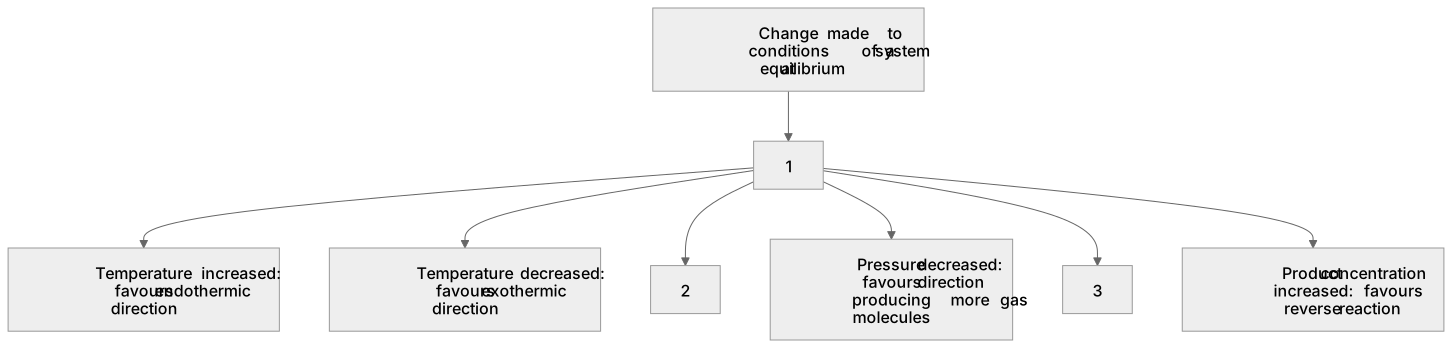
1Box 1
2Box 2
3Box 3
There is more to this lesson
The full lesson goes on to check your understanding and help you earn the marks. Create a free account to carry on, with your progress saved.
A week of Premium from your first lesson · Then the free plan continues · No card, no charge
Test your understanding of The effect of changing conditions on equilibrium (HT only): If a system is at equilibrium and a change is made to any of the conditions, then the system responds to counteract the change.
Active recall beats re-reading. Take an instant quiz now to test what you’ve learned and lock it into long-term memory.
A week of Premium from your first lesson · Then the free plan continues · No card, no charge