AQA · GCSE · Chemistry
Course version: 8462 · Version from Sept 2018
The relative amounts of all the reactants and products at equilibrium…
Full specification wording
The effect of changing conditions on equilibrium (HT only): The relative amounts of all the reactants and products at equilibrium depend on the conditions of the reaction.
At equilibrium, the mixture contains both reactants and products, but the proportions of each are not fixed.
Checked against the AQA 8462 specification (opens in a new tab) on .
- Point 1 of 4
Study notes
From the checked teaching notes for this specification point.
The idea
At equilibrium, the mixture contains both reactants and products, but the proportions of each are not fixed. They depend on the conditions under which the reaction takes place, especially temperature, pressure and concentration. Changing a condition alters the position of equilibrium, so the relative amounts of reactants and products settle at new constant values. For example, in the Haber process for ammonia, nitrogen and hydrogen react reversibly to form ammonia; at a higher pressure the equilibrium mixture contains a greater proportion of ammonia, while at a higher temperature the proportion of ammonia decreases. The relative amounts are therefore a consequence of the chosen conditions, not a universal constant.
What earns the marks
- States that the amounts of reactants and products at equilibrium are not fixed but depend on the reaction conditions.
- Identifies temperature, pressure and concentration as conditions that can affect the position of equilibrium.
- Explains that changing a condition shifts the position of equilibrium and changes the relative amounts of reactants and products.
- Applies the idea to an industrial example such as the Haber process, linking pressure or temperature to the proportion of ammonia formed.
- Recognises that the equilibrium mixture still contains both reactants and products, but in different relative amounts.
- Uses the term position of equilibrium correctly to describe the balance between reactants and products.
Common mistakes and how to put them right
Thinking that the relative amounts at equilibrium are always the same for a given reaction.
Put it right: They depend on the conditions used.
Confusing the rate of reaction with the position of equilibrium.
Put it right: Conditions can change both, but the position of equilibrium describes the relative amounts, not the speed.
Assuming that changing conditions changes only the forward reaction.
Put it right: Both forward and reverse rates are affected and the system settles at a new equilibrium position.
Exam tips
- Name the specific condition being changed, such as temperature or pressure, and state how the relative amounts of reactants and products change.
- Use a familiar industrial equilibrium such as the Haber process to illustrate the effect of conditions on relative amounts.
- Avoid saying that equilibrium is destroyed; instead say that the position of equilibrium shifts to a new balance.
Try the lesson
The start of the The effect of changing conditions on equilibrium (HT only): The relative amounts of all the reactants and products at equilibrium depend on the conditions of the reaction. lesson, made from checked teaching notes for this specification point.
Have a go first
Which of the following factors will affect the relative amounts of reactants and products at equilibrium?
Listen
At equilibrium, the mixture contains both reactants and products, but the proportions of each are not fixed. They depend on the conditions under which the reaction takes place, especially temperature, pressure and concentration. Changing a condition alters the position of equilibrium, so the relative amounts of reactants and products settle at new constant values. For example, in the Haber process for ammonia, nitrogen and hydrogen react reversibly to form ammonia; at a higher pressure the equilibrium mixture contains a greater proportion of ammonia, while at a higher temperature the proportion of ammonia decreases. The relative amounts are therefore a consequence of the chosen conditions, not a universal constant. A strong answer earns marks for these points. States that the amounts of reactants and products at equilibrium are not fixed but depend on the reaction conditions. Identifies temperature, pressure and concentration as conditions that can affect the position of equilibrium. Explains that changing a condition shifts the position of equilibrium and changes the relative amounts of reactants and products. Applies the idea to an industrial example such as the Haber process, linking pressure or temperature to the proportion of ammonia formed. A common slip: Thinking that the relative amounts at equilibrium are always the same for a given reaction. Instead, they depend on the conditions used. Exam tip: Name the specific condition being changed, such as temperature or pressure, and state how the relative amounts of reactants and products change.
See it
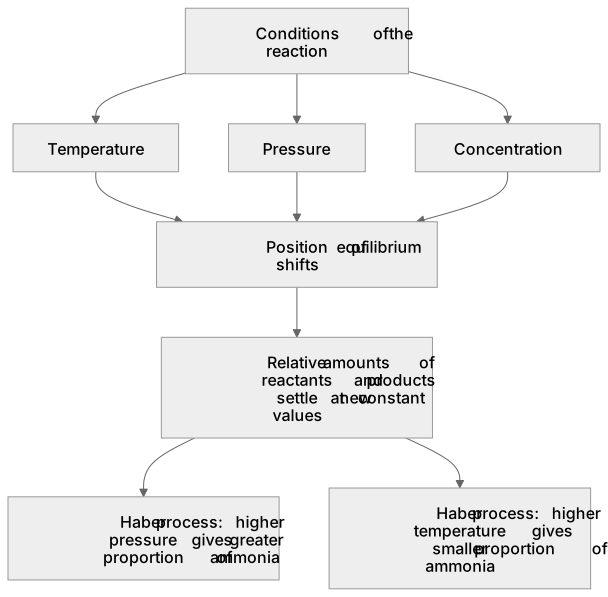
Label the diagram
Some boxes have lost their names. Pick the right name for each number.
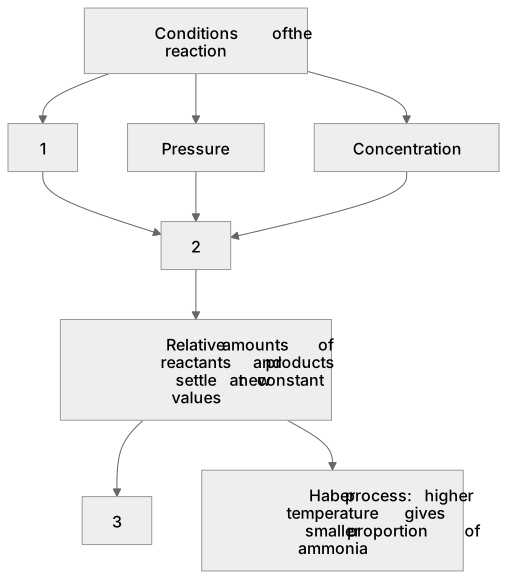
1Box 1
2Box 2
3Box 3
There is more to this lesson
The full lesson goes on to check your understanding and help you earn the marks. Create a free account to carry on, with your progress saved.
A week of Premium from your first lesson · Then the free plan continues · No card, no charge
Test your understanding of The effect of changing conditions on equilibrium (HT only): The relative amounts of all the reactants and products at equilibrium depend on the conditions of the reaction.
Active recall beats re-reading. Take an instant quiz now to test what you’ve learned and lock it into long-term memory.
A week of Premium from your first lesson · Then the free plan continues · No card, no charge