AQA · GCSE · Chemistry
Course version: 8462 · Version from Sept 2018
In an endothermic reaction, the energy needed to break existing bonds is…
Full specification wording
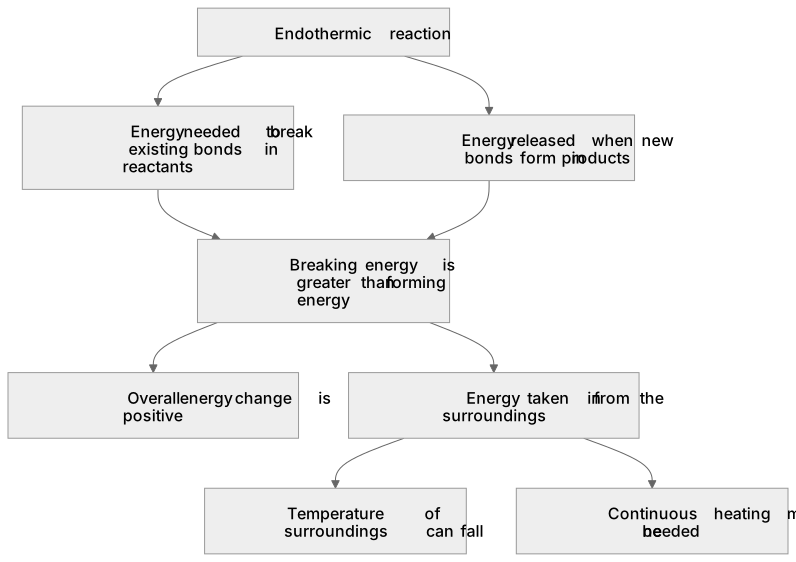
The energy change of reactions (HT only): In an endothermic reaction, the energy needed to break existing bonds is greater than the energy released from forming new bonds.
An endothermic reaction takes in energy from the surroundings, often shown by a temperature fall.
Checked against the AQA 8462 specification (opens in a new tab) on .
- Point 5 of 6
Study notes
From the checked teaching notes for this specification point.
The idea
An endothermic reaction takes in energy from the surroundings, often shown by a temperature fall. At the bond level, the energy needed to break existing bonds in the reactants is greater than the energy released when new bonds form in the products. For example, thermal decomposition of calcium carbonate requires continuous heating because breaking the bonds in CaCO₃ needs more energy than is released when the products form, so the overall energy change is positive. The surroundings supply the extra energy, which is why the temperature of the surroundings can fall. The sign of the calculated overall energy change confirms whether the reaction is endothermic.
What earns the marks
- State that in an endothermic reaction the energy needed to break existing bonds is greater than the energy released when new bonds form.
- Link the greater energy input to a positive overall energy change, ΔH.
- Describe energy being taken in from the surroundings, often observed as a temperature fall.
- Use a balanced equation and bond energies to show numerically that the breaking total exceeds the forming total.
- Explain that continuous heating may be needed to supply energy for the reaction to continue.
Common mistakes and how to put them right
Stating that endothermic reactions release energy because new bonds form.
Put it right by explaining that bond formation does release energy, but less than the energy needed to break the existing bonds.
Ignoring the sign of the overall energy change.
Put it right by stating that a positive value indicates an endothermic reaction.
Confusing a temperature fall in the surroundings with the reaction mixture becoming colder by creating coldness.
Put it right by describing energy transfer from the surroundings to the reaction.
Exam tips
- State the comparison explicitly: energy needed to break bonds is greater than energy released when bonds form.
- Support the explanation with a calculated overall energy change that is positive, including units.
- Link the bond-level explanation to an observable change such as a temperature fall or the need for continuous heating.
Try the lesson
The start of the The energy change of reactions (HT only): In an endothermic reaction, the energy needed to break existing bonds is greater than the energy released from forming new bonds. lesson, made from checked teaching notes for this specification point.
Have a go first
In an endothermic reaction, how does the energy needed to break existing bonds compare with the energy released from forming new bonds?
Listen
An endothermic reaction takes in energy from the surroundings, often shown by a temperature fall. At the bond level, the energy needed to break existing bonds in the reactants is greater than the energy released when new bonds form in the products. For example, thermal decomposition of calcium carbonate requires continuous heating because breaking the bonds in CaCO₃ needs more energy than is released when the products form, so the overall energy change is positive. The surroundings supply the extra energy, which is why the temperature of the surroundings can fall. The sign of the calculated overall energy change confirms whether the reaction is endothermic. A strong answer earns marks for these points. State that in an endothermic reaction the energy needed to break existing bonds is greater than the energy released when new bonds form. Link the greater energy input to a positive overall energy change, ΔH. Describe energy being taken in from the surroundings, often observed as a temperature fall. Use a balanced equation and bond energies to show numerically that the breaking total exceeds the forming total. A common slip: Stating that endothermic reactions release energy because new bonds form. Instead, explaining that bond formation does release energy, but less than the energy needed to break the existing bonds. Exam tip: State the comparison explicitly: energy needed to break bonds is greater than energy released when bonds form.
See it
Label the diagram
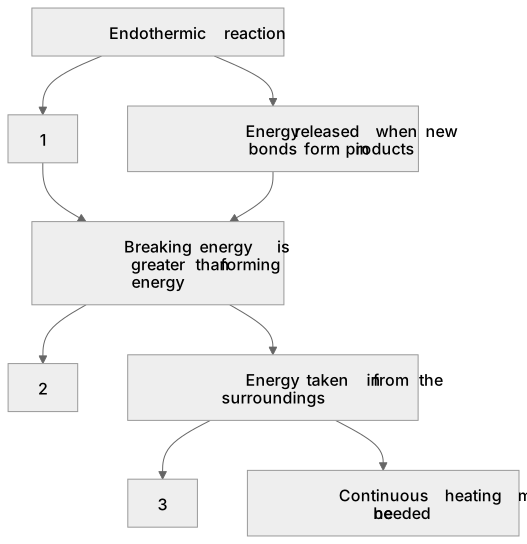
Some boxes have lost their names. Pick the right name for each number.
1Box 1
2Box 2
3Box 3
There is more to this lesson
The full lesson goes on to check your understanding and help you earn the marks. Create a free account to carry on, with your progress saved.
A week of Premium from your first lesson · Then the free plan continues · No card, no charge
Test your understanding of The energy change of reactions (HT only): In an endothermic reaction, the energy needed to break existing bonds is greater than the energy released from forming new bonds.
Active recall beats re-reading. Take an instant quiz now to test what you’ve learned and lock it into long-term memory.
A week of Premium from your first lesson · Then the free plan continues · No card, no charge