AQA · GCSE · Chemistry
Course version: 8462 · Version from Sept 2018
In an exothermic reaction, the energy released from forming new bonds is…
Full specification wording
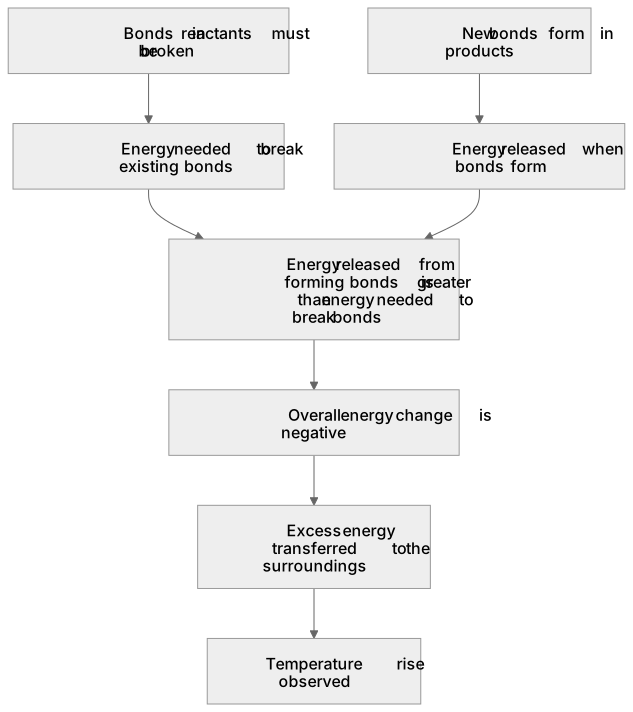
The energy change of reactions (HT only): In an exothermic reaction, the energy released from forming new bonds is greater than the energy needed to break existing bonds.
An exothermic reaction transfers energy to the surroundings, usually shown by a temperature rise.
Checked against the AQA 8462 specification (opens in a new tab) on .
- Point 4 of 6
- 4 key terms
Study notes
From the checked teaching notes for this specification point.
The idea
An exothermic reaction transfers energy to the surroundings, usually shown by a temperature rise. At the bond level, the energy released when new bonds form in the products is greater than the energy needed to break bonds in the reactants. For example, in the combustion of methane, breaking all the bonds in CH₄ and O₂ requires a certain amount of energy, but forming the bonds in CO₂ and H₂O releases more energy, so the overall energy change is negative and the reaction is exothermic. The excess energy is transferred to the surroundings. A reaction can still need an initial energy input to start, but that does not make it endothermic overall.
What earns the marks
- State that in an exothermic reaction the energy released when new bonds form is greater than the energy needed to break existing bonds.
- Link the greater energy release to a negative overall energy change, ΔH.
- Describe the transfer of excess energy to the surroundings, often observed as a temperature rise.
- Use a balanced equation and bond energies to show numerically that the forming total exceeds the breaking total.
- Distinguish the initial activation energy input from the overall energy change of the reaction.
Common mistakes and how to put them right
Claiming that exothermic reactions need no energy to break bonds.
Put it right by explaining that bonds must still be broken, but forming bonds releases more energy overall.
Confusing a temperature rise in the surroundings with energy being created.
Put it right by describing energy transfer from the reaction to the surroundings.
Assuming any reaction that starts with heating must be endothermic.
Put it right by comparing the total energy released when bonds form with the total energy needed to break bonds.
Exam tips
- Use the phrase energy released when bonds form is greater than energy needed to break bonds to make the comparison explicit.
- Support the explanation with a calculated overall energy change that is negative, including units.
- Link the bond-level explanation to an observable change such as a temperature rise of the surroundings.
Try the lesson
The start of the The energy change of reactions (HT only): In an exothermic reaction, the energy released from forming new bonds is greater than the energy needed to break existing bonds. lesson, made from checked teaching notes for this specification point.
Have a go first
In an exothermic reaction, how does the energy released from forming new bonds compare with the energy needed to break existing bonds?
Listen
An exothermic reaction transfers energy to the surroundings, usually shown by a temperature rise. At the bond level, the energy released when new bonds form in the products is greater than the energy needed to break bonds in the reactants. For example, in the combustion of methane, breaking all the bonds in CH₄ and O₂ requires a certain amount of energy, but forming the bonds in CO₂ and H₂O releases more energy, so the overall energy change is negative and the reaction is exothermic. The excess energy is transferred to the surroundings. A reaction can still need an initial energy input to start, but that does not make it endothermic overall. A strong answer earns marks for these points. State that in an exothermic reaction the energy released when new bonds form is greater than the energy needed to break existing bonds. Link the greater energy release to a negative overall energy change, ΔH. Describe the transfer of excess energy to the surroundings, often observed as a temperature rise. Use a balanced equation and bond energies to show numerically that the forming total exceeds the breaking total. A common slip: Claiming that exothermic reactions need no energy to break bonds. Instead, explaining that bonds must still be broken, but forming bonds releases more energy overall. Exam tip: Use the phrase energy released when bonds form is greater than energy needed to break bonds to make the comparison explicit.
See it
Key words
Say what each word means before you turn the card.
Exothermic reaction
Try answering aloud or in your head before turning the card.
Overall energy change
Try answering aloud or in your head before turning the card.
Activation energy
Try answering aloud or in your head before turning the card.
Energy transfer to the surroundings
Try answering aloud or in your head before turning the card.
See every definition
- Exothermic reaction
- A reaction in which the energy released from forming new bonds is greater than the energy needed to break existing bonds.
- Overall energy change
- For an exothermic reaction this is negative, because forming the bonds in the products releases more energy than breaking bonds in the reactants requires.
- Activation energy
- An initial energy input a reaction can still need to start, which does not make it endothermic overall.
- Energy transfer to the surroundings
- The excess energy is transferred to the surroundings, usually shown by a temperature rise.
Label the diagram
Some boxes have lost their names. Pick the right name for each number.
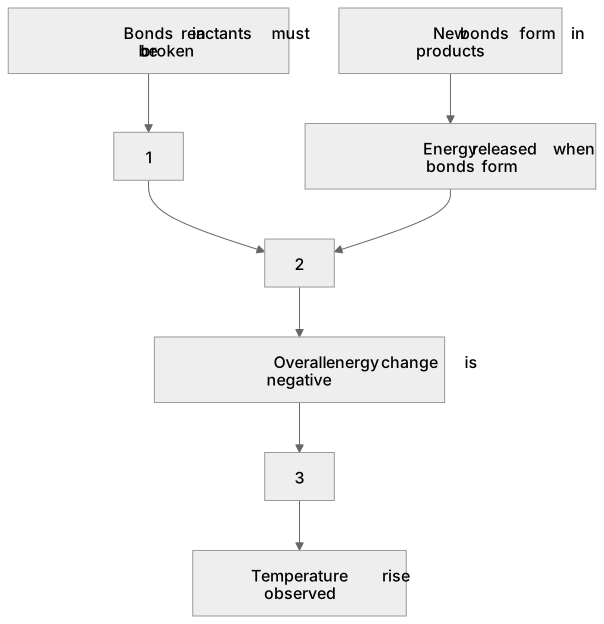
1Box 1
2Box 2
3Box 3
There is more to this lesson
The full lesson goes on to check your understanding and help you earn the marks. Create a free account to carry on, with your progress saved.
A week of Premium from your first lesson · Then the free plan continues · No card, no charge
Test your understanding of The energy change of reactions (HT only): In an exothermic reaction, the energy released from forming new bonds is greater than the energy needed to break existing bonds.
Active recall beats re-reading. Take an instant quiz now to test what you’ve learned and lock it into long-term memory.
A week of Premium from your first lesson · Then the free plan continues · No card, no charge