AQA · GCSE · Chemistry
Course version: 8462 · Version from Sept 2018
Students should be able to recall a source for the nitrogen and a source…
Full specification wording
The Haber process: Students should be able to recall a source for the nitrogen and a source for the hydrogen used in the Haber process.
The Haber process makes ammonia from nitrogen and hydrogen, so you must be able to name where each reactant comes from.
Checked against the AQA 8462 specification (opens in a new tab) on .
- Point 3 of 5
- 3 key terms
Study notes
From the checked teaching notes for this specification point.
The idea
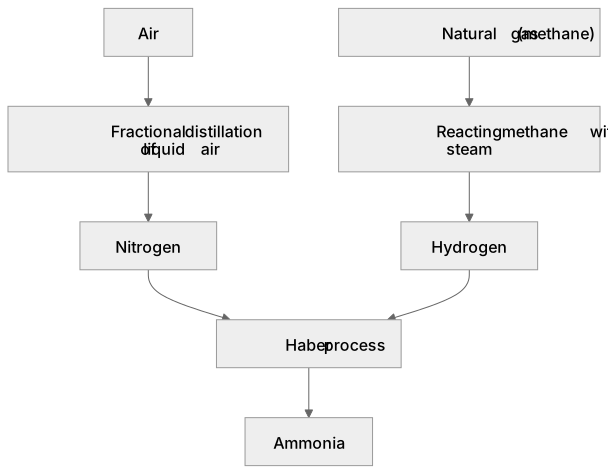
The Haber process makes ammonia from nitrogen and hydrogen, so you must be able to name where each reactant comes from. Nitrogen is obtained from the air, which is about 78% nitrogen by volume; fractional distillation of liquid air separates it from oxygen and other gases. Hydrogen is usually obtained from natural gas (methane) by reaction with steam, though other sources exist. A useful memory hook is that nitrogen comes from the sky and hydrogen comes from fossil fuel. In an exam, a question may ask you to state one source for each gas, so learn one reliable source for nitrogen and one for hydrogen, and be ready to name the raw material rather than just the element.
What earns the marks
- Nitrogen is obtained from air, which is approximately 78% nitrogen by volume.
- Nitrogen can be separated from air by fractional distillation of liquid air.
- Hydrogen is commonly obtained from natural gas, which is mainly methane.
- Hydrogen can be produced by reacting methane with steam (steam reforming).
- The Haber process combines nitrogen and hydrogen to produce ammonia.
- A named raw material, such as air or natural gas, is a valid source in an exam answer.
Common mistakes and how to put them right
Saying nitrogen comes from nitrogen fertiliser.
Put it right: Nitrogen is obtained from air.
Saying hydrogen comes from water with no named process.
Put it right: Name natural gas or methane reacted with steam.
Writing that nitrogen is made in the Haber process.
Put it right: Nitrogen is a reactant obtained from air, while ammonia is the product.
Exam tips
- Learn one named source for each gas rather than several, so recall is quick and accurate.
- Use the phrase 'from air' for nitrogen and 'from natural gas' for hydrogen as a minimum secure answer.
- If asked to explain, link fractional distillation to separating nitrogen from liquid air, and steam reforming to producing hydrogen from methane.
Try the lesson
The start of the The Haber process: Students should be able to recall a source for the nitrogen and a source for the hydrogen used in the Haber process. lesson, made from checked teaching notes for this specification point.
Have a go first
In the Haber process, from which substance is the nitrogen obtained?
Listen
The Haber process makes ammonia from nitrogen and hydrogen, so you must be able to name where each reactant comes from. Nitrogen is obtained from the air, which is about 78% nitrogen by volume; fractional distillation of liquid air separates it from oxygen and other gases. Hydrogen is usually obtained from natural gas (methane) by reaction with steam, though other sources exist. A useful memory hook is that nitrogen comes from the sky and hydrogen comes from fossil fuel. In an exam, a question may ask you to state one source for each gas, so learn one reliable source for nitrogen and one for hydrogen, and be ready to name the raw material rather than just the element. A strong answer earns marks for these points. Nitrogen is obtained from air, which is approximately 78% nitrogen by volume. Nitrogen can be separated from air by fractional distillation of liquid air. Hydrogen is commonly obtained from natural gas, which is mainly methane. Hydrogen can be produced by reacting methane with steam (steam reforming). A common slip: Saying nitrogen comes from nitrogen fertiliser: the error is confusing a use of nitrogen compounds with the industrial source. Instead, nitrogen is obtained from air. Exam tip: Learn one named source for each gas rather than several, so recall is quick and accurate.
See it
Key words
Say what each word means before you turn the card.
Nitrogen source
Try answering aloud or in your head before turning the card.
Hydrogen source
Try answering aloud or in your head before turning the card.
Haber process
Try answering aloud or in your head before turning the card.
See every definition
- Nitrogen source
- Nitrogen is obtained from air, which is approximately 78% nitrogen by volume, and can be separated from air by fractional distillation of liquid air.
- Hydrogen source
- Hydrogen is commonly obtained from natural gas, which is mainly methane, by reacting methane with steam.
- Haber process
- The process combines nitrogen and hydrogen to produce ammonia.
Label the diagram
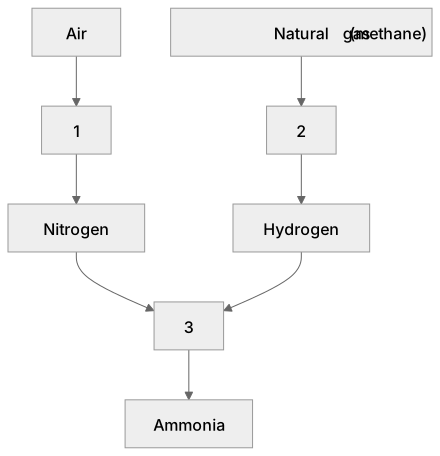
Some boxes have lost their names. Pick the right name for each number.
1Box 1
2Box 2
3Box 3
There is more to this lesson
The full lesson goes on to check your understanding and help you earn the marks. Create a free account to carry on, with your progress saved.
A week of Premium from your first lesson · Then the free plan continues · No card, no charge
Test your understanding of The Haber process: Students should be able to recall a source for the nitrogen and a source for the hydrogen used in the Haber process.
Active recall beats re-reading. Take an instant quiz now to test what you’ve learned and lock it into long-term memory.
A week of Premium from your first lesson · Then the free plan continues · No card, no charge