AQA · GCSE · Chemistry
Course version: 8462 · Version from Sept 2018
The raw materials for the Haber process are nitrogen and hydrogen.
Full specification wording
The Haber process: The raw materials for the Haber process are nitrogen and hydrogen.
The two raw materials fed into the Haber process are nitrogen and hydrogen.
Checked against the AQA 8462 specification (opens in a new tab) on .
- Point 2 of 5
- 3 key terms
Study notes
From the checked teaching notes for this specification point.
The idea
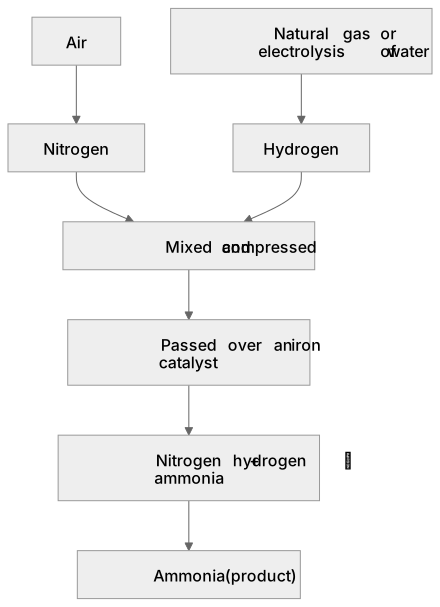
The two raw materials fed into the Haber process are nitrogen and hydrogen. Nitrogen is obtained from air, which is about four-fifths nitrogen, usually by fractional distillation of liquid air. Hydrogen is commonly obtained from natural gas or by electrolysis of water. The gases are mixed, compressed and passed over an iron catalyst, where they react reversibly to form ammonia. Knowing the sources matters because exam questions often ask where each gas comes from, not just their names. Air is a physical source of nitrogen, so no chemical reaction is needed to extract it; hydrogen needs to be manufactured. The word equation nitrogen + hydrogen ⇌ ammonia summarises the reaction and shows that the process is reversible.
What earns the marks
- Names nitrogen and hydrogen as the raw materials for the Haber process.
- States that nitrogen is obtained from air.
- States that hydrogen is obtained from natural gas or by electrolysis of water.
- Writes or recognises the word equation nitrogen + hydrogen ⇌ ammonia.
- Identifies the reaction as reversible and catalysed by iron.
- Distinguishes raw materials from the product ammonia.
Common mistakes and how to put them right
Listing ammonia as a raw material.
Put it right: Ammonia is the product, while nitrogen and hydrogen are the raw materials.
Saying nitrogen comes from the soil or from fertiliser.
Put it right: Nitrogen is obtained from air.
Writing the equation with an equals sign.
Put it right: Use the reversible arrow ⇌ to show the reaction can go both ways.
Exam tips
- Learn both the names and the sources of the raw materials, as either can be asked.
- Use the reversible arrow ⇌ in the word equation rather than an equals sign.
- Check whether the question asks for raw materials or products before writing your answer.
Try the lesson
The start of the The Haber process: The raw materials for the Haber process are nitrogen and hydrogen. lesson, made from checked teaching notes for this specification point.
Have a go first
Ammonia is manufactured using the Haber process. Nitrogen is one of the raw materials used. Which other gas is required as a raw material?
Listen
The two raw materials fed into the Haber process are nitrogen and hydrogen. Nitrogen is obtained from air, which is about four-fifths nitrogen, usually by fractional distillation of liquid air. Hydrogen is commonly obtained from natural gas or by electrolysis of water. The gases are mixed, compressed and passed over an iron catalyst, where they react reversibly to form ammonia. Knowing the sources matters because exam questions often ask where each gas comes from, not just their names. Air is a physical source of nitrogen, so no chemical reaction is needed to extract it; hydrogen needs to be manufactured. The word equation nitrogen + hydrogen ⇌ ammonia summarises the reaction and shows that the process is reversible. A strong answer earns marks for these points. Names nitrogen and hydrogen as the raw materials for the Haber process. States that nitrogen is obtained from air. States that hydrogen is obtained from natural gas or by electrolysis of water. Writes or recognises the word equation nitrogen + hydrogen ⇌ ammonia. A common slip: Listing ammonia as a raw material. Instead, ammonia is the product, while nitrogen and hydrogen are the raw materials. Exam tip: Learn both the names and the sources of the raw materials, as either can be asked.
See it
Key words
Say what each word means before you turn the card.
Raw materials and their sources
Try answering aloud or in your head before turning the card.
Reversible reactions
Try answering aloud or in your head before turning the card.
Word equations
Try answering aloud or in your head before turning the card.
See every definition
- Raw materials and their sources
- Nitrogen and hydrogen are the raw materials, with nitrogen obtained from air and hydrogen commonly obtained from natural gas or by electrolysis of water.
- Reversible reactions
- The reaction can go both ways, shown by the reversible arrow in the word equation nitrogen + hydrogen ⇌ ammonia.
- Word equations
- Nitrogen + hydrogen ⇌ ammonia summarises the reaction and shows that the process is reversible.
Label the diagram
Some boxes have lost their names. Pick the right name for each number.
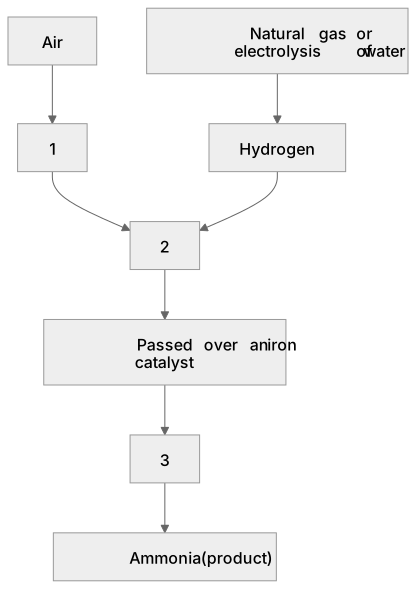
1Box 1
2Box 2
3Box 3
There is more to this lesson
The full lesson goes on to check your understanding and help you earn the marks. Create a free account to carry on, with your progress saved.
A week of Premium from your first lesson · Then the free plan continues · No card, no charge
Test your understanding of The Haber process: The raw materials for the Haber process are nitrogen and hydrogen.
Active recall beats re-reading. Take an instant quiz now to test what you’ve learned and lock it into long-term memory.
A week of Premium from your first lesson · Then the free plan continues · No card, no charge